Learning Journey
Watch this topic in 60 seconds
Free preview · Lesson 1
Understanding Analogy questions [Logical Reasoning (Olympiad Mandatory)]
Understanding Analogy Questions: Finding the Hidden Connections!
Welcome to the exciting world of analogy questions! These questions are like little puzzles that test how well you can find relationships between things. Think of it like being a detective, searching for clues to connect different ideas or objects. Analogy questions are a super important part of logical reasoning, and they often show up in fun challenges like the Olympiads! Let's learn how to solve them.
What is an Analogy?
At its heart, an analogy is a comparison between two things that are alike in some way. It helps us understand something new or complex by comparing it to something we already know. We often use analogies in everyday life without even realizing it!
Analogy Example 1 (Simple):
Spoon is to Soup as Fork is to Salad.
What's the connection here? You use a spoon to eat soup, and you use a fork to eat salad. The relationship is 'tool used to eat a specific food'. Both parts of the analogy share this same relationship.
Analogy Example 2 (Slightly More Complex):
Happy is to Joyful as Sad is to Melancholy.
Here, the words on the left (Happy and Joyful) mean almost the same thing. They are synonyms. The words on the right (Sad and Melancholy) also mean almost the same thing. The relationship is 'synonymy' or 'words with similar meanings'.
Why are Analogy Questions Important?
Analogy questions help us develop several important skills:
- Observation Skills: You learn to look closely at the details of things.
- Comparison Skills: You get better at noticing how things are similar and different.
- Reasoning Skills: You practice thinking logically to figure out the connection.
- Vocabulary Building: You learn new words and their meanings.
Types of Relationships in Analogy Questions
The key to solving analogy questions is to identify the specific relationship between the first pair of words (or items). Once you know the relationship, you can apply it to find the correct matching pair. Here are some common types of relationships:
1. Part to Whole
One item is a part of the other item.
Example: Finger is to Hand as Toe is to Foot.
A finger is a part of a hand. A toe is a part of a foot. The relationship is 'part of a larger body part'.
2. Cause and Effect
One item causes the other item to happen.
Example: Spark is to Fire as Seed is to Plant.
A spark can cause a fire. A seed can cause a plant to grow. The relationship is 'initial event leading to a result'.
3. Object and Function
An item is described by what it does or its purpose.
Example: Knife is to Cut as Pen is to Write.
A knife's function is to cut. A pen's function is to write. The relationship is 'object and its main use'.
4. Synonymy (Words with Similar Meanings)
Both items have almost the same meaning.
Example: Big is to Large as Small is to Tiny.
Big and Large are synonyms. Small and Tiny are synonyms. The relationship is 'words meaning the same or nearly the same'.
5. Antonymy (Words with Opposite Meanings)
Both items have opposite meanings.
Example: Hot is to Cold as Fast is to Slow.
Hot and Cold are opposites. Fast and Slow are opposites. The relationship is 'words with opposite meanings'.
6. User and Tool
A person uses a specific tool for a job.
Example: Carpenter is to Hammer as Doctor is to Stethoscope.
A carpenter uses a hammer. A doctor uses a stethoscope. The relationship is 'person and the tool they commonly use'.
7. Item and Characteristic
An item is described by a key quality it possesses.
Example: Sun is to Hot as Ice is to Cold.
The sun is characterized by being hot. Ice is characterized by being cold. The relationship is 'object and its defining characteristic'.
8. Sequence or Order
Items are in a specific order.
Example: First is to Second as Third is to Fourth.
Second comes after First. Fourth comes after Third. The relationship is 'consecutive items in a sequence'.
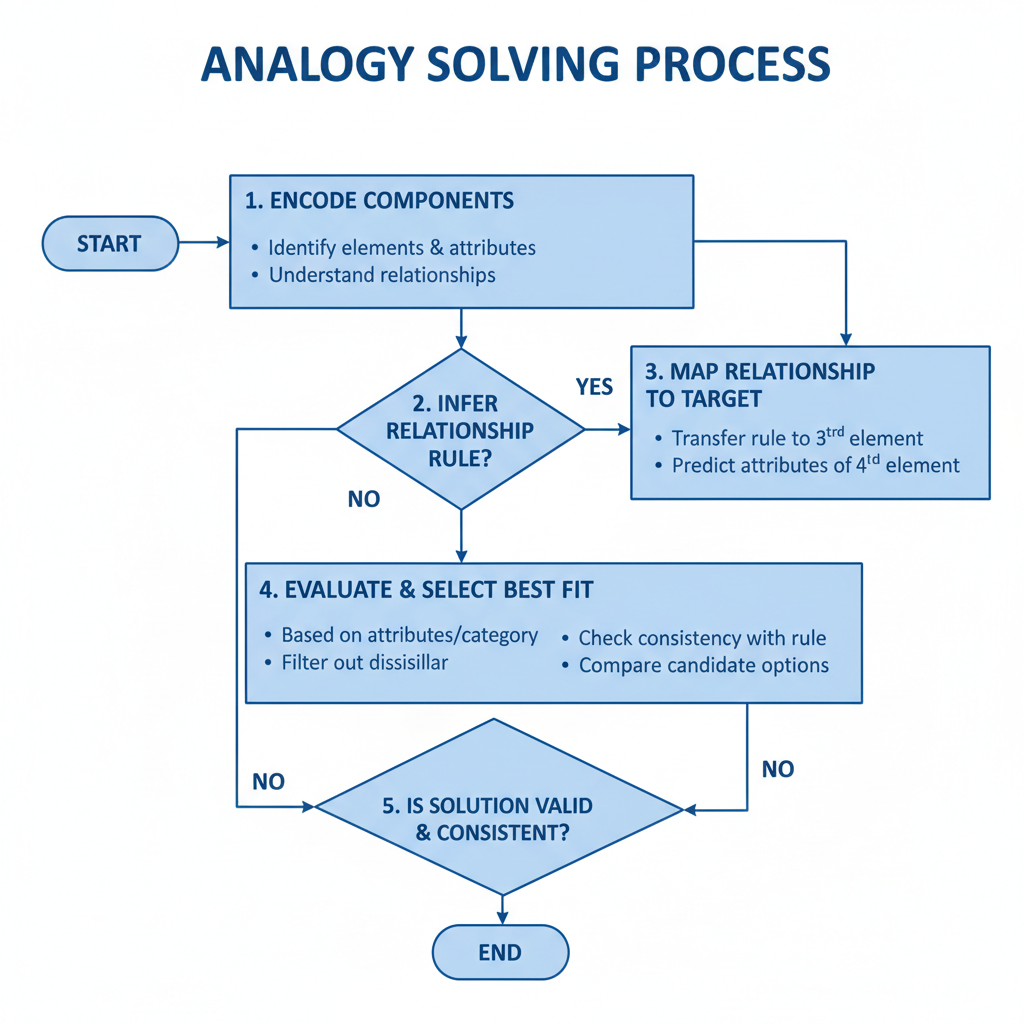
How to Solve Analogy Questions: A Step-by-Step Guide
Let's break down how to tackle these questions:
- Read the First Pair Carefully: Look at the first two words (or items) in the analogy. For example, Teacher : School.
- Identify the Relationship: Ask yourself: "How are 'Teacher' and 'School' related?" In this case, a teacher works at a school. The relationship is 'person and their place of work'.
- Form a Sentence: Create a sentence that describes this relationship. "A teacher works at a school."
- Test the Options: Now, look at the answer choices. For each choice, try to fit it into the same sentence structure using the same relationship.
Example Problem:
Teacher : School :: Student : ?
- Option A: Library
- Option B: Classroom
- Option C: Books
- Option D: Teacher
Applying the steps:
- First pair: Teacher : School.
- Relationship: A teacher works at a school. (Person and place of work).
- Sentence: "A teacher works at a school."
- Test options:
- A "Student works at a library." (Possible, but not the primary place of work/learning for a student)
- B "A student works/learns in a classroom." (This fits the primary relationship of where a student does their main learning activities, similar to a teacher's primary location).
- C "A student works at books." (Doesn't make sense.)
- D "A student works at a teacher." (Doesn't make sense.)
The best fit is 'Classroom' because it represents the primary place of activity for a student, just as a school is for a teacher. So, Teacher : School :: Student : Classroom.
Another Analogy: Sun : Warm
What is the relationship? The sun gives warmth. The sun's characteristic is warmth.
Let's say the options are:
- A) Moon : Light
- B) Fire : Hot
- C) Water : Wet
- D) Snow : White
Let's test:
- A) "The moon gives light." (Possible, but 'warm' is a primary characteristic of the sun, 'light' is a characteristic of the moon, but is it the *most* defining?)
- B) "Fire gives heat." (Yes, fire is very strongly associated with being hot. This is a strong match.)
- C) "Water gives wetness." (Water *is* wet, it doesn't really *give* wetness in the same way the sun gives warmth. The relationship is slightly different.)
- D) "Snow gives whiteness." (Snow *is* white, it doesn't *give* whiteness.)
Comparing A and B, 'Fire : Hot' is a stronger analogy because 'Hot' is a primary, defining characteristic of 'Fire' just as 'Warm' (or hot) is a primary characteristic of the 'Sun'.
 ⚠️ This picture may have spelling mistakes. Trust the words in the lesson.
Tips for Success
- Think in Pairs: Always focus on the relationship between the first two items.
- Be Specific: Try to pinpoint the *exact* relationship, not just a general one.
- Use a Sentence: Making a sentence helps solidify the relationship and makes it easier to test options.
- Consider Different Types of Relationships: Keep the different types of relationships (part-to-whole, cause-effect, etc.) in mind.
- Practice Makes Perfect: The more analogy questions you practice, the better you'll become at spotting the connections!
Analogy questions are like a fun workout for your brain. By understanding the relationships and practicing the steps, you'll be able to solve them with confidence!
Keep learning, free
Create a free Syllabax account to unlock practice questions and games for this topic.
Visual Learning Enhanced! 🚀
To help you master this topic, we use Advanced Syllabax AI to generate detailed diagrams and visual models.
Note on Visuals: The AI sometimes makes spelling errors in image labels. Please refer to the lesson text for the correct terminology.