Random Sampling Methods
Watch this topic in 60 seconds
Free preview · Lesson 1
Understanding Random Sampling Methods
Understanding Random Sampling Methods: Getting the 'Scoop' on Big Groups!
Imagine you have a giant bowl of your favorite candy – maybe hundreds or even thousands of pieces! If you wanted to know what proportion of the candies were red without counting every single one, what would you do? You wouldn't eat the whole bowl, would you? You'd probably grab a handful, count the red ones in your hand, and make an educated guess about the whole bowl. Congratulations, you've just thought about the core idea of sampling!
In the world of statistics and research, we often deal with groups of people, animals, or things that are far too large to examine individually. This entire big group is called the population. For example, all 8th-grade students in your state, all the trees in a forest, or every single customer who buys a particular brand of cereal. Trying to collect information from every single member of such a massive population would be incredibly difficult, time-consuming, and expensive – sometimes even impossible!
This is where sampling comes to the rescue! Sampling is like taking that handful of candy. It's the process of selecting a smaller, manageable group from a larger population. This smaller group is called the sample. The goal of sampling is to learn about the entire big group (the population) by only studying the smaller group (the sample).
Why Can't We Just Pick Any Old Sample? The Problem of Bias!
Let's go back to our candy bowl. What if you *only* picked out the candies from the very top? Or only the ones with a specific wrapper? Would your handful accurately represent all the candies in the bowl? Probably not! If all the red candies sank to the bottom, and you only picked from the top, you'd think there were very few red candies, even if the bowl was full of them! This unfair or unrepresentative selection is called bias.
Bias happens when your sample doesn't truly reflect the larger population. It's like trying to judge the taste of an entire pot of soup by only tasting the broth from the top, without stirring it first. You might miss all the delicious ingredients that have settled at the bottom! A biased sample leads to wrong conclusions about the population, which can be a big problem when making important decisions.
The Magic of Random Sampling: Fair Chances for Everyone!
So, how do we avoid bias and make sure our sample is a fair representation of the whole population? The answer is random sampling! Random sampling is a method of choosing a sample where every single member of the population has an equal chance of being selected. Think of it like a fair lottery or drawing names out of a hat.
Why is "random" so important? Because when selection is truly random, it helps to ensure that your sample is diverse and representative. It prevents you from accidentally (or purposefully) favoring certain members over others. It's the best way to get a 'mini-me' version of your population!
Key Principles of Random Sampling:
- Equal Chance: Every individual or item in the population has the same probability of being chosen.
- Independence: The selection of one individual doesn't affect the chances of another individual being selected.
- No Human Bias: The selection process relies on chance, not on someone's judgment or preference.
Let's Explore a Core Random Sampling Method: Simple Random Sampling (SRS)
The simplest and most fundamental type of random sampling is called Simple Random Sampling (SRS). It's exactly what it sounds like: simple and random!
Imagine you have a class of 30 students, and your teacher wants to pick 5 students to present their projects, but wants to do it fairly. How would she use Simple Random Sampling?
- Assign a Number: Each student gets a unique number (from 1 to 30).
- Use a Random Process: The teacher could write each number on a slip of paper, put all the slips into a hat, and then thoroughly mix them up.
- Draw the Sample: Without looking, the teacher would draw out 5 slips of paper. The students whose numbers are drawn would be the sample!
In this example, every student had an equal chance of being selected for the sample of 5. There was no favoritism, no 'picking on' certain students, and no 'always choosing' the same ones. It was purely by chance!
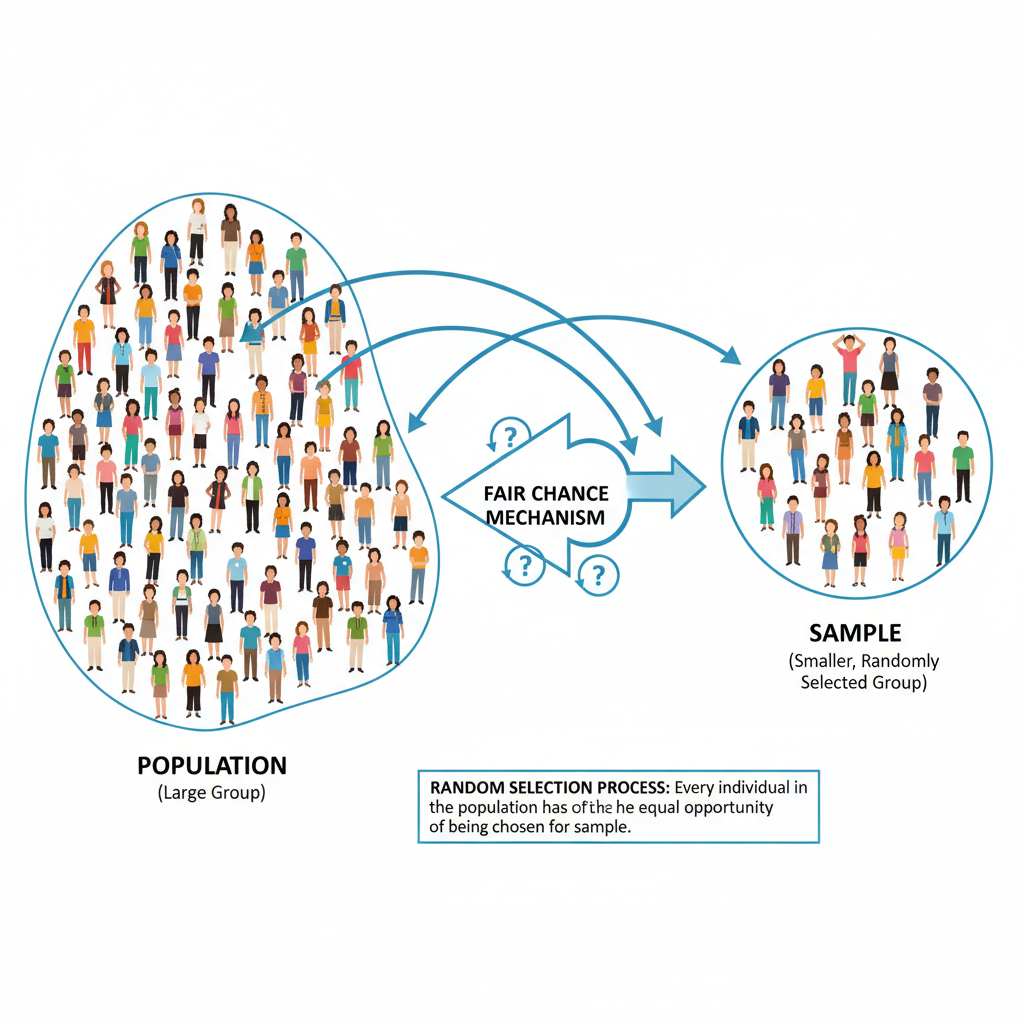 ⚠️ This picture may have spelling mistakes. Trust the words in the lesson.
Other Types of Random Sampling (Brief Overview for Curiosity!):
While Simple Random Sampling is foundational, there are other clever ways to do random sampling when populations are very large or have specific structures:
- Systematic Random Sampling: Imagine you have a long list of students. Instead of drawing names from a hat, you might pick every 10th student on the list. You'd still start with a random starting point (e.g., randomly pick a number between 1 and 10 to start with, say 3), and then pick the 3rd, 13th, 23rd, and so on. This is still random because your starting point is random, and everyone on the list has a calculable chance of being chosen.
- Stratified Random Sampling: What if your school has different grades (6th, 7th, 8th), and you want to make sure your sample includes students from all grades proportionally? You could divide the population into 'strata' (groups) by grade level, and then take a Simple Random Sample from each grade. This ensures that important subgroups are represented.
For foundational understanding, remember that Simple Random Sampling is the most straightforward and clearest example of giving every member an equal and independent chance of being part of your sample.
Why Bother with Random Sampling? The Power of Generalizing!
The whole point of using random sampling is to be able to take what you learn from your small sample and confidently apply it to the much larger population. This is called generalizing your findings. If your sample is random and representative, then you can say, "What we observed in our sample is probably true for the entire population too!"
For example, if a company wants to know if their new cereal flavor is popular, they can't ask every person in the country. But if they take a large, randomly selected sample of people, ask them to taste the cereal, and 80% say they like it, the company can be reasonably confident that about 80% of the *entire population* would also like the new flavor.
Summary: Your Sampling Superpowers!
Think of random sampling as a superpower that allows you to understand vast groups without having to interact with every single member. It’s a tool for fairness, accuracy, and efficiency in research and data collection. By understanding and applying random sampling methods, especially Simple Random Sampling, you're on your way to making smart, unbiased observations about the world around you!
Keep learning, free
Create a free Syllabax account to unlock practice questions and games for this topic.
Visual Learning Enhanced! 🚀
To help you master this topic, we use Advanced Syllabax AI to generate detailed diagrams and visual models.
Note on Visuals: The AI sometimes makes spelling errors in image labels. Please refer to the lesson text for the correct terminology.