Turning On and Off Safely
Watch this topic in 60 seconds
Free preview · Lesson 1
Understanding Turning On and Off Safely
Turning On and Off Safely: A Guide for Young Explorers!
Hey there, young explorers! Have you ever wondered how your favorite toys, lamps, or even the television magically turn on and off? It's all thanks to something called electricity! Electricity is super helpful, like a magical energy that makes things work. But just like a powerful superhero, electricity needs to be handled with care and respect. This lesson is all about learning the special rules for 'Turning On and Off Safely' so you can be a smart and safe helper at home!
What Does 'Turning On and Off Safely' Mean?
Imagine you have a brand-new toy that needs batteries. You wouldn't just throw the batteries in any old way, right? You'd look for the plus (+) and minus (-) signs to put them in correctly. Turning things on and off safely is a lot like that! It means using electrical devices, like your mom's blender or your video game console, in a way that keeps you and everyone around you safe, and also keeps the device from breaking.
Think of it like playing a game. Every game has rules, and if you follow the rules, the game is fun and safe. If you don't follow the rules, someone might get hurt or the game might get ruined. Electricity has rules too, and learning them is super important!
Why is it SO Important to Be Safe with Electricity?
Electricity is a fantastic helper, but it can also be a little bit sneaky and dangerous if we're not careful. It's invisible, which makes it tricky! You can't see it, but you can definitely feel it if it's not handled right, and that feeling is called an 'electric shock.' An electric shock can hurt a lot, like a very big sting, and it's something we want to avoid completely.
Analogy: Imagine fire. Fire helps us cook yummy food and keeps us warm. But if you touch fire without being careful, it can burn you. Electricity is a bit like that – a wonderful helper, but you need to know the safe ways to use it!
Rule #1: The Golden Rule – Always Ask an Adult!
This is the most important rule of all, like the secret handshake of safety! Before you touch any plug, switch, or button on an electrical device, always, always, ASK AN ADULT FIRST! This could be your parent, guardian, grandparent, or teacher.
Analogy: Think about crossing the street. You wouldn't run across by yourself without looking, would you? You'd hold an adult's hand and wait for them to say it's safe to cross. Using electricity is the same – let the grown-up be your guide!
 ⚠️ This picture may have spelling mistakes. Trust the words in the lesson.
Turning Things ON Safely
Once you've asked an adult and they say it's okay, here are some other things to remember when turning a device ON:
- Check for Damage: Look at the cord and the plug. Do they look perfectly smooth and clean? Or do they look worn out, cracked, or like they have a bite mark? If anything looks damaged, tell an adult right away! Never touch a damaged cord or plug. It's like finding a broken toy – you wouldn't try to play with it if it might hurt you, would you?
- Keep Water Away: Water and electricity are like oil and water – they absolutely do NOT mix! Water can help electricity travel in ways that are very dangerous. So, make sure your hands are completely dry, and there's no water, juice, or any other liquid near electrical devices or outlets.
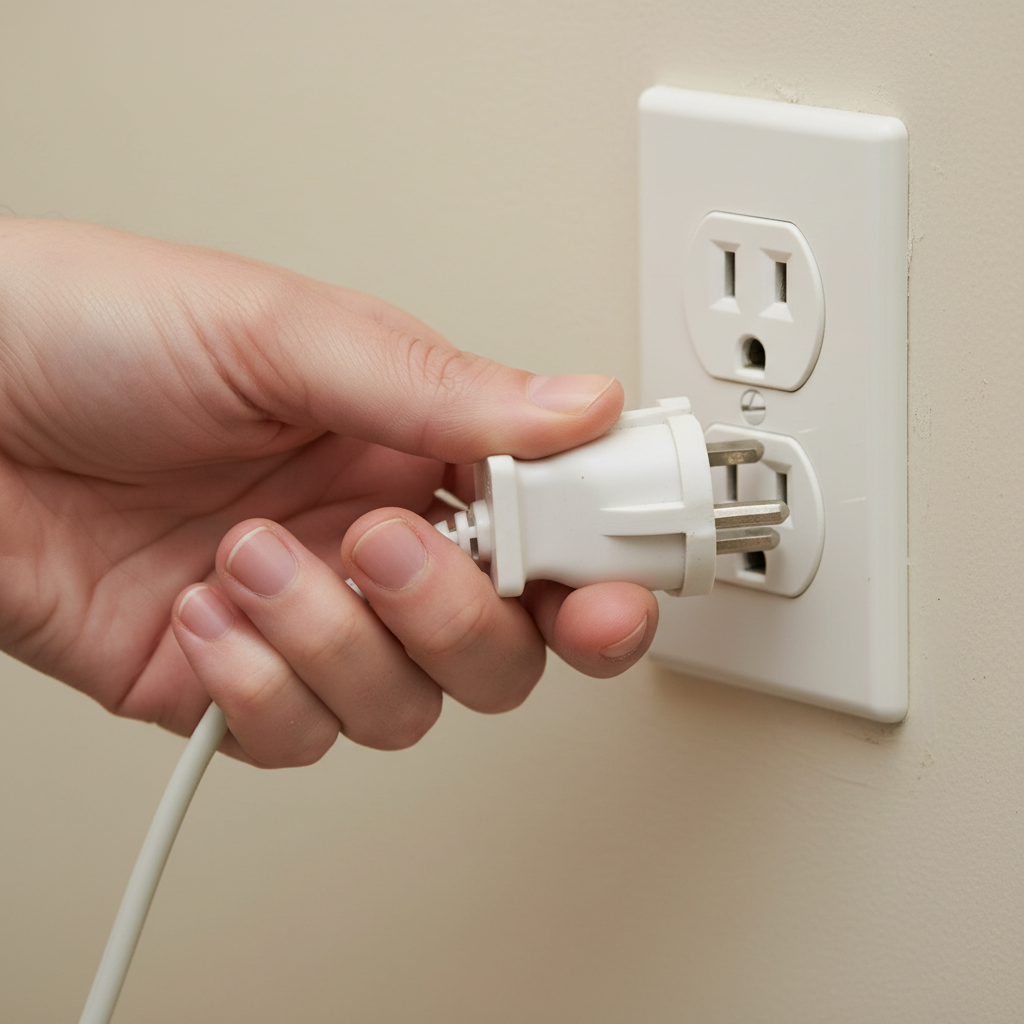
- Use the Right Plug in the Right Outlet: Plugs have a special shape, and outlets have special holes. They're like puzzle pieces! Make sure the plug fits easily into the outlet. Never try to force a plug into an outlet. If it doesn't fit, it's not the right one, or something is wrong. Get an adult to check.
- Plug it in Firmly: Once it's the right fit, push the plug gently but firmly all the way into the outlet. Don't leave it dangling out.
Turning Things OFF Safely
When you're done using a device, turning it off safely is just as important as turning it on safely!
- Use the 'Off' Button or Switch: Most devices have a button or a switch (sometimes marked 'O' for off, or a circle) that turns them off. Always use this first! It's like gently putting your toy back in its box after playing, instead of just dropping it.
- Unplugging with Care: After you've turned the device off, sometimes you need to unplug it. To do this, always hold the hard, plastic part of the plug. Never pull on the cord itself! Pulling on the cord can damage the wires inside, which makes it unsafe for next time and can even cause a fire.
- Store Cords Neatly: Once unplugged, help an adult coil the cord neatly so it doesn't get tangled or trip anyone. It's like putting your jump rope away carefully so it doesn't get knotted.
- Unplug When Not in Use: It's a good habit to unplug devices when you're not using them, especially things like phone chargers or hair dryers. This saves energy and keeps the house safer. It's like turning off the light when you leave a room!
 ⚠️ This picture may have spelling mistakes. Trust the words in the lesson.
What if Something Goes Wrong?
Even when you're super careful, sometimes things can go wrong. If you ever see a sparking outlet, smell something burning, or notice a cord that feels hot, here's what to do:
- DO NOT TOUCH IT!
- Tell an adult immediately! Shout for help if you need to, but stay away from the problem area.
Analogy: If you saw a fire or something scary, you wouldn't try to handle it yourself, would you? You'd run to the nearest grown-up for help! It's the same with electricity problems.
Conclusion: Be a Safety Superhero!
By learning these simple rules, you are becoming a safety superhero! You now know how to respect electricity and use it wisely. Always remember: Ask an adult, check for damage, keep water away, and handle plugs and cords with care. Being safe with electricity means you can enjoy all the wonderful things it helps power, without any ouchies or worries!
Keep learning, free
Create a free Syllabax account to unlock practice questions and games for this topic.
Visual Learning Enhanced! 🚀
To help you master this topic, we use Advanced Syllabax AI to generate detailed diagrams and visual models.
Note on Visuals: The AI sometimes makes spelling errors in image labels. Please refer to the lesson text for the correct terminology.