Fundamental theorem of arithmetic (Real Numbers)
Watch this topic in 60 seconds
Free preview · Lesson 1
Understanding Fundamental theorem of arithmetic (Real Numbers)
Unlocking the Secrets of Numbers: The Fundamental Theorem of Arithmetic
Have you ever wondered what numbers are truly made of? Just like all matter around us is composed of tiny, fundamental particles like atoms, and atoms combine to form molecules, numbers also have their own basic building blocks. For 10th-grade students, understanding these building blocks is crucial, especially when we talk about the fascinating world of real numbers. Today, we're going to dive into one of the most foundational ideas in mathematics: The Fundamental Theorem of Arithmetic. Don't let the fancy name intimidate you; it's a concept as simple and powerful as realizing that every recipe has unique ingredients!
1. The 'Atoms' of Numbers: Prime Numbers
Imagine you have a box of LEGO bricks. Some bricks are very simple – they can't be broken down into smaller, simpler bricks. These are like our Prime Numbers. A prime number is a positive integer greater than 1 that has exactly two distinct positive divisors: 1 and itself.
- Examples of Prime Numbers: 2, 3, 5, 7, 11, 13, 17, 19, ...
Think of them as the fundamental, indivisible pieces. You can't make a '2' from anything smaller except 1 times 2. The number 1 is special; it's neither prime nor composite. It's like the 'empty' LEGO piece, always there but not really building anything by itself in this context.
2. Building with 'Atoms': Composite Numbers
Now, what happens when you combine those simple LEGO bricks? You build something more complex, right? These are our Composite Numbers. A composite number is a positive integer greater than 1 that is not prime. This means it has more than two positive divisors (it can be divided evenly by numbers other than 1 and itself).
- Examples of Composite Numbers: 4 (divisors: 1, 2, 4), 6 (divisors: 1, 2, 3, 6), 9 (divisors: 1, 3, 9), 10 (divisors: 1, 2, 5, 10), ...
Every composite number is like a structure built from prime number LEGOs. For instance, 6 is made from 2 and 3 (2 x 3). 10 is made from 2 and 5 (2 x 5). 4 is made from 2 and 2 (2 x 2).
3. The Grand Idea: Prime Factorization
The act of breaking down a composite number into its prime number 'ingredients' (factors) is called Prime Factorization. It's like taking apart a complex machine to see all the individual, fundamental parts it's made of. For example, if you have the number 12, you can break it down:
12 = 2 x 6
But 6 isn't a prime number, so we break it down further:
6 = 2 x 3
So, 12 = 2 x 2 x 3. Here, 2 and 3 are prime numbers. We've successfully factorized 12 into its prime components!
4. The Star of the Show: The Fundamental Theorem of Arithmetic
This brings us to the core concept of our lesson. The Fundamental Theorem of Arithmetic, also known as the Unique Factorization Theorem, states something incredibly powerful and elegant:
Every composite number can be expressed (factorized) as a product of prime numbers, and this factorization is unique, apart from the order in which the prime factors occur.
Let's break down what this means in simple terms:
- Every composite number can be broken down: Any number greater than 1 that isn't prime can always be expressed as a multiplication of only prime numbers. There's no exception!
- ...as a product of prime numbers: The 'ingredients' are always prime numbers. You won't find a composite number like 4 or 6 in the final breakdown.
- ...and this factorization is unique: This is the 'WOW!' part. For any given composite number, there's only *one* set of prime numbers that multiply together to make it. It's like a number's unique DNA or fingerprint.
- ...apart from the order in which the prime factors occur: This means that 2 x 2 x 3 is the same as 2 x 3 x 2, or 3 x 2 x 2. The specific primes are the same, just arranged differently. It's like saying a chocolate cake recipe always calls for flour, sugar, and cocoa, regardless of whether you list the flour first or the sugar first. The ingredients are unique!
Visualizing Prime Factorization
Let's look at more examples of how this unique factorization works. We often use a 'factor tree' or repeated division to find the prime factors. This visual representation clearly shows how a composite number branches down to its unique prime components.
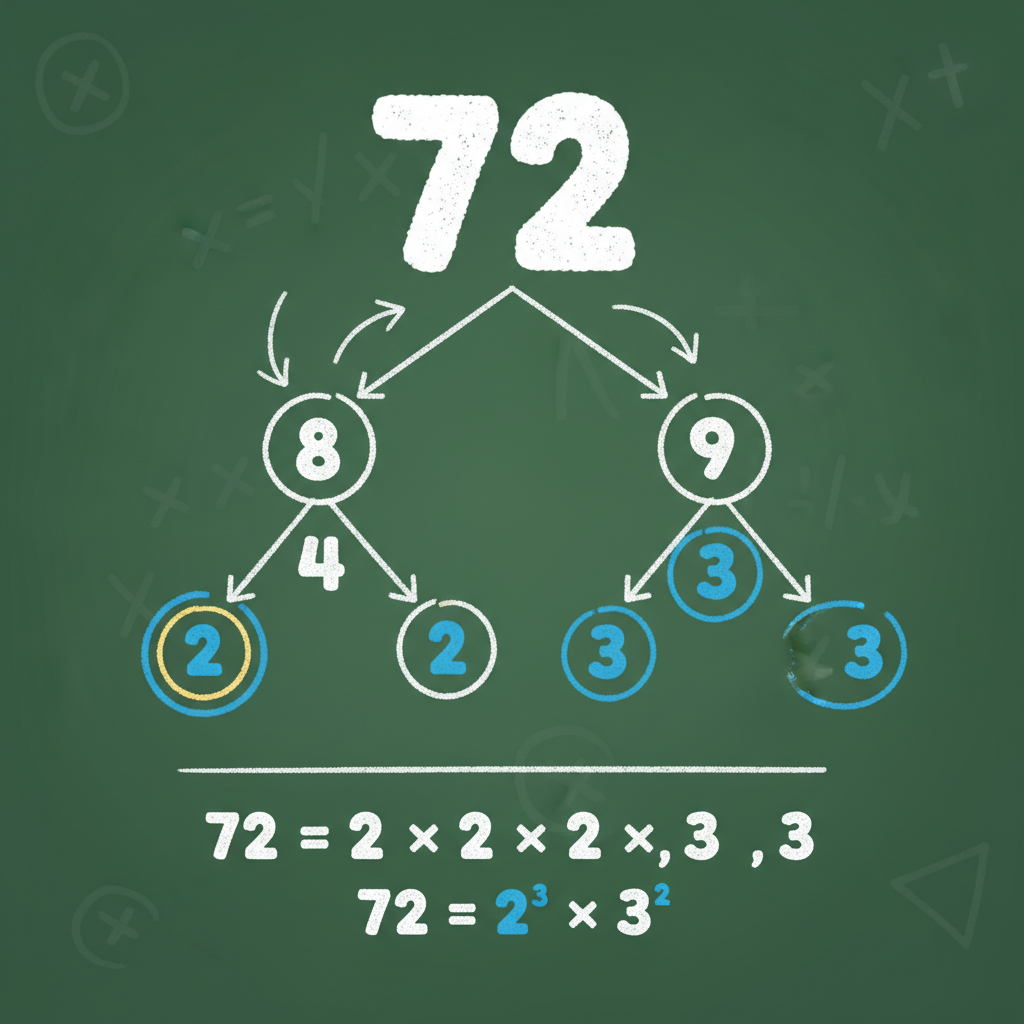 ⚠️ This picture may have spelling mistakes. Trust the words in the lesson.
Consider the number 30:
- Method 1: Repeated Division
- 30 ÷ 2 = 15
- 15 ÷ 3 = 5
- 5 ÷ 5 = 1
- So, 30 = 2 x 3 x 5.
Consider the number 100:
- Method 2: Factor Tree
- 100 = 10 x 10
- 10 = 2 x 5
- So, 100 = (2 x 5) x (2 x 5) = 2 x 2 x 5 x 5.
No matter how you start breaking down 30 or 100 (e.g., 30 = 5 x 6 first, or 100 = 4 x 25), you will always end up with the same set of prime factors: {2, 3, 5} for 30 and {2, 2, 5, 5} for 100. This is the 'uniqueness' in action!
5. Why is it 'Fundamental'? The Power of This Theorem
This theorem is called 'fundamental' because it's a bedrock principle in number theory, which is a branch of mathematics focused on integers. It helps us understand the structure of numbers and is used in many areas:
- Finding HCF (Highest Common Factor) and LCM (Lowest Common Multiple): Prime factorization makes finding these values systematic and easy, especially for larger numbers. For example, to find HCF and LCM of 12 (22 x 3) and 18 (2 x 32), you simply look at their prime factors.
- Cryptology (Making Codes): The difficulty of factoring very large numbers into their prime components is the basis for many modern encryption methods that keep our online information secure.
- Proving other mathematical theorems: It's a stepping stone for understanding more complex number properties, even for irrational numbers like √2.
6. A Note on 'Real Numbers'
The topic mentions 'Real Numbers.' It's important to clarify that the Fundamental Theorem of Arithmetic specifically applies to positive integers greater than 1. While real numbers encompass a much broader range (including fractions, decimals, irrational numbers), understanding the unique prime factorization of integers is a fundamental concept within the broader study of number systems. Integers form the basis upon which rational numbers (fractions) and eventually real numbers are constructed. So, while the theorem itself focuses on integers, its implications resonate through all of number theory, providing a basic 'genetic code' for integers.
Conclusion
The Fundamental Theorem of Arithmetic might sound complex, but at its heart, it's a simple, elegant idea: every composite number is built from a unique combination of prime number 'bricks.' This understanding is not just an abstract mathematical concept; it's a powerful tool that unlocks many secrets of numbers and forms the basis for advanced mathematics and even modern technology. Keep exploring these 'atomic' particles of numbers, and you'll find a whole new appreciation for the structure of our numerical world!
Keep learning, free
Create a free Syllabax account to unlock practice questions and games for this topic.
Visual Learning Enhanced! 🚀
To help you master this topic, we use Advanced Syllabax AI to generate detailed diagrams and visual models.
Note on Visuals: The AI sometimes makes spelling errors in image labels. Please refer to the lesson text for the correct terminology.