All Together: Finding Totals
Watch this topic in 60 seconds
Free preview · Lesson 1
Understanding All Together: Finding Totals
All Together: Finding Totals!
Hello, young mathematicians! Today, we're going on a super fun adventure to learn about putting things 'all together.' Imagine you have some toys, and your friend brings some more toys. When you put them all in one big pile, what do you get? A TOTAL! That's what 'all together' means: finding out how many there are when you combine different groups.
What Does 'All Together' Mean?
Think of it like this: You have a yummy snack! You have 3 crunchy carrot sticks. Then, your grown-up gives you 2 more carrot sticks. How many carrot sticks do you have 'all together' now? You count them: 1, 2, 3, 4, 5! Wow, you have 5 carrot sticks!
This idea of putting things together is called addition. It's like collecting all your treasures into one big chest. When we add, we are finding the 'sum' or the 'total' of two or more groups.
Let's Look at Some Words We Use:
- Add: This means to put groups together.
- Plus: This is a fancy word for 'and' when we're adding. We use a special sign for it: +
- Total: This is the final number we get when we put everything together.
- Sum: Another word for the total!
- All Together: This tells us we need to add!
How Do We Put Things 'All Together'?
There are many ways to find a total. Let's explore some easy ones!
1. Counting Everything!
This is the simplest way! If you have 4 red crayons and 1 blue crayon, just count them all: "One, two, three, four... and five!" You have 5 crayons 'all together'.
Imagine you have a basket of shiny red apples and another basket of green apples. To find out how many apples you have all together, you would gently empty both baskets into one super-duper big basket and then count each apple, one by one! That big number at the end is your total!
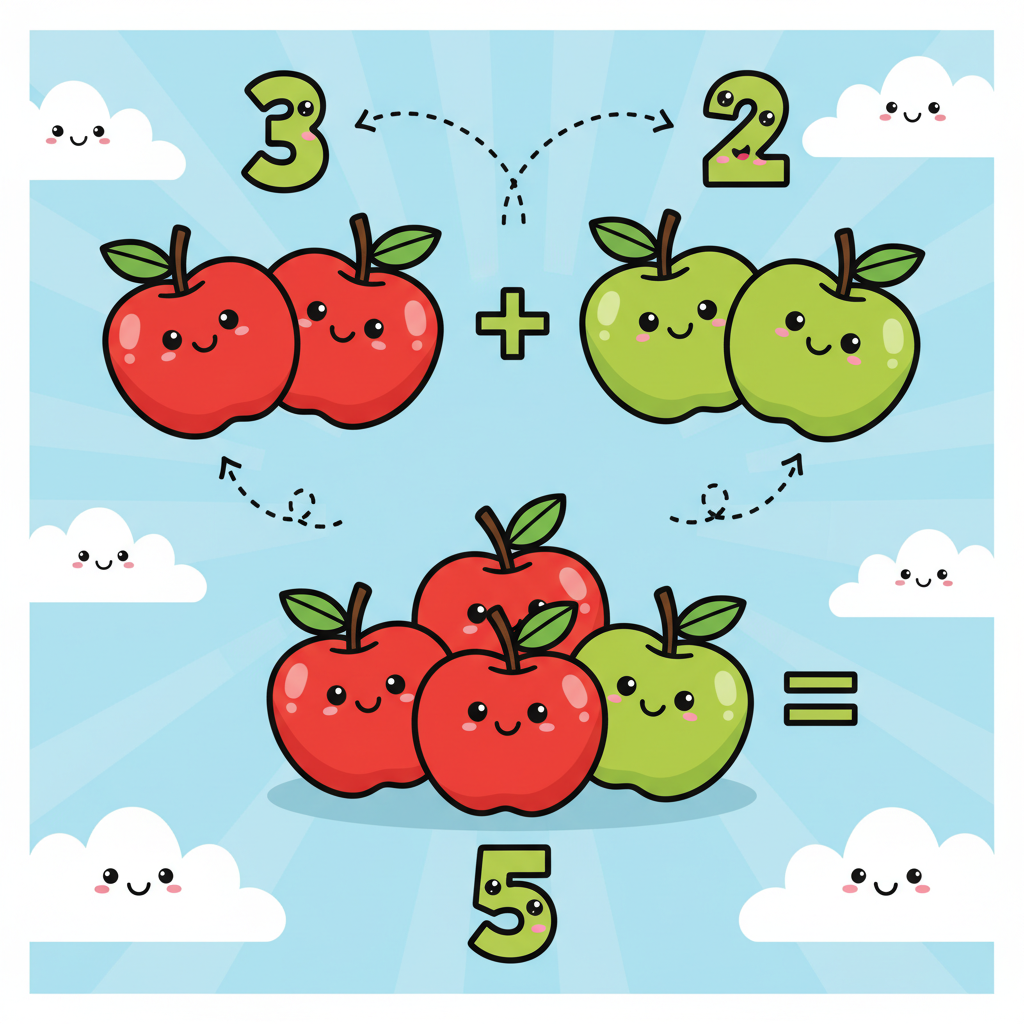 ⚠️ This picture may have spelling mistakes. Trust the words in the lesson.
2. Using Our Fingers (or other objects)!
Your fingers are amazing math tools! If you want to add 2 and 3:
- Hold up 2 fingers on one hand.
- Hold up 3 fingers on your other hand.
- Now, count ALL your fingers that are up! 1, 2, 3, 4, 5! So, 2 + 3 = 5.
You can use anything you have: blocks, buttons, candies, or even small stones! Put 3 blocks in one pile and 4 blocks in another. Then, slide them into one big pile and count. You'll find you have 7 blocks 'all together'!
3. Drawing Pictures!
Drawing is another fantastic way to see the 'all together' number. If you need to add 3 and 2:
- Draw 3 happy faces. 😊 😊 😊
- Draw 2 more happy faces. 😊 😊
- Now, count all the happy faces you drew! 1, 2, 3, 4, 5! You have 5 happy faces 'all together'.
This is super helpful when the numbers get a little bigger, but not too big!
Putting It Into a Math Sentence!
When we find totals, we write something called a 'math sentence.' It looks like this:
(First Number) + (Second Number) = (Total/Sum)
Let's use our carrot sticks example:
You had 3 carrot sticks.
Your grown-up gave you 2 more carrot sticks.
The math sentence is: 3 + 2 = 5
It reads: "Three plus two equals five." The 'equals' sign (=) means 'is the same as' or 'gives us'.
Here's another example:
There are 4 little birds singing on a branch.
Then, 3 more little birds fly over to join them.
How many birds are 'all together' on the branch now? Let's draw it or use our fingers!
4 (birds) + 3 (more birds) = 7 (birds 'all together')
So, the math sentence is: 4 + 3 = 7
Why is 'All Together' Important?
Learning to find totals is super important because we use it every single day! When you share toys, count how many cookies you have, or even figure out how many socks are clean, you're using addition!
It's like having a superpower that lets you count things easily and know how much of something you have. The more you practice, the faster and smarter your math brain will get!
Time to Practice!
Remember, 'all together' means we put things into one big group and count how many there are in total. You've got this!
Keep learning, free
Create a free Syllabax account to unlock practice questions and games for this topic.
Visual Learning Enhanced! 🚀
To help you master this topic, we use Advanced Syllabax AI to generate detailed diagrams and visual models.
Note on Visuals: The AI sometimes makes spelling errors in image labels. Please refer to the lesson text for the correct terminology.