Learning Journey
Free preview · Lesson 1
Understanding Probability of Simple Events
Understanding the Probability of Simple Events (Grade 9 Foundational)
Welcome, young explorers, to the fascinating world of Probability! Have you ever wondered about the chances of something happening? Like, what are the odds of your favorite sports team winning? Or what’s the likelihood of it raining tomorrow? Probability is the branch of mathematics that helps us measure and understand these chances. It's like having a crystal ball, but instead of seeing the future, it helps us predict how likely certain futures are!
What is Probability, Anyway? A Sneak Peek!
At its core, probability is all about likelihood. It’s a number that tells us how probable, or likely, an event is to occur. This number always falls between 0 and 1 (or 0% and 100%).
- A probability of 0 means the event is impossible. Imagine a pig flying – it’s not going to happen!
- A probability of 1 means the event is certain to happen. The sun will rise tomorrow, guaranteed!
- Anything in between means the event is possible, with varying degrees of likelihood. For example, flipping a coin and getting heads has a probability of 0.5 (or 50%). It's equally likely to happen as not.
Think of it like a weather forecast. When a meteorologist says there's a 70% chance of rain, they're using probability to tell you how likely it is you'll need an umbrella!
Key Players in the Probability Game: Basic Definitions
1. Experiment (or Trial)
In probability, an experiment is any process with well-defined results. It's an action or activity where we observe what happens. Think of it as the "thing you do" to see what outcome you get.
- Analogy: If you're playing a board game, rolling a die is an experiment. Flipping a coin is an experiment. Picking a card from a deck is an experiment.
2. Outcome
An outcome is one of the possible results of an experiment. It's what actually happens when you perform your experiment.
- Analogy: When you roll a standard six-sided die, landing on a '3' is an outcome. When you flip a coin, 'Heads' is an outcome, and 'Tails' is another outcome.
3. Sample Space
The sample space is the set of all possible outcomes of an experiment. It's like making a complete list of everything that could happen.
- Analogy: For rolling a six-sided die, the sample space is {1, 2, 3, 4, 5, 6}. For flipping a coin, the sample space is {Heads, Tails}. If you have a bag with a red, a blue, and a green marble, the sample space for picking one marble is {Red, Blue, Green}.
4. Event (and Simple Event)
An event is a specific outcome or a collection of outcomes from a sample space. It's what we are interested in happening. A simple event is an event that consists of only one outcome.
- Analogy: When rolling a die, getting a '4' is a simple event. Getting an 'even number' (which includes 2, 4, or 6) is an event, but not a simple event because it includes multiple outcomes. In this lesson, we're focusing on simple events – those single, specific outcomes!
Calculating the Probability of a Simple Event: The Magic Formula!
Now for the exciting part! To find the probability of a simple event, we use a straightforward formula:
P(Event) = (Number of Favorable Outcomes) / (Total Number of Possible Outcomes)
Let's break that down:
- Favorable Outcomes: These are the outcomes where the event you're interested in actually happens. It's "what you want to happen."
- Total Number of Possible Outcomes: This is the total count of everything that could possibly happen in your experiment (the size of your sample space).
This formula gives you a fraction or a decimal between 0 and 1. You can also convert it to a percentage by multiplying by 100.
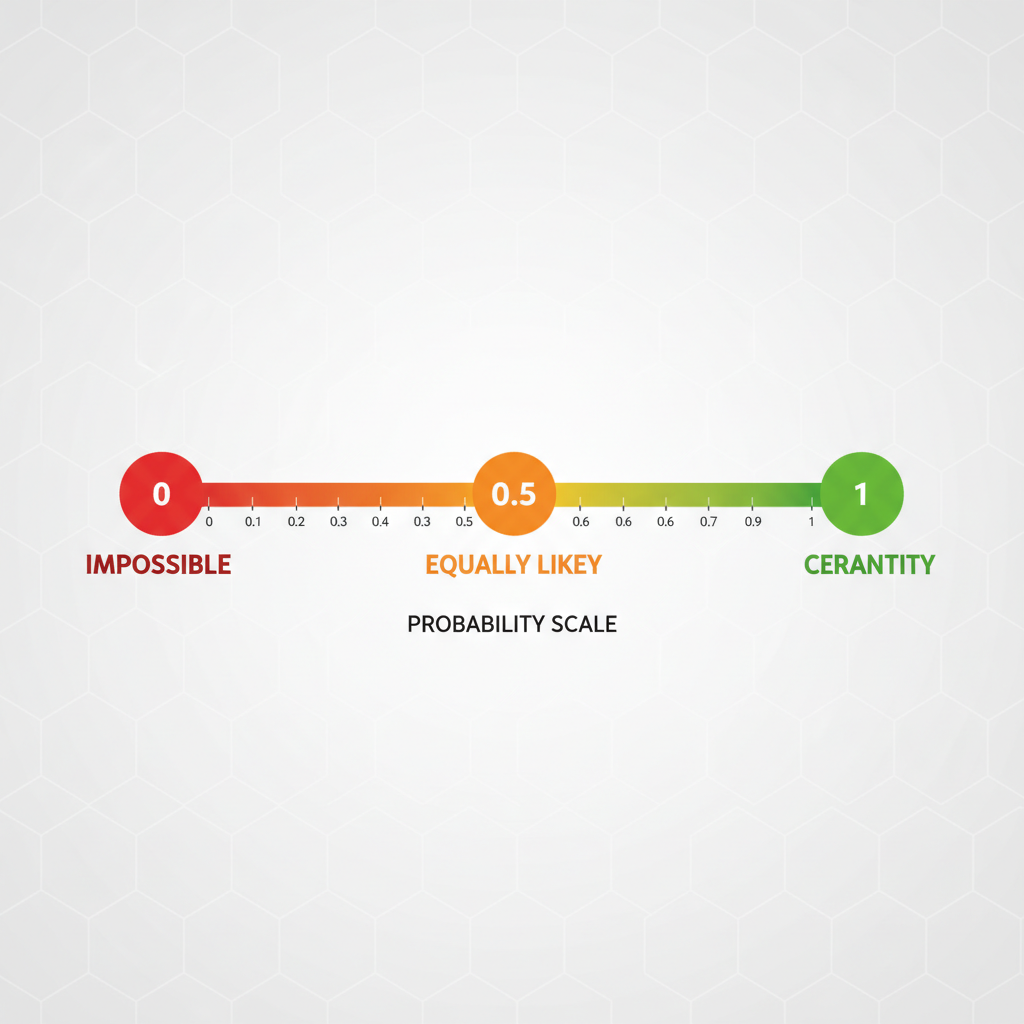 ⚠️ This picture may have spelling mistakes. Trust the words in the lesson.
Let's Get Practical: Examples Galore!
Example 1: The Coin Toss
Imagine you're about to flip a fair coin. What is the probability of getting Heads?
- Experiment: Flipping a coin.
- Sample Space: {Heads, Tails} - So, the total number of possible outcomes is 2.
- Event: Getting Heads.
- Favorable Outcomes: {Heads} - So, the number of favorable outcomes is 1.
Using our formula:
P(Heads) = (Number of Favorable Outcomes) / (Total Number of Possible Outcomes) = 1 / 2 = 0.5 or 50%
This means there's a 50% chance you'll get heads, which feels right, doesn't it?
Example 2: Rolling a Single Die
You roll a standard six-sided die. What is the probability of rolling a 3?
- Experiment: Rolling a die.
- Sample Space: {1, 2, 3, 4, 5, 6} - Total number of possible outcomes is 6.
- Event: Rolling a 3.
- Favorable Outcomes: {3} - Number of favorable outcomes is 1.
Using our formula:
P(Rolling a 3) = 1 / 6
This is approximately 0.1667 or about 16.7%. So, it's less likely than getting heads on a coin flip.
Example 3: Marbles in a Bag
Let's say you have a bag containing 5 red marbles, 3 blue marbles, and 2 green marbles. You reach into the bag without looking and pull out one marble. What is the probability that you pick a green marble?
- Experiment: Picking a marble from the bag.
- Total Number of Possible Outcomes: This is the total number of marbles in the bag. 5 (red) + 3 (blue) + 2 (green) = 10 marbles.
- Event: Picking a green marble.
- Favorable Outcomes: There are 2 green marbles.
Using our formula:
P(Green Marble) = (Number of Green Marbles) / (Total Number of Marbles) = 2 / 10 = 1 / 5 = 0.2 or 20%
So, you have a 20% chance of pulling out a green marble.
Example 4: A Spinner Fun!
Imagine a spinner divided into 8 equal sections, numbered 1 through 8. What is the probability of landing on the number 7?
- Experiment: Spinning the spinner.
- Sample Space: {1, 2, 3, 4, 5, 6, 7, 8} - Total number of possible outcomes is 8.
- Event: Landing on 7.
- Favorable Outcomes: {7} - Number of favorable outcomes is 1.
Using our formula:
P(Landing on 7) = 1 / 8
This is 0.125 or 12.5%. It's a fairly low chance, similar to rolling a 3 on a die, but from a larger set of options.
Important Things to Remember!
- Probability is always a number between 0 and 1 (inclusive).
- The sum of the probabilities of ALL possible simple events in a sample space must equal 1. For example, P(Heads) + P(Tails) = 0.5 + 0.5 = 1.
- "Fair" or "Unbiased" means that each outcome has an equal chance of happening. Most of our basic probability problems assume this!
Probability is not just for games; it's used in science, finance, insurance, and even in daily decisions. Understanding simple events is the first, crucial step to unlocking its power!
Keep learning, free
Create a free Syllabax account to unlock practice questions and games for this topic.
Visual Learning Enhanced! 🚀
To help you master this topic, we use Advanced Syllabax AI to generate detailed diagrams and visual models.
Note on Visuals: The AI sometimes makes spelling errors in image labels. Please refer to the lesson text for the correct terminology.