Secondary sexual changes[BIOLOGY]
Watch this topic in 60 seconds
Free preview · Lesson 1
Understanding Secondary sexual changes[BIOLOGY]
Understanding Secondary Sexual Changes
Welcome, future scientists! Today, we're diving into a fascinating topic in biology: secondary sexual changes. You might have heard terms like puberty or adolescence. These are the times when our bodies start to transform from childhood into adulthood, and a big part of that transformation involves these secondary sexual changes.
What are Secondary Sexual Changes?
Let's break down the term: 'secondary' means it comes after the primary. In biology, the primary sexual characteristics are the reproductive organs themselves – the ones we're born with, like the ovaries and testes. These are essential for reproduction.
Secondary sexual characteristics, on the other hand, are the physical traits that appear during puberty, which help distinguish between males and females but are not directly part of the reproductive system. Think of them as the 'accessories' that signal sexual maturity.
Why Do They Happen?
These changes are driven by special chemical messengers called hormones. Hormones are like tiny instruction manuals that travel through your bloodstream and tell different parts of your body what to do. During puberty, your body starts producing more of certain hormones, primarily estrogen (in females) and testosterone (in males).
Imagine your body is a big factory. The hormones are the supervisors who come in and give specific orders, leading to new machines (body parts) being built or existing ones being upgraded to get the factory ready for a new phase of production (reproduction).
Secondary Sexual Changes in Females
As girls enter puberty, the surge in estrogen triggers a range of changes:
- Breast Development: This is often one of the first noticeable changes. Breast tissue begins to grow, and the nipples become more prominent. Think of it like a plant starting to bud before it flowers.
- Growth Spurt: Girls typically experience a growth spurt earlier than boys, meaning they grow taller more quickly for a period.
- Widening of Hips: The pelvis (the bony structure in the lower body) widens, giving the hips a more rounded shape. This is important for childbirth later in life. Imagine a doorway widening to allow something larger to pass through.
- Pubic and Underarm Hair Growth: Hair starts to grow in these areas. This hair is typically coarser and darker than the hair on the head.
- Start of Menstruation (Periods): This is a crucial sign of reproductive maturity. Every month, the lining of the uterus prepares for a potential pregnancy. If pregnancy doesn't occur, the lining is shed, resulting in bleeding. This is a cyclical process.
- Changes in Skin and Body Odor: Skin can become oilier, leading to acne. Body odor also becomes more noticeable due to the activation of sweat glands.
Secondary Sexual Changes in Males
As boys enter puberty, the increased production of testosterone leads to different changes:
- Growth of the Penis and Testes: The primary reproductive organs enlarge.
- Growth Spurt: Boys usually have a later but more dramatic growth spurt, leading to increased height and muscle mass.
- Pubic, Underarm, and Facial Hair Growth: Hair grows in these areas, often starting with the pubic region and then spreading to the face (beard and mustache) and chest.
- Voice Deepening: The larynx (voice box) grows larger, causing the vocal cords to thicken and the voice to become deeper. It's like tuning a guitar string – a thicker string makes a lower sound.
- Increased Muscle Mass: Muscles grow larger and stronger.
- Changes in Skin and Body Odor: Similar to girls, skin can become oilier, and body odor becomes more pronounced.
It's a Process, Not an Event!
It's important to remember that puberty and these changes don't happen overnight. They occur gradually over several years, and the timing can vary greatly from person to person. Some people start earlier, and some start later. Both are perfectly normal!
Think of it like a caterpillar turning into a butterfly. The caterpillar doesn't become a butterfly instantly; it goes through stages in a chrysalis. Similarly, our bodies go through different stages during puberty.
Why are these Changes Important?
Secondary sexual changes are a vital part of growing up. They signify that our bodies are maturing and preparing for the possibility of reproduction. They also play a role in our identity and how we see ourselves as we transition into adulthood.
This period of change can sometimes feel confusing or overwhelming, but understanding what's happening can make it easier to navigate. Remember to be patient with your body and yourself!
Here's a visual to help illustrate the differences:
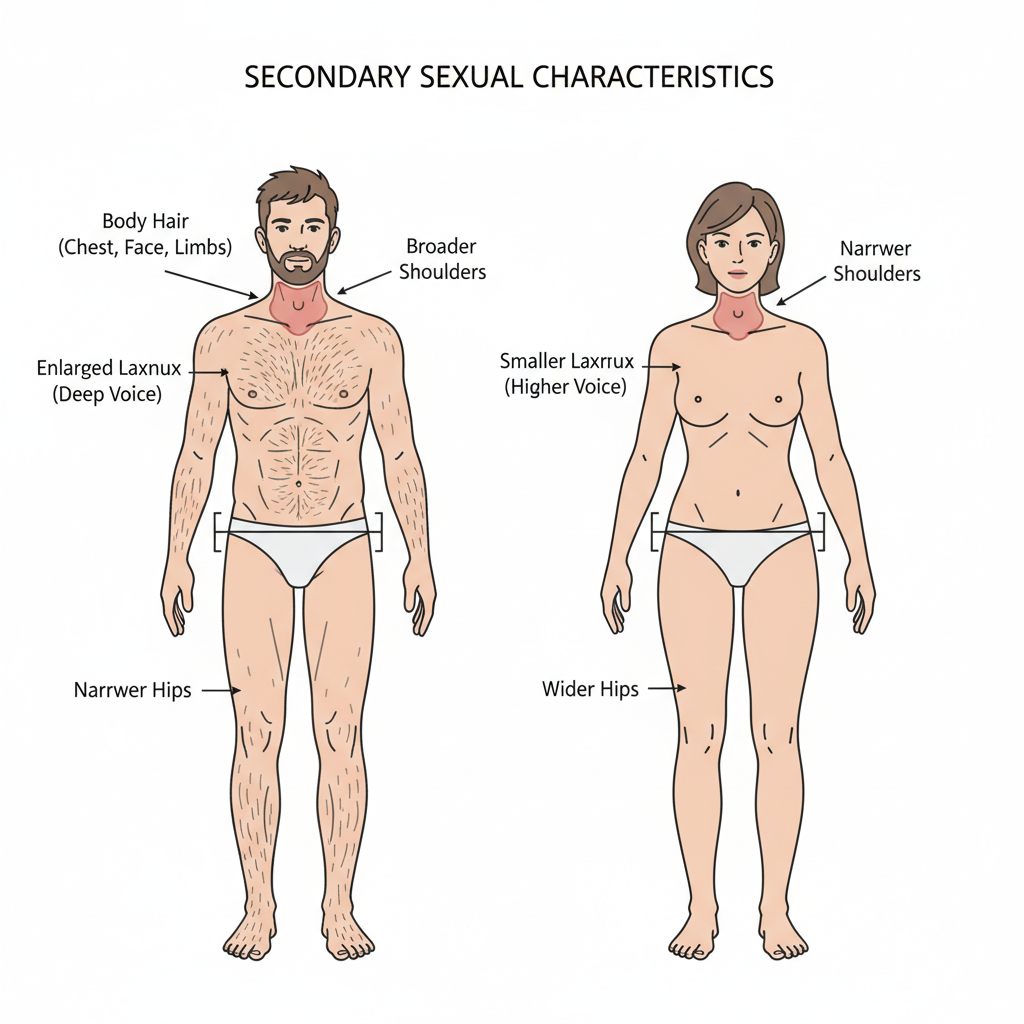
In summary, secondary sexual changes are the physical developments that occur during puberty, driven by hormones, that distinguish males and females and signal sexual maturity, but are not directly involved in reproduction.
Keep learning, free
Create a free Syllabax account to unlock practice questions and games for this topic.
Visual Learning Enhanced! 🚀
To help you master this topic, we use Advanced Syllabax AI to generate detailed diagrams and visual models.
Note on Visuals: The AI sometimes makes spelling errors in image labels. Please refer to the lesson text for the correct terminology.