Before–after–between (Understanding Numbers)
Watch this topic in 60 seconds
Free preview · Lesson 1
Understanding Before–after–between (Understanding Numbers)
Understanding Numbers: Before, After, and Between
Welcome, young mathematicians! Today, we're going on an exciting adventure to explore the world of numbers. We'll learn about where numbers live on the number line and how they relate to each other. Think of numbers like little houses on a street. Each house has a number, and they are all lined up in order!
What Does 'Before' Mean?
When we talk about numbers being 'before' another number, it means they come earlier in the line. Imagine you have a row of your favorite toys. The toy that is closest to the beginning of the row is 'before' the others. In the world of numbers, smaller numbers come 'before' larger numbers.
Let's look at a number line. A number line is like a special ruler for numbers. The numbers start small on the left and get bigger as you move to the right.
For example, if we look at the number 5, the numbers 4, 3, 2, 1, and 0 are all 'before' 5. They are smaller than 5 and come earlier on the number line.
Analogy: Waiting in Line
Think about waiting in line for the ice cream truck. The person who is first in line is 'before' everyone else. The person right behind them is also 'before' the people further down the line. In math, the number 3 is 'before' the number 7 because it comes earlier on the number line (3, 4, 5, 6, 7).
What Does 'After' Mean?
The word 'after' is the opposite of 'before'. If a number is 'after' another number, it means it comes later in the line. It's a bigger number!
Using our number line example, if we look at the number 5 again, the numbers 6, 7, 8, 9, and so on are all 'after' 5. They are bigger than 5 and come later on the number line.
Analogy: A Race
Imagine a race! The person who finishes the race first is the winner. The person who finishes next is 'after' the winner. In numbers, 10 is 'after' 8 because it comes later on the number line (8, 9, 10).
What Does 'Between' Mean?
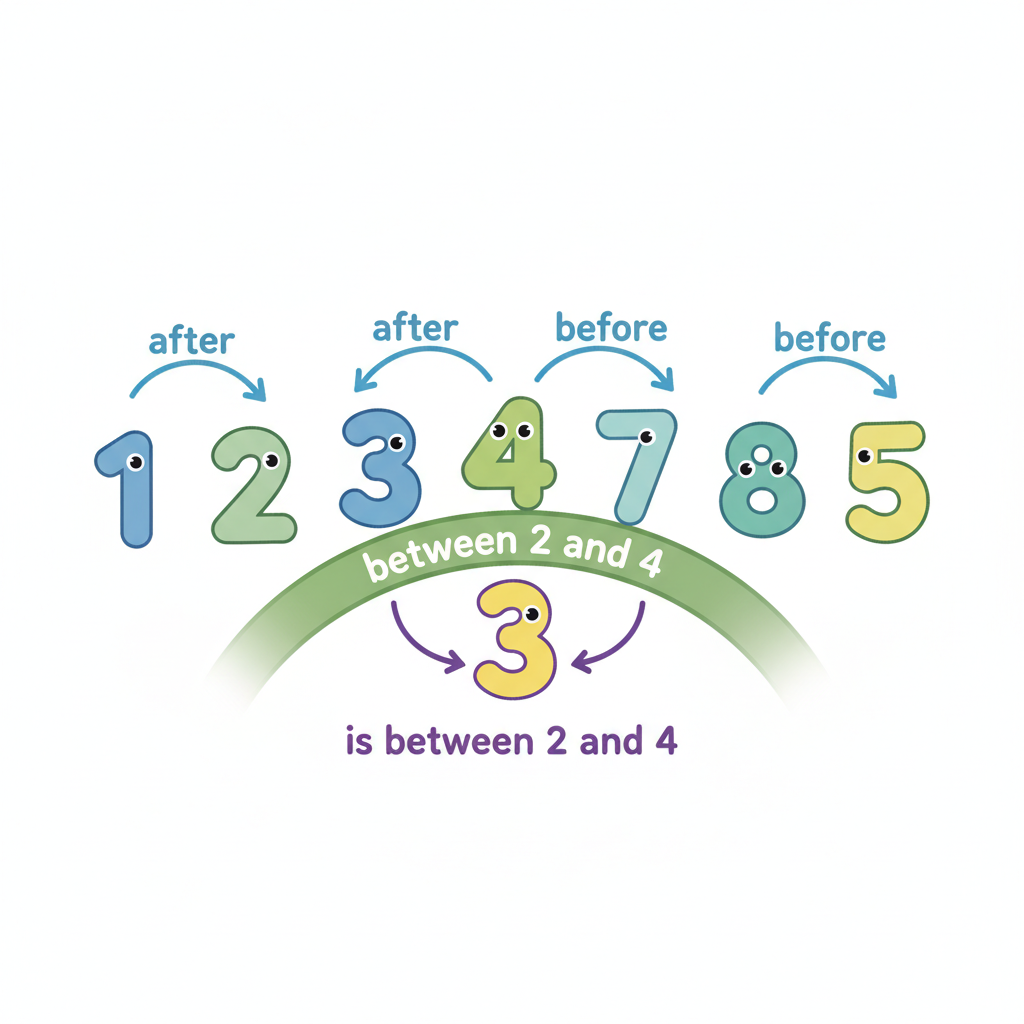
'Between' is a very useful word! It means something is in the middle, or in the space that separates two other things. If a number is 'between' two other numbers, it means it's larger than the first number and smaller than the second number.
Let's take the numbers 3 and 7. What numbers come after 3 but before 7? We have 4, 5, and 6! So, 4, 5, and 6 are 'between' 3 and 7.
Analogy: A Sandwich!
Think about a yummy sandwich! The filling (like cheese or ham) is 'between' the two slices of bread. The bread slices are like the two numbers, and the filling is the number that is 'between' them.
Another way to think about it is like two friends standing apart. The space in the middle is 'between' them. If you place another friend right in that middle space, they are 'between' the first two friends.
Key Idea: Order Matters!
Numbers have a special order. They always go up from left to right on a number line. This order helps us understand which number comes before, after, or between others.
Let's try another example. What number comes 'after' 15? That's right, 16! What number comes 'before' 10? Correct, 9! And what number is 'between' 20 and 22? Yes, it's 21!
Putting It All Together
Understanding 'before,' 'after,' and 'between' helps us understand how numbers work. It's like knowing your way around your neighborhood! You know which house is next door, which one is on the other side of the street, and which one is down the block.
Remember these simple rules:
- Before means smaller, comes earlier.
- After means bigger, comes later.
- Between means in the middle of two other numbers.
Keep practicing, and you'll become a number expert in no time!
Keep learning, free
Create a free Syllabax account to unlock practice questions and games for this topic.
Visual Learning Enhanced! 🚀
To help you master this topic, we use Advanced Syllabax AI to generate detailed diagrams and visual models.
Note on Visuals: The AI sometimes makes spelling errors in image labels. Please refer to the lesson text for the correct terminology.