Learning Journey
Free preview · Lesson 1
Understanding Number patterns (Patterns)
Spotting the Secret Code: Understanding Number Patterns!
Hi Super Sleuths! Today, we're going on an exciting adventure to find hidden "secret codes" in numbers. These secret codes are called patterns! Imagine a secret handshake you do with your friends, or the way you line up for recess – those are patterns too! In math, a pattern is like a special rule that numbers follow to get from one to the next. Let's become pattern detectives!
What is a Pattern?
A pattern is something that repeats or follows a predictable order. Think about a checkerboard. It has squares that alternate between two colors, right? Black, white, black, white... That's a pattern! Or think about the days of the week: Monday, Tuesday, Wednesday, Thursday, Friday, Saturday, Sunday. After Sunday, what comes next? Monday! It repeats every week. That's a pattern too!
In math, we look for patterns in numbers. It's like finding a recipe for how numbers are made! For example, if we have the numbers 2, 4, 6, 8... what do you think comes next? It looks like we are adding 2 each time! 2 + 2 = 4, 4 + 2 = 6, 6 + 2 = 8. So, the next number would be 10! We found the secret code!
Types of Number Patterns We'll Explore:
1. Adding Patterns (Growing Patterns)
These patterns are like a plant growing bigger! We start with a number, and we add the same number each time to get the next number. It's like adding a new block to a tower!
Example 1: Look at this pattern: 5, 10, 15, 20...
- How do we get from 5 to 10? We add 5!
- How do we get from 10 to 15? We add 5!
- How do we get from 15 to 20? We add 5!
The secret code here is to add 5 every time. So, what number comes after 20? That's right, 20 + 5 = 25!
Example 2: What about this one: 3, 6, 9, 12...
- 3 + 3 = 6
- 6 + 3 = 9
- 9 + 3 = 12
The secret code is add 3. The next number is 12 + 3 = 15.
2. Subtracting Patterns (Shrinking Patterns)
These patterns are like a balloon losing air, or eating cookies from a jar! We start with a number, and we subtract the same number each time to get the next number. The numbers get smaller!
Example 1: Let's look at: 20, 18, 16, 14...
- How do we get from 20 to 18? We subtract 2!
- How do we get from 18 to 16? We subtract 2!
- How do we get from 16 to 14? We subtract 2!
The secret code here is to subtract 2 every time. What number comes after 14? Yes, 14 - 2 = 12!
Example 2: Try this one: 50, 45, 40, 35...
- 50 - 5 = 45
- 45 - 5 = 40
- 40 - 5 = 35
The secret code is subtract 5. The next number is 35 - 5 = 30.
3. Repeating Patterns
These patterns are like a song that repeats its chorus, or a sequence of actions like clap, stomp, clap, stomp! The same group of items or numbers appears over and over again in the same order.
Example 1: Look at the colors: Red, Blue, Green, Red, Blue, Green...
The repeating part is Red, Blue, Green. What color comes next?
- After Green, we start the pattern again! So, the next color is Red.
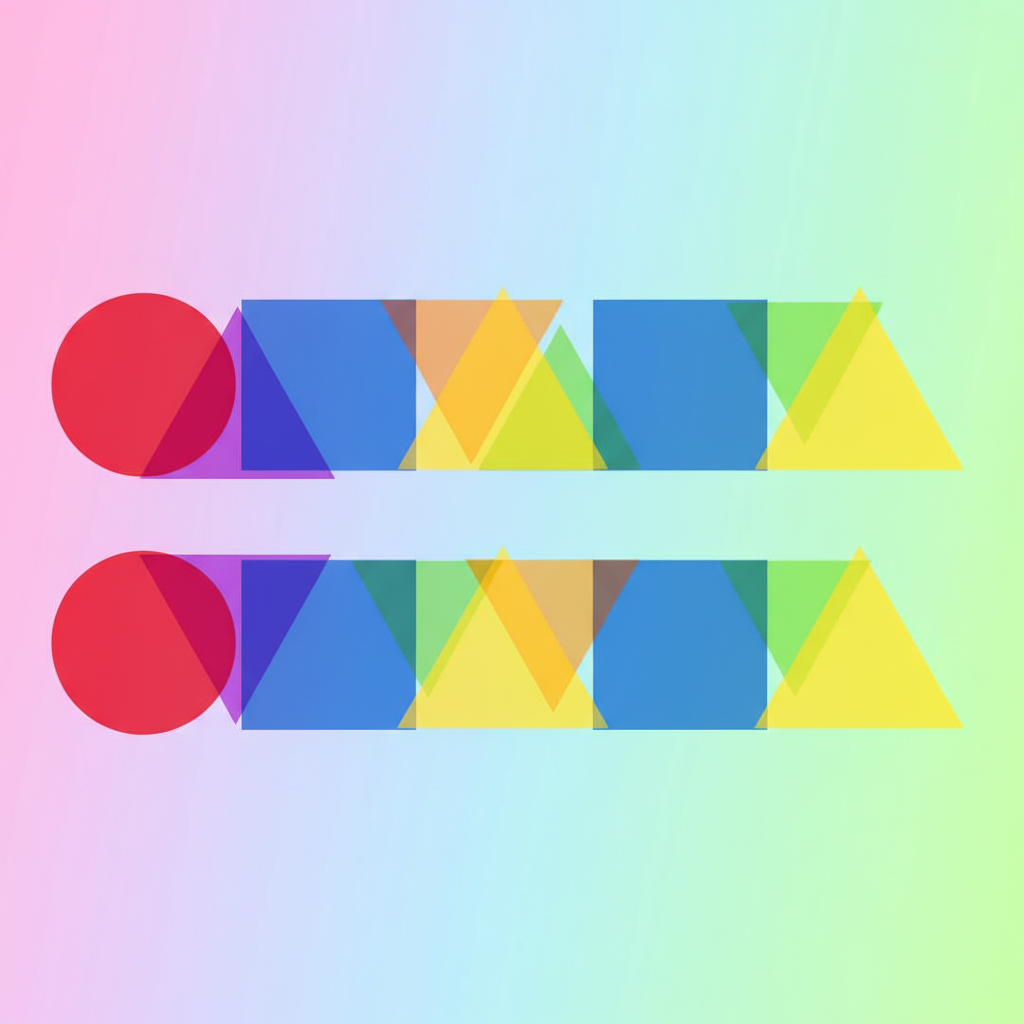
Example 2: What about these shapes? Circle, Square, Triangle, Circle, Square, Triangle...
The repeating group is Circle, Square, Triangle. What shape comes next?
- After Triangle, we start the pattern again! So, the next shape is a Circle.
 ⚠️ This picture may have spelling mistakes. Trust the words in the lesson.
Sometimes repeating patterns can be with numbers too! For example: 1, 2, 1, 2, 1, 2... The repeating part is 1, 2. The next number is 1.
Why are Patterns Important?
Spotting patterns helps us understand the world around us! It helps us make predictions. If you know that trains arrive every 10 minutes, you can predict when the next train will come. It also makes math more fun, like solving a puzzle! Keep your eyes open for those number codes!
Keep learning, free
Create a free Syllabax account to unlock practice questions and games for this topic.
Visual Learning Enhanced! 🚀
To help you master this topic, we use Advanced Syllabax AI to generate detailed diagrams and visual models.
Note on Visuals: The AI sometimes makes spelling errors in image labels. Please refer to the lesson text for the correct terminology.