Fair vs. Unfair Events
Watch this topic in 60 seconds
Free preview · Lesson 1
Understanding Fair vs. Unfair Events
Understanding Fair vs. Unfair Events
Hello, future probability pros! Have you ever played a game and felt like it wasn't quite fair? Or maybe you played a game where everyone had a truly equal shot at winning? Today, we're going to explore what makes an event, like drawing a name or rolling a die, either fair or unfair. It's like learning the secret rules behind all the games you play!
What is an 'Event'?
Before we dive into fair and unfair, let's quickly understand what an 'event' is in math. An event is simply something that happens. Like:
- Rolling a die
- Flipping a coin
- Spinning a spinner
- Drawing a card from a deck
- Picking a name out of a hat
Each time you do one of these things, an 'outcome' happens. For example, if you roll a die, the outcome could be a 1, a 2, a 3, a 4, a 5, or a 6.
What Makes an Event 'Fair'?
Imagine you and your friend are sharing a bag of 10 candies. If you both get 5 candies, that's fair, right? Why? Because each of you got an equal share. In the world of events, 'fair' means something very similar.
Definition of a Fair Event:
An event is fair if every possible outcome has an equal chance of happening. No outcome is favored or has a higher likelihood than any other.
Analogies for Fair Events:
- The Perfect Coin Flip: When you flip a standard coin, there are two outcomes: heads or tails. Each side has a 1 out of 2 (or 50%) chance of landing face up. It's perfectly fair! It's like a tiny two-sided decision-maker that gives both options an equal shot.
- The Regular Six-Sided Die: If you roll a normal die, each number (1, 2, 3, 4, 5, 6) has an equal chance of appearing. There's a 1 out of 6 chance for each number. No number is heavier or lighter than the others; they are all balanced.
- Drawing Names from a Hat: If you write everyone's name on a piece of paper, fold them exactly the same way, and put them in a hat, then mix them up really well, everyone has an equal chance of being picked. It's a fair way to choose!
- A Spinner with Equal Sections: Imagine a spinner for a board game that has 4 sections, all exactly the same size and shape, colored red, blue, green, and yellow. When you spin it, each color has an equal 1 out of 4 chance of being landed on.
What Makes an Event 'Unfair'?
Now, let's go back to those candies. What if your friend got 9 candies and you only got 1? That wouldn't feel fair at all, would it? One person got a much bigger share. In events, 'unfair' means that some outcomes have a better (or worse) chance than others.
Definition of an Unfair Event:
An event is unfair if some possible outcomes have a greater or lesser chance of happening than others. The chances are not equal.
Analogies for Unfair Events:
The Loaded Die: Imagine a special die where the number 6 has a tiny piece of metal inside that makes it heavier. When you roll it, the 6 is much more likely to land face down (meaning the number on the opposite side, often a 1, is more likely to appear face up) or the 6 is more likely to land face up if the weight is strategically placed. This die is 'loaded' or 'rigged,' making the game unfair because certain numbers have a higher chance of showing up.
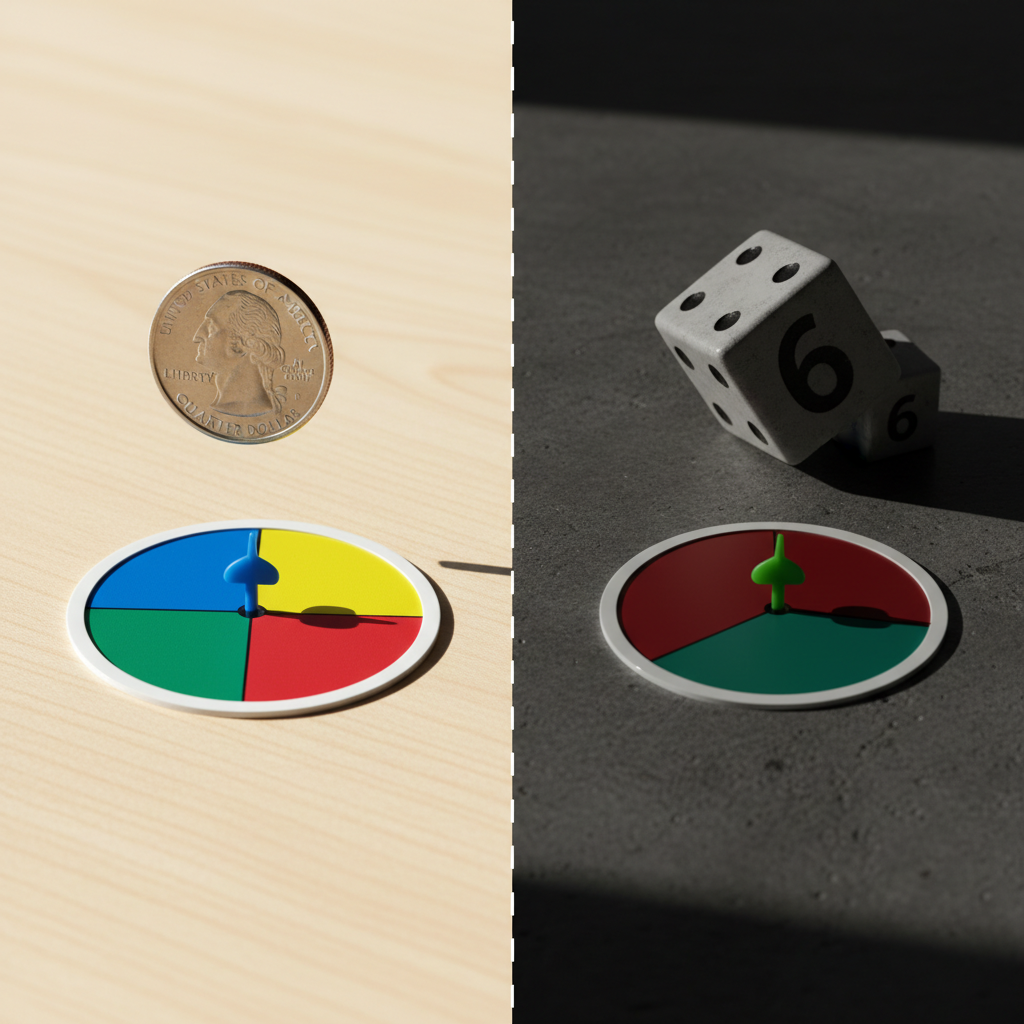
(Image: This image represents the difference between fair tools like a balanced coin and an equal spinner, versus unfair tools like a weighted die and an unequal spinner.)
- A Spinner with Unequal Sections: What if your game spinner has one section that takes up half the circle, and the other half is split into three tiny sections? The outcome of landing on the large section is much more likely than landing on any of the tiny sections. This makes the spinner unfair. It's like cutting a pizza and giving one person a huge slice and everyone else a tiny crumb!
- Drawing Names from a Hat (the wrong way): If you write some names on big pieces of paper and others on tiny pieces, or fold some names differently, or don't mix them well, the person drawing might accidentally pick a bigger or more easily felt piece of paper more often. This makes the drawing unfair.
- A Deck of Cards with Missing Cards: If you play a card game but some cards are missing from the deck, or if someone 'stacks' the deck (arranges the cards in a specific order), then certain players or outcomes become much more likely. This is unfair because not everyone has the same probability of getting certain cards.
How to Tell the Difference: Look for Equal Chances!
The main way to tell if an event is fair or unfair is to ask yourself: Does every possible outcome have exactly the same chance of happening?
- If the answer is YES, it's a FAIR event.
- If the answer is NO, it's an UNFAIR event.
Examples to Think About:
- You have a bag with 3 red marbles and 3 blue marbles. You pick one without looking. Fair or Unfair? (Fair, because there are equal numbers of each color, so equal chances.)
- You have a bag with 5 red marbles and 1 blue marble. You pick one without looking. Fair or Unfair? (Unfair, because you are much more likely to pick a red marble.)
- A teacher chooses a student's name from a jar where all names are written on identical slips of paper and mixed well. Fair or Unfair? (Fair, everyone has an equal chance.)
- A teacher chooses a student by picking the tallest person in the class. Fair or Unfair? (Unfair, because only one person or a few very tall people have a chance, not everyone.)
Why Does Fairness Matter?
Understanding fair and unfair events isn't just for math class! It helps us understand the world around us. In games, we want everyone to have an equal chance to win. In real life, we often strive for fairness in how decisions are made, how resources are distributed, and how rules are applied. It's about ensuring everyone has an equal opportunity.
So, the next time you play a game or see something being decided, you'll be able to spot whether the event is truly fair!
Keep learning, free
Create a free Syllabax account to unlock practice questions and games for this topic.
Visual Learning Enhanced! 🚀
To help you master this topic, we use Advanced Syllabax AI to generate detailed diagrams and visual models.
Note on Visuals: The AI sometimes makes spelling errors in image labels. Please refer to the lesson text for the correct terminology.