Understanding (x, y) coordinates [Coordinate Geometry (Intro)]
Watch this topic in 60 seconds
Free preview · Lesson 1
Understanding Understanding (x, y) coordinates [Coordinate Geometry (Intro)]
Welcome to the World of Coordinates!
Have you ever played a game of "Battleship"? Or maybe you've looked at a treasure map? These games and maps use a special system to help us find exactly where something is. This system is called the coordinate system, and today we're going to learn all about it, specifically how to find places using (x, y) coordinates.
What is a Coordinate System?
Imagine you have a giant grid, like a checkerboard, that covers a whole area. A coordinate system is like a set of directions that uses two numbers to tell you precisely where to find any spot on that grid. Think of it as a secret code for locations!
The Two Special Lines: The Axes
Our coordinate system is built on two very important lines that cross each other. They are called axes.
- The x-axis: This is the horizontal line, the one that goes straight across from left to right. Think of it as the "street" you walk along.
- The y-axis: This is the vertical line, the one that goes straight up and down. Think of it as the "building" you walk towards or away from.
These two axes meet at a very special point called the origin. The origin is like the starting point, the "home base" of our grid. Its coordinates are always (0, 0).
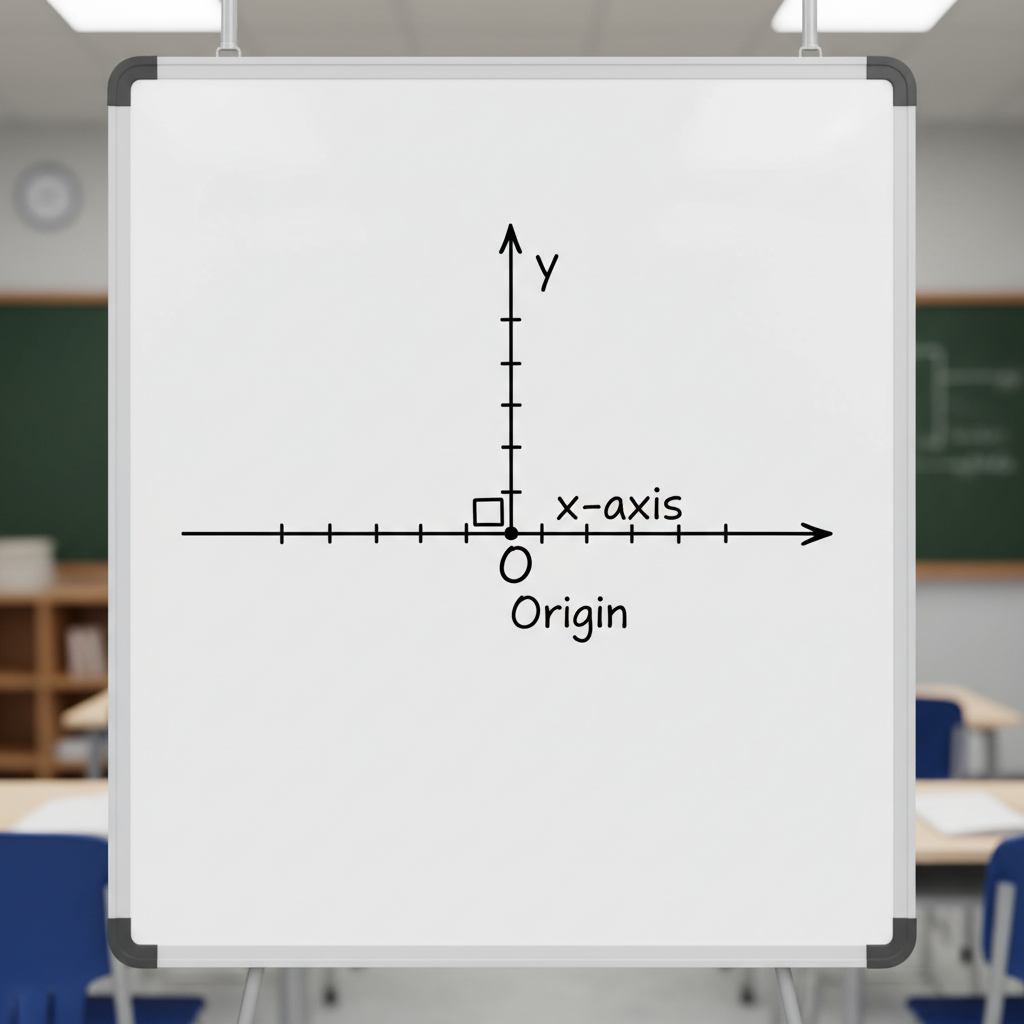
Understanding (x, y) Coordinates
Now, let's talk about the magic code: (x, y) coordinates. This is a pair of numbers written inside parentheses, separated by a comma. For example, (3, 2).
The first number in the pair tells you how far to move along the x-axis. This is the x-coordinate.
The second number in the pair tells you how far to move along the y-axis. This is the y-coordinate.
Analogy Time!
Imagine you are giving directions to a friend to find your house on a map.
- You might say: "Walk 3 blocks East (that's the x-direction) and then turn and walk 2 blocks North (that's the y-direction)."
- Your friend would then know exactly where to go: 3 blocks along the East-West street (x-axis) and then 2 blocks along the North-South street (y-axis).
- So, your house would be at the coordinate (3, 2).
Let's break it down further:
- Positive x-coordinates: If the first number is positive, you move to the right on the x-axis.
- Negative x-coordinates: If the first number is negative, you move to the left on the x-axis.
- Positive y-coordinates: If the second number is positive, you move up on the y-axis.
- Negative y-coordinates: If the second number is negative, you move down on the y-axis.
The Four Quadrants
The x-axis and y-axis divide the entire coordinate plane into four sections, called quadrants. They are numbered using Roman numerals, starting from the top right and going counter-clockwise.
- Quadrant I: Top right. Both x and y coordinates are positive. (e.g., (4, 3))
- Quadrant II: Top left. x is negative, y is positive. (e.g., (-2, 5))
- Quadrant III: Bottom left. Both x and y coordinates are negative. (e.g., (-1, -6))
- Quadrant IV: Bottom right. x is positive, y is negative. (e.g., (7, -4))
Finding Points on the Grid
Let's practice finding some points. Imagine a grid with numbers marked on the x-axis and y-axis.
- To find (4, 1): Start at the origin (0, 0). Move 4 steps to the right (because x is 4). Then, move 1 step up (because y is 1). You've found the spot for (4, 1)!
- To find (-3, 2): Start at the origin (0, 0). Move 3 steps to the left (because x is -3). Then, move 2 steps up (because y is 2). You've found the spot for (-3, 2)!
- To find (0, 5): Start at the origin (0, 0). Don't move left or right (because x is 0). Move 5 steps up (because y is 5). This point is on the y-axis.
- To find (6, 0): Start at the origin (0, 0). Move 6 steps to the right (because x is 6). Don't move up or down (because y is 0). This point is on the x-axis.
Key Tip: Always remember to move along the x-axis (left or right) first, and then move along the y-axis (up or down) second.
Why Are Coordinates Useful?
Coordinates are used everywhere!
- Maps: GPS systems use coordinates to tell you where you are and how to get to places.
- Video Games: Game developers use coordinates to know where characters, objects, and enemies are on the screen.
- Science: Scientists use coordinates to map out data, like weather patterns or the locations of stars.
- Art: Artists might use grids and coordinates to help them draw or paint large pictures with accuracy.
Understanding (x, y) coordinates is like learning a new language that helps you describe and understand location. It's a fundamental skill in math and has many real-world applications!
Keep learning, free
Create a free Syllabax account to unlock practice questions and games for this topic.
Visual Learning Enhanced! 🚀
To help you master this topic, we use Advanced Syllabax AI to generate detailed diagrams and visual models.
Note on Visuals: The AI sometimes makes spelling errors in image labels. Please refer to the lesson text for the correct terminology.