Learning Journey
Watch this topic in 60 seconds
Free preview · Lesson 1
Understanding Cube & cuboid (Volume)
Understanding Volume: Cubes and Cuboids
Welcome, future mathematicians! Today, we're going on an exciting journey into the world of three-dimensional shapes and a very important concept called Volume. Don't worry if these words sound complicated; we'll break everything down into simple, easy-to-understand pieces, using lots of examples from your everyday life.
What is Volume? The Space Inside!
Imagine you have an empty shoebox. Now, imagine you want to fill that shoebox with socks, or perhaps even small toys. How much "stuff" can you fit inside the shoebox? That "how much stuff" is essentially what volume measures! In simpler terms, volume is the amount of three-dimensional space an object occupies, or the capacity of a container. It tells us how much air, water, sand, or anything else can fit inside a 3D object.
Think of it like this:
- If you have a glass, its volume tells you how much water (or juice!) it can hold.
- If you have a backpack, its volume tells you how many books and supplies you can carry in it.
- If you have a swimming pool, its volume tells you how many liters of water are needed to fill it up.
Volume is always measured in cubic units, like cubic centimeters (cm³), cubic meters (m³), or cubic inches (in³). Why "cubic"? Because we're dealing with three dimensions: length, width, and height.
Meet the Cube: The Perfect Box!
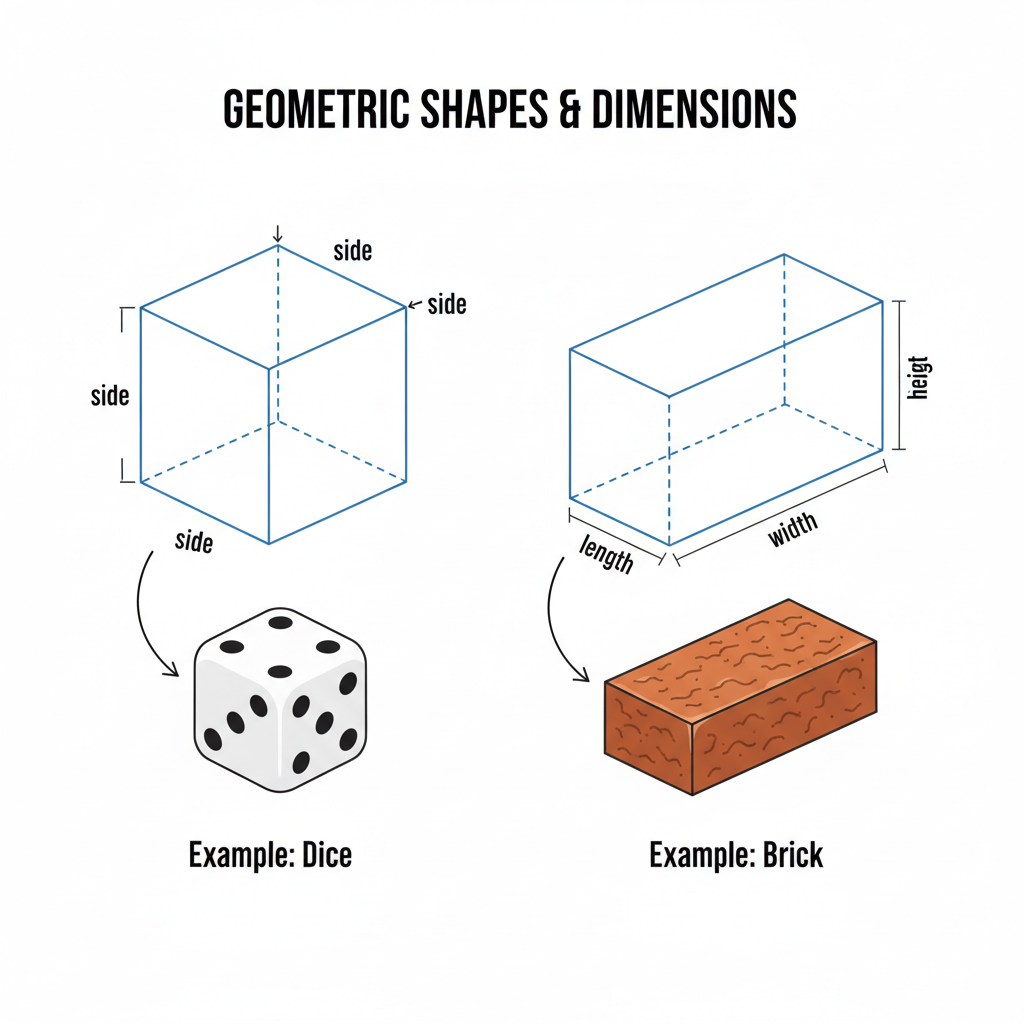
First up, let's talk about the Cube. You already know what a cube looks like, even if you don't call it by that name! Think of a standard dice, a Rubik's Cube, or even a sugar cube. What do all these objects have in common?
- They are perfectly symmetrical.
- All their faces are squares.
- Most importantly for us, all their sides (length, width, and height) are exactly the same size!
Let's use an analogy: Imagine building a box out of square pieces of cardboard. If you use six identical squares and glue them together, you'll get a cube! Because all its sides are equal, we often just call one of its side lengths 's'.
Calculating the Volume of a Cube
Since a cube has equal length, width, and height, let's say each of these dimensions is 's' (for side). To find the volume of any rectangular 3D object, you multiply its length by its width by its height.
For a cube, this becomes:
Volume of a Cube = side × side × side
Or, in mathematical shorthand:
V = s × s × s = s³
This "s³" is read as "s cubed" – which is where the name "cubic units" comes from!
Example Time for a Cube:
Let's say you have a Rubik's Cube, and each side measures 5 centimeters (cm). What is its volume?
Given: Side (s) = 5 cm
Using the formula: V = s³
V = 5 cm × 5 cm × 5 cm
V = 25 cm² × 5 cm
V = 125 cm³
So, the Rubik's Cube occupies 125 cubic centimeters of space. This means you could, theoretically, fit 125 tiny cubes, each 1 cm on a side, inside it!
 ⚠️ This picture may have spelling mistakes. Trust the words in the lesson.
Meet the Cuboid: The Stretched Box!
Next, we have the Cuboid (sometimes also called a Rectangular Prism). Think of a brick, a shoebox, a textbook, or even most rooms in your house. What do these have in common?
- They have rectangular faces.
- Their length, width, and height can be different sizes.
A cuboid is like a cube that has been stretched or squashed in one or more directions. Imagine taking that perfect square-sided box (a cube) and pulling one side to make it longer, or pushing down on the top to make it shorter. You'd get a cuboid!
For a cuboid, we typically label its dimensions as:
- Length (l): How long it is.
- Width (w): How wide it is.
- Height (h): How tall it is.
Calculating the Volume of a Cuboid
The good news is that the basic idea for finding the volume of a cuboid is the same as for a cube: you multiply its three dimensions together. The only difference is that now, these dimensions might be different numbers.
So, for a cuboid, the formula is:
Volume of a Cuboid = Length × Width × Height
Or, in mathematical shorthand:
V = l × w × h
This formula is super versatile and is used all the time in construction, packaging, and even moving furniture!
Example Time for a Cuboid:
Imagine you have a gift box that is 10 cm long, 6 cm wide, and 4 cm high. How much space is inside for a gift?
Given: Length (l) = 10 cm, Width (w) = 6 cm, Height (h) = 4 cm
Using the formula: V = l × w × h
V = 10 cm × 6 cm × 4 cm
V = 60 cm² × 4 cm
V = 240 cm³
So, the gift box has a volume of 240 cubic centimeters. This means it can hold 240 tiny 1 cm x 1 cm x 1 cm cubes.
Why Are Units So Important? Cubic Units Explained
You've noticed we're always using units like cm³ or m³. Why is that? When you measure length, you use units like cm or m (one dimension). When you measure area, like the area of a square or rectangle, you multiply two dimensions (length × width), so you get square units (cm², m²). For volume, you multiply three dimensions (length × width × height), so you get cubic units (cm³, m³).
Think of it visually:
- A line is 1D (cm).
- A flat square is 2D (cm²).
- A solid cube is 3D (cm³).
Real-World Applications of Volume: Beyond the Classroom!
Understanding volume isn't just for math class; it's a skill you use every day without even realizing it!
- Packaging: Companies need to know the volume of boxes and containers to pack products efficiently and determine shipping costs.
- Construction: Builders calculate the volume of concrete needed for foundations, sand for playgrounds, or water for pools.
- Cooking & Baking: Recipes often call for specific volumes of liquids (e.g., cups, milliliters) or dry ingredients.
- Science & Engineering: Scientists measure the volume of liquids in beakers, and engineers design structures considering the volume of materials.
- Moving Houses: When you rent a moving truck, its capacity is measured in cubic feet or meters. You need to estimate the total volume of your belongings to choose the right size truck.
- Aquariums: Knowing the volume of water an aquarium can hold helps ensure you don't overfill it or that you have enough space for fish.
As you can see, volume is a fundamental concept that helps us interact with and understand the physical world around us. Mastering these basic formulas for cubes and cuboids is a fantastic first step!
Keep learning, free
Create a free Syllabax account to unlock practice questions and games for this topic.
Visual Learning Enhanced! 🚀
To help you master this topic, we use Advanced Syllabax AI to generate detailed diagrams and visual models.
Note on Visuals: The AI sometimes makes spelling errors in image labels. Please refer to the lesson text for the correct terminology.