Artificial Intelligence (AI) Overview
Watch this topic in 60 seconds
Free preview · Lesson 1
Understanding Artificial Intelligence (AI) Overview
Artificial Intelligence (AI) Overview: Thinking Machines
Welcome to the fascinating world of Artificial Intelligence! You've likely encountered AI many times in your daily life without even realizing it. From asking a question to a voice assistant on your phone to getting personalized recommendations for shows on a streaming service, AI is quietly at work all around us. But what exactly is AI, and how does it function?
What is Artificial Intelligence? The Big Picture
At its core, Artificial Intelligence (AI) refers to the ability of machines to perform tasks that typically require human intelligence. Think about what makes humans intelligent: we can learn, solve problems, understand language, make decisions, and even recognize faces or objects. AI aims to give machines these same kinds of capabilities.
A Quick Look Back: The Idea of AI
The concept of intelligent machines isn't new; it has fascinated humans for centuries, appearing in ancient myths and science fiction stories. However, the modern field of AI really began to take shape in the mid-20th century. Pioneers in computer science started asking, "Can machines think?" and began developing the first programs that could solve complex problems or play games.
Different Kinds of AI: From Specialized Tools to Super Minds
Not all AI is created equal. There are different categories that help us understand the range of AI's capabilities:
-
1. Narrow AI (Artificial Narrow Intelligence - ANI)
This is the most common type of AI we encounter today. Narrow AI, also known as 'Weak AI', is designed and trained for a very specific task. It can perform that single task exceptionally well, often better than humans, but it cannot perform other tasks.
Think of Narrow AI like a super-specialized tool in a toolbox. A calculator is fantastic at math, but it can't write a poem or bake a cake. Similarly, the AI that recommends movies on Netflix is brilliant at figuring out what you might like, but it can't drive a car or translate languages (that's a different Narrow AI!). Most of the AI you interact with daily – voice assistants, spam filters, chess-playing programs – are examples of Narrow AI. -
2. General AI (Artificial General Intelligence - AGI)
General AI, sometimes called 'Strong AI', refers to machines that possess human-level cognitive abilities across a wide range of tasks. An AGI would be able to understand, learn, and apply intelligence to any intellectual task that a human being can.
Imagine General AI as having a brain just like yours. It could learn new languages, solve complex scientific problems, write stories, play sports, and understand emotions – basically, do anything a person can. We are not yet at the stage of creating true General AI; it remains a significant goal for AI research. -
3. Super AI (Artificial Super Intelligence - ASI)
Super AI would be an intelligence far beyond human capabilities in virtually every field, including scientific creativity, general wisdom, and social skills. It would be significantly smarter than the best human brains in every practical sense.
Think of Super AI as a super-genius. It's like taking the smartest human being on the planet and multiplying their intelligence by a thousand. This type of AI is currently purely theoretical and a subject of intense discussion and ethical debate about its potential impact on humanity.
How Does AI Learn and Work? The Basics
Even though AI seems like magic, it relies on fundamental principles of computer science and mathematics. Here are some key concepts:
-
Data: The Fuel for AI
Just like students learn from textbooks, lectures, and experiences, AI systems learn from data. Data can be anything from images, text, sounds, numbers, or videos. The more high-quality data an AI system has, the better it can learn and make accurate predictions or decisions.
Consider training a dog. You show it many examples of what to do and what not to do. The examples (the treats, the commands, the corrections) are its 'data'. Similarly, if you want an AI to recognize cats, you feed it millions of images – some of cats, some of dogs, birds, and other animals – clearly labeled. -
Algorithms: The Recipes for Intelligence
An algorithm is essentially a set of step-by-step instructions or rules that a computer follows to solve a problem or complete a task. In AI, algorithms are the 'brains' that process the data and learn from it.
Think of an algorithm like a cooking recipe. It tells you exactly what ingredients to use (data) and what steps to follow (instructions) to create a delicious meal (the AI's output or decision). Different AI tasks use different recipes, or algorithms. -
Machine Learning (ML): Learning Without Explicit Programming
Machine Learning (ML) is a subfield of AI that gives computers the ability to learn from data without being explicitly programmed for every single scenario. Instead of a programmer writing out every rule, the machine learns to identify patterns and make decisions based on the data it analyzes.
Imagine learning to ride a bicycle. Nobody gave you a list of thousands of instructions for every possible lean, wobble, and pedal stroke. Instead, you tried, you fell, you adjusted, and your brain learned the patterns to keep you upright. Machine Learning works similarly: it's about learning from trial and error, identifying patterns in data, and improving performance over time without being told precisely how to do it.There are different types of Machine Learning, but the core idea is for the system to improve its performance on a task over time by 'learning' from data.
-
Deep Learning (DL): Mimicking the Brain
Deep Learning (DL) is a specialized branch of Machine Learning inspired by the structure and function of the human brain, specifically using artificial neural networks with many layers. These 'deep' networks can automatically discover intricate patterns in vast amounts of data.
If Machine Learning is like a brain learning, Deep Learning is like having a super-complex, multi-layered brain, with many interconnected 'thinking cells' (neurons) working together. Each layer processes information and passes it on to the next, allowing for very sophisticated pattern recognition, like recognizing faces in photos or understanding human speech, even in noisy environments.
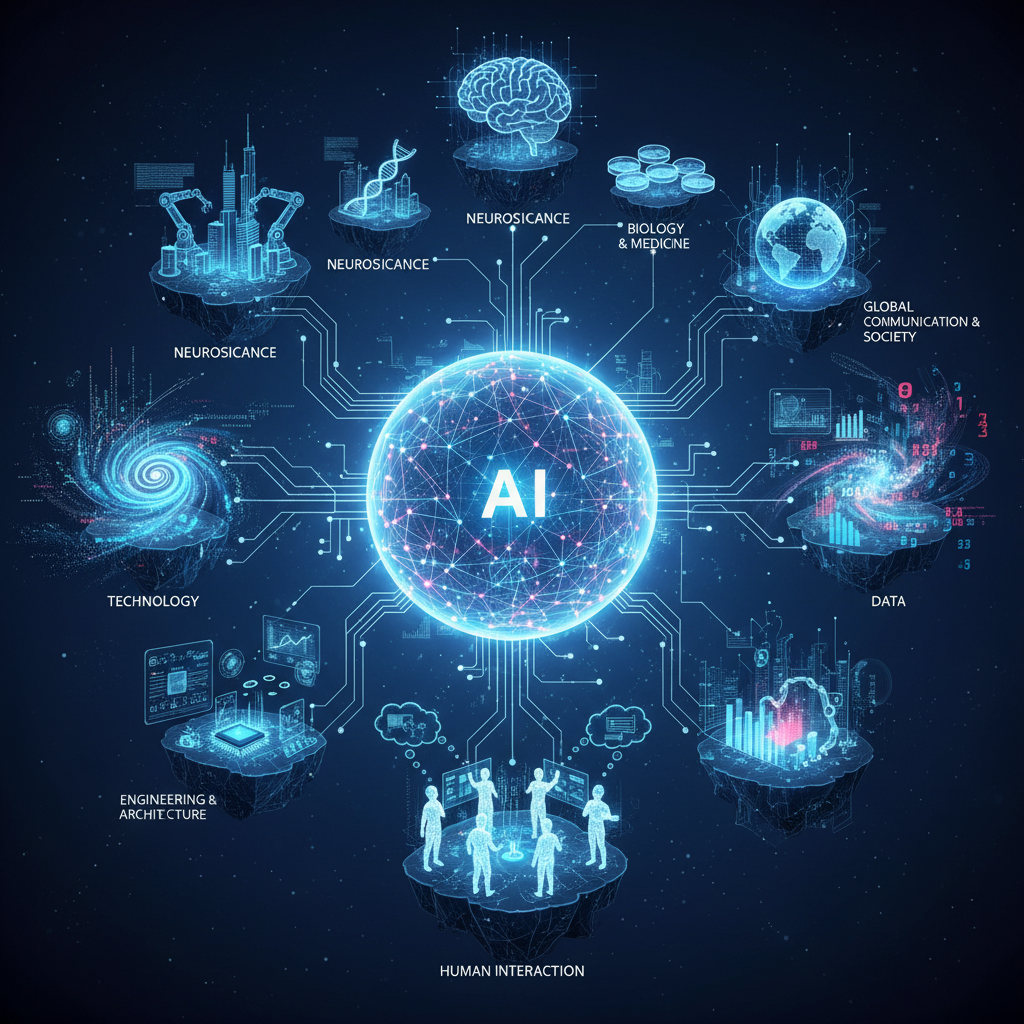 ⚠️ This picture may have spelling mistakes. Trust the words in the lesson.
AI in Action: Everyday Examples
AI is no longer just a futuristic concept; it's deeply integrated into many aspects of our lives:
- Voice Assistants: Siri, Alexa, Google Assistant use AI to understand your commands, answer questions, and control smart devices.
- Recommendation Systems: When Netflix suggests a movie, Amazon recommends a product, or Spotify creates a playlist, AI is analyzing your past preferences and predicting what you'll like next.
- Self-Driving Cars: AI powers the sensors, cameras, and decision-making systems that allow autonomous vehicles to perceive their environment and navigate safely.
- Facial Recognition: Unlocking your phone with your face or tagging friends in photos on social media relies on AI recognizing unique facial patterns.
- Spam Filters: Your email service uses AI to identify and filter out unwanted spam messages, keeping your inbox clean.
- Medical Diagnosis: AI can analyze medical images (like X-rays or MRIs) to help doctors detect diseases earlier and more accurately.
The Future and Ethical Considerations of AI
As AI continues to advance, it brings incredible potential for solving complex global challenges, from climate change to disease treatment. However, it also raises important questions and challenges:
- Bias: If AI learns from biased data (data that reflects existing societal inequalities), it can perpetuate and even amplify those biases in its decisions.
- Privacy: AI systems often require vast amounts of personal data, leading to concerns about how that data is collected, used, and protected.
- Job Displacement: As AI automates more tasks, there's a debate about its impact on the job market and the need for new skills.
- Accountability: Who is responsible when an AI system makes a mistake or causes harm?
Understanding these ethical considerations is crucial as we move forward with AI development. It's not just about building smarter machines, but about building them responsibly and ethically.
Conclusion: A Powerful Tool for the Future
Artificial Intelligence is a revolutionary technology that is transforming our world. From specialized tools that excel at single tasks to the theoretical promise of human-level and super-human intelligence, AI is constantly evolving. By understanding its core concepts – how it learns from data, uses algorithms, and the differences between Narrow, General, and Super AI – you're better equipped to navigate this exciting technological landscape. AI is a powerful tool, and like any tool, its impact depends on how we choose to use it.
Keep learning, free
Create a free Syllabax account to unlock practice questions and games for this topic.
Visual Learning Enhanced! 🚀
To help you master this topic, we use Advanced Syllabax AI to generate detailed diagrams and visual models.
Note on Visuals: The AI sometimes makes spelling errors in image labels. Please refer to the lesson text for the correct terminology.