Practical angle-word problems (Applications of Trigonometry)
Watch this topic in 60 seconds
Free preview · Lesson 1
Understanding Practical angle-word problems (Applications of Trigonometry)
Becoming a Math Detective: Solving Practical Angle-Word Problems!
Welcome, future Math Detectives! Have you ever wondered how engineers calculate the height of a towering skyscraper before it's even built? Or how pilots know their altitude and how far they are from the runway? The secret often lies in understanding angles and applying a super-cool branch of mathematics called Trigonometry. Don't worry, we're going to break it down into simple, fun steps, using lots of everyday examples.
Your Math Detective Toolkit: The Right-Angled Triangle
Every great detective needs their tools, and yours for angle-word problems is the right-angled triangle. This is a triangle that has one angle exactly 90 degrees (like the corner of a square or a book). Think of it like the basic building block for all our investigations.
- The longest side, always opposite the 90-degree angle, is called the Hypotenuse. Imagine it's the slide at a playground.
- The other two sides are called legs. Their names change depending on which other angle (not the 90-degree one) we're focusing on.
- The side across from the angle we're interested in is the Opposite side.
- The side next to the angle we're interested in (but not the hypotenuse) is the Adjacent side.
Think of it like being in a room. If you're looking at the wall straight in front of you, that's 'opposite.' The wall to your side is 'adjacent.' The ceiling, if it's sloped, might be your 'hypotenuse' if you're standing against a wall.
The Secret Code: SOH CAH TOA
This might look like gibberish, but it's the most powerful secret code you'll learn today! It helps you remember the three basic trigonometric ratios that link angles and sides in a right-angled triangle.
SOH stands for: Sine = Opposite / Hypotenuse
CAH stands for: Cosine = Adjacent / Hypotenuse
TOA stands for: Tangent = Opposite / Adjacent
Imagine you have three different lenses for your detective magnifying glass: the Sine lens, the Cosine lens, and the Tangent lens. You pick the right lens based on which 'clues' (sides) you have and which 'mystery' (side or angle) you want to solve!
Looking Up, Looking Down: Angles of Elevation and Depression
These are super important in practical problems. They describe how you look at things relative to a flat, horizontal line (like the ground or the horizon).
-
Angle of Elevation: Looking UP!
Imagine you're standing on the ground, flying a kite. When you look up from your eyes to the kite, the angle your line of sight makes with the horizontal ground is the Angle of Elevation. It's always measured upwards from a horizontal line.
Analogy: Think of it as the angle you tilt your head back to see the top of a tall building.
-
Angle of Depression: Looking DOWN!
Now, imagine you're on top of that tall building, looking down at a car on the street below. The angle your line of sight makes with a horizontal line going straight out from your eyes (not the building wall!) is the Angle of Depression. It's always measured downwards from a horizontal line.
Analogy: This is like the angle you tilt your head forward to watch a pebble drop from a cliff.
Key Detective Insight: Here's a cool trick! If you're on the ground looking up at a bird (angle of elevation), that angle is exactly the same as the angle the bird would have to look down at you (angle of depression)! They are like two sides of the same coin, or parallel railway tracks with a connecting path. This is because of something called 'alternate interior angles' from geometry, which form when a transversal line cuts across two parallel lines (your two horizontal lines).
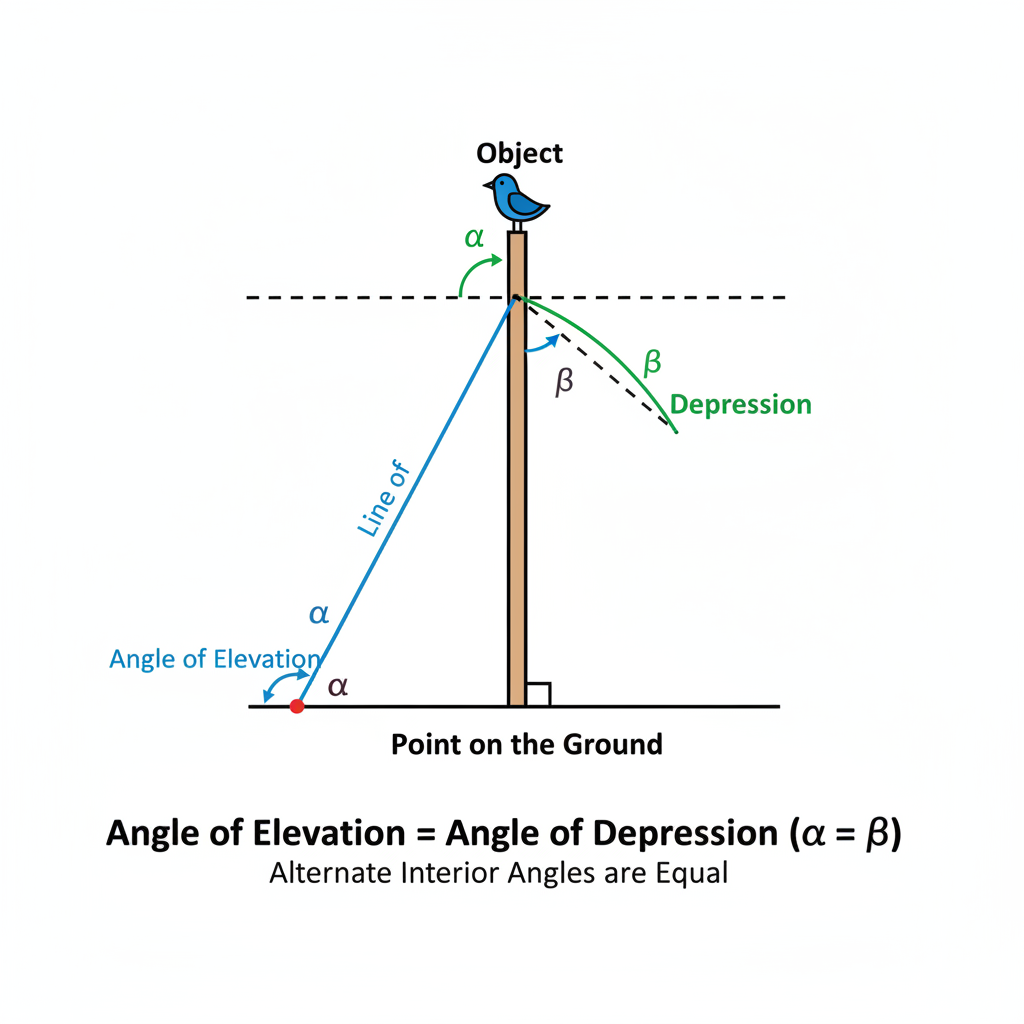 ⚠️ This picture may have spelling mistakes. Trust the words in the lesson.
Your Mission: Steps to Solve Angle-Word Problems
Ready to put on your detective hat? Here’s your step-by-step guide to cracking these angle-word cases:
-
Read Carefully: Understand what the problem is asking. What are you trying to find? What information is given?
Analogy: This is like reading the case file from start to finish.
-
Draw a Diagram: This is the MOST important step! Sketch a clear right-angled triangle. Label all the known values (angles, side lengths) and the unknown value you need to find. Make sure to draw the horizontal line for angles of elevation/depression.
Analogy: This is your crime scene sketch, marking where everything is.
-
Identify the Relationship: Look at your diagram. From the angle you know (or want to find), which sides are involved? Is it the Opposite, Adjacent, or Hypotenuse? This will tell you which SOH CAH TOA ratio to use.
Analogy: This is like identifying the type of clue: is it a fingerprint, a footprint, or a witness statement?
-
Set Up the Equation: Write down the trigonometric ratio using the values from your diagram. For example, if you're using Tangent, it might look like: tan(angle) = Opposite / Adjacent.
Analogy: This is like putting your clues together to form a theory.
-
Solve for the Unknown: Use your calculator (make sure it's in 'DEG' mode for degrees!) to find the angle or side length. You might need to use inverse functions (like sin⁻¹, cos⁻¹, tan⁻¹) if you're looking for an angle.
Analogy: This is where you use your scientific tools to analyze the evidence.
-
Check Your Answer: Does your answer make sense in the context of the problem? Is a height reasonable? Is a distance logical? If you get a negative height, you know something is wrong!
Analogy: This is like reviewing your case summary to ensure all the pieces fit together logically.
Let's Solve Some Cases! (Worked Examples)
Example 1: The Tall Tree Mystery
A squirrel is at the top of a tree. From a point on the ground 20 meters away from the base of the tree, the angle of elevation to the top of the tree is 35 degrees. How tall is the tree?
- Read: Find tree height. Known: distance from tree (20m), angle of elevation (35°).
- Draw: Draw a right-angled triangle. The tree is the vertical side, the ground is the horizontal side (20m), and the line of sight to the top of the tree is the hypotenuse. The angle of elevation is at the base where you stand.
- Identify: From the 35° angle, we know the Adjacent side (20m) and we want to find the Opposite side (height of the tree). Which ratio uses Opposite and Adjacent? TOA! (Tangent)
- Set Up: tan(35°) = height / 20
- Solve: height = 20 * tan(35°). Using a calculator, tan(35°) ≈ 0.700. So, height ≈ 20 * 0.700 = 14 meters.
- Check: A 14-meter tree is a reasonable height.
Example 2: The Lighthouse Lookout
From the top of a 50-meter-tall lighthouse, a ship is observed at an angle of depression of 25 degrees. How far is the ship from the base of the lighthouse?
- Read: Find distance from ship to lighthouse base. Known: lighthouse height (50m), angle of depression (25°).
- Draw: Draw a right-angled triangle. Lighthouse is vertical (50m). The unknown distance is the horizontal side. The angle of depression is outside the triangle initially, measured from a horizontal line at the top of the lighthouse looking down. Remember our detective insight: the angle of depression from the lighthouse to the ship is equal to the angle of elevation from the ship to the lighthouse! So, the angle inside our triangle at the ship's location is 25°.
- Identify: From the 25° angle (at the ship), we know the Opposite side (lighthouse height = 50m) and we want to find the Adjacent side (distance to ship). Which ratio? Again, TOA! (Tangent)
- Set Up: tan(25°) = 50 / distance
- Solve: distance = 50 / tan(25°). Using a calculator, tan(25°) ≈ 0.466. So, distance ≈ 50 / 0.466 ≈ 107.3 meters.
- Check: A ship over 100 meters away from a 50m lighthouse sounds reasonable.
Conclusion: Your Angle Superpower!
You've just learned the foundational skills to solve real-world problems using angles! From measuring heights to calculating distances, trigonometry is like a superpower that allows you to see beyond what's immediately visible. Keep practicing, keep drawing those diagrams, and you'll be a master Math Detective in no time!
Keep learning, free
Create a free Syllabax account to unlock practice questions and games for this topic.
Visual Learning Enhanced! 🚀
To help you master this topic, we use Advanced Syllabax AI to generate detailed diagrams and visual models.
Note on Visuals: The AI sometimes makes spelling errors in image labels. Please refer to the lesson text for the correct terminology.