GST & discount basics (Financial Mathematics)
Watch this topic in 60 seconds
Free preview · Lesson 1
Understanding GST & discount basics (Financial Mathematics)
Unlocking the Secrets of Your Wallet: GST & Discount Basics!
Welcome, future financial whizzes! Ever wondered why a shirt on sale still seems to cost a bit more at the checkout, or how stores decide their "30% off" prices? This lesson is your secret decoder ring for understanding two super important ideas in the world of money: Discounts and GST (Goods and Services Tax). Don't worry, we'll break it down into simple, easy-to-understand steps, with lots of real-world examples and analogies.
Part 1: The Magic of Discounts – Getting More for Less!
Imagine you're at your favorite store, and you see a sign that screams, "50% OFF!" What a thrill, right? That's a discount! A discount is simply a reduction in the usual price of something. It's like the store is giving you a special deal, a little bit of money back in your pocket.
What is a Discount?
Think of a discount as a "thank you" from the store, or a way to encourage you to buy something. Stores offer discounts for many reasons:
- To clear old stock (making way for new items).
- During special sales events (like Black Friday or end-of-season sales).
- To reward loyal customers.
- To attract new customers.
Analogy: Imagine you have a coupon for a pizza. That coupon gives you a discount, meaning you pay less than the original price of the pizza. It's like having a superpower that makes things cheaper!
Calculating Discounts: How Much Do You Actually Save?
Discounts are almost always given as a percentage (like 10%, 25%, 50%). To find out the actual money you save, you need to calculate that percentage of the original price.
Formula 1: Finding the Discount Amount
Discount Amount = Original Price × Discount Percentage
Let's say a video game costs
To calculate 20% of $60, remember that 20% is the same as 0.20 (as a decimal) or 20/100 (as a fraction).
Discount Amount =
So, you save $12!
Formula 2: Finding the New Price (Sale Price)
Once you know the discount amount, finding the new price is easy!
New Price = Original Price - Discount Amount
Using our video game example:
New Price =
So, you'd pay $48 for the game!
Quick Trick: Finding the New Price Directly!
You can also find the new price in one step. If you get 20% off, it means you are paying 100% - 20% = 80% of the original price.
New Price = Original Price × (100% - Discount Percentage)
New Price =
New Price =
This trick is super handy for quick calculations!
Analogy: Imagine you have 10 slices of pizza, and your friend eats 20% of them. They eat 2 slices (20% of 10). You're left with 8 slices. Or, directly, if they eat 20%, you have 80% left, so 80% of 10 slices is 8 slices.
Part 2: Understanding GST – Your Contribution to the Community Pot!
Now, let's talk about something that often gets added to the price: GST. GST stands for Goods and Services Tax. It's a tax that governments charge on most goods (like clothes, electronics, food) and services (like haircuts, car repairs, movie tickets) that are sold in the country.
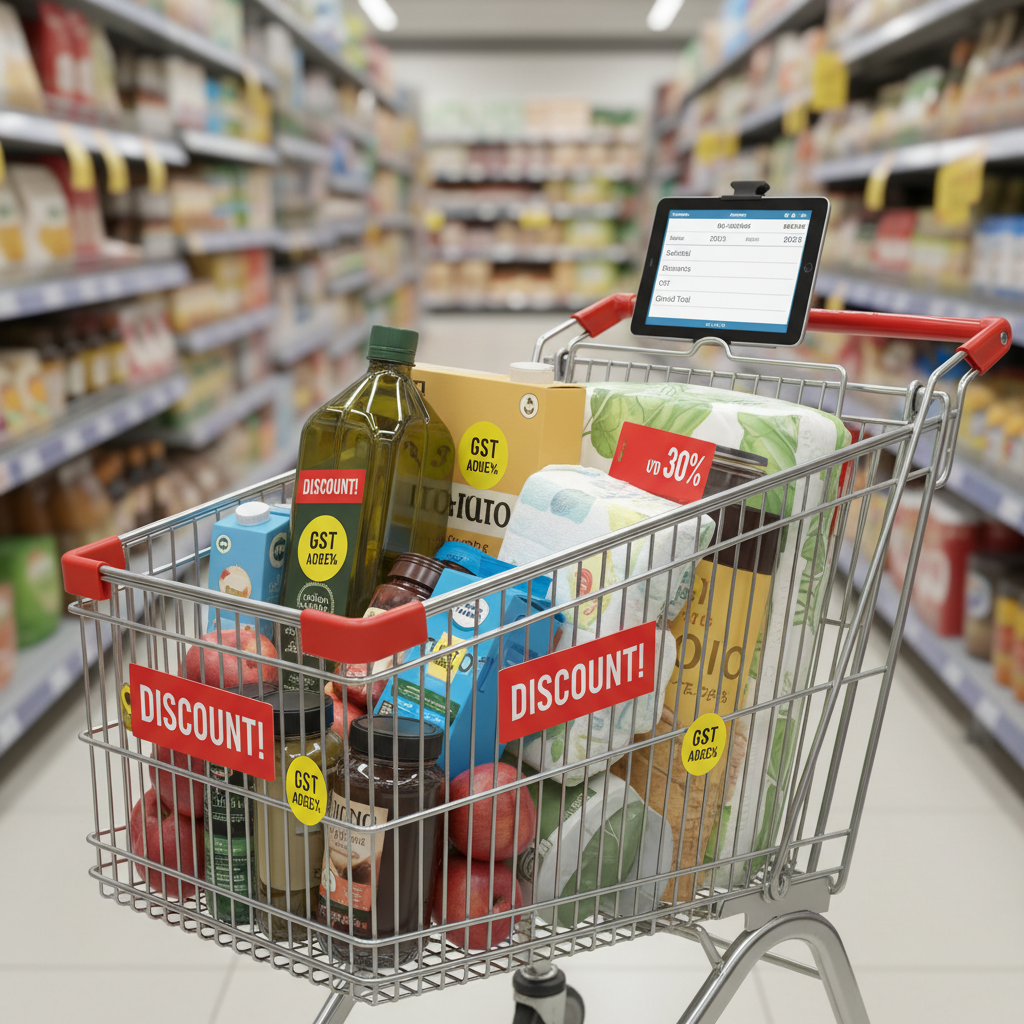 ⚠️ This picture may have spelling mistakes. Trust the words in the lesson.
What is GST?
Think of GST like a tiny, mandatory contribution you make every time you buy something. This money doesn't go into the store owner's pocket; it goes to the government.
Why Do We Pay GST?
The money collected from GST is used by the government to fund important public services that benefit everyone. This includes:
- Building and maintaining roads, bridges, and public transport.
- Funding hospitals and healthcare.
- Supporting schools and education.
- Providing police and fire services.
Analogy: Imagine your family decides to have a party. Everyone chips in a small amount of money into a "community pot" to buy decorations, food, and drinks. GST is like that small "chip in" for the whole country's services. The more people buy, the bigger the "community pot" gets, and the more services the government can provide.
Calculating GST: Adding to the Price
Just like discounts, GST is usually calculated as a percentage, but instead of taking money off, you add money on. In many countries, a common GST rate is 10%. (Always check the specific rate for your region, but for our exercises, we'll often use 10% as an example).
Formula 3: Finding the GST Amount
GST Amount = Original Price (before GST) × GST Percentage
Let's say a new pair of headphones costs $100 before GST, and the GST rate is 10%.
GST Amount =
So, $10 is added for GST.
Formula 4: Finding the Total Price (including GST)
Once you know the GST amount, finding the total price is simple:
Total Price = Original Price (before GST) + GST Amount
Using our headphones example:
Total Price =
So, you'd pay $110 for the headphones.
Quick Trick: Finding the Total Price Directly!
If you're adding 10% GST, it means you're paying 100% + 10% = 110% of the original price.
Total Price = Original Price (before GST) × (100% + GST Percentage)
Total Price =
Total Price =
This trick is just as useful for GST as it is for discounts!
Analogy: Imagine you're buying a toy online for
Part 3: The Real World Challenge – Combining Discounts and GST!
In real life, you often encounter both discounts AND GST on the same item. How do you handle that? The general rule is to apply the discount first, and then calculate GST on the discounted price.
Example: A jacket has an original price of $150. It's on sale for 20% off, and there's a 10% GST.
Step 1: Calculate the Discounted Price.
Discount Amount =
Price After Discount =
(Using the quick trick:
Step 2: Calculate GST on the Discounted Price.
GST Amount = Discounted Price × GST Percentage
GST Amount =
Step 3: Calculate the Final Price (including GST).
Final Price = Price After Discount + GST Amount
Final Price =
So, you'd pay $132 for the jacket.
Analogy: Imagine baking a cake. You first reduce the amount of sugar (the discount), then you add the icing on top (the GST) to the now-less-sweet cake. You wouldn't add the icing and then try to take sugar out of the whole thing! Order matters!
Wrapping It Up: Your New Financial Superpowers!
Congratulations! You've just unlocked some fundamental financial superpowers. You now understand how discounts can save you money and how GST contributes to the services we all rely on. The next time you're shopping, you'll be able to confidently calculate prices and know exactly what you're paying for. Keep practicing, and you'll be a financial math whiz in no time!
Keep learning, free
Create a free Syllabax account to unlock practice questions and games for this topic.
Visual Learning Enhanced! 🚀
To help you master this topic, we use Advanced Syllabax AI to generate detailed diagrams and visual models.
Note on Visuals: The AI sometimes makes spelling errors in image labels. Please refer to the lesson text for the correct terminology.