Composite circle problems (Areas Related to Circles)
Watch this topic in 60 seconds
Free preview · Lesson 1
Understanding Composite circle problems (Areas Related to Circles)
Mastering Composite Circle Problems: Unpacking Areas Related to Circles (Grade 10, Foundational)
Welcome, future geometry whizzes! Today, we're going to dive into the exciting world of composite circle problems. Don't let the fancy name scare you! Think of it like playing with LEGOs. Instead of building with just one type of block, you're combining different shapes to create something new and interesting. Our goal is to figure out the 'surface' or 'floor space' (which we call area) of these unique creations.
Part 1: The Basics – Your Geometry Toolkit
Before we build complex structures, let's make sure our basic tools are sharp. Remember the circle, that perfect, never-ending curve? It has a few important measurements:
- Radius (r): Imagine a pizza. The radius is the distance from the very center of the pizza to any point on its crust. It's half the journey across!
- Diameter (d): This is the full journey straight across the pizza, passing right through the center. So, diameter = 2 × radius.
- Pi (π): This is a special, never-ending number, approximately 3.14 or sometimes 22/7. It's the secret ingredient that links a circle's size to its circumference and area. Think of it as the 'magic number' of circles!
Key Formulas to Remember:
- Area of a Circle: This tells you how much 'pizza' there is on the surface. The formula is A = πr². It's like finding the space a round rug covers on your floor.
- Circumference of a Circle: This is the 'length of the crust' around the entire pizza. The formula is C = 2πr or C = πd. It's like measuring the fence needed to go around a circular garden.
Part 2: What Are Composite Circle Problems?
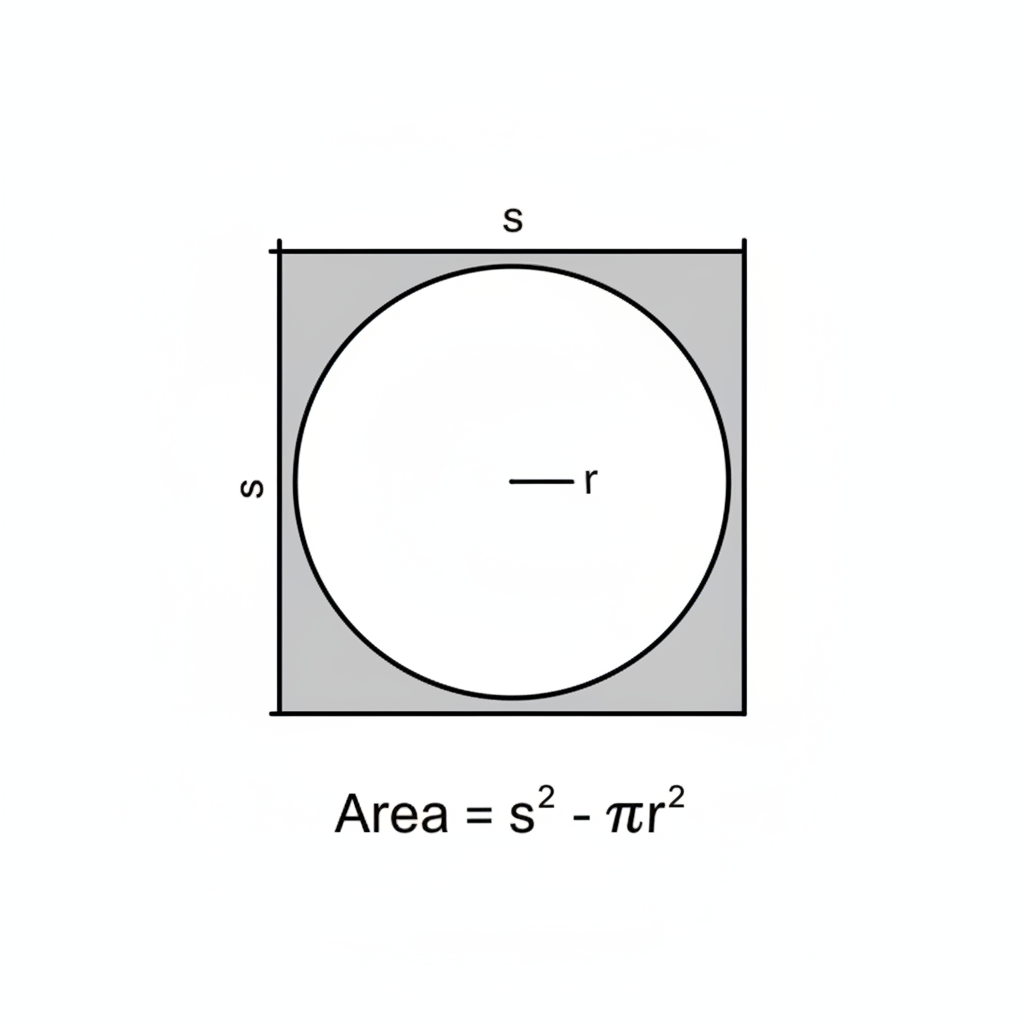
Now for the fun part! Composite circle problems involve shapes that are made by combining circles (or parts of circles, like semicircles or quadrants) with other basic geometric shapes, such as squares, rectangles, or triangles. Imagine you have a square piece of paper, and you cut a perfect circle out of its middle. The remaining paper, with a circular hole, is a composite shape! Or, picture a running track: it's a rectangle with two semicircles on the ends.
The main challenge is to find the area of these combined or 'leftover' shapes. It's like trying to figure out how much grass is left in a square park after a round fountain is built in the middle.
Part 3: The 'Add or Subtract' Strategy – Your Superpower!
Solving composite area problems usually boils down to two simple actions: adding areas together or subtracting one area from another. Think of it like this:
- Adding Areas: If you have a house that's a rectangle with a semicircular porch added on, to find the total floor space, you'd find the area of the rectangular house AND the area of the semicircular porch, then add them together. It's putting two puzzle pieces together to make a bigger picture.
- Subtracting Areas: If you have a large chocolate bar (a rectangle) and you bite a circular piece out of it, to find how much chocolate is left, you'd find the area of the whole bar AND the area of the bitten piece, then subtract the bitten piece's area from the whole bar's area. It's like taking a cookie cutter to a sheet of dough – you want to know the area of the 'scraps' left over.
A Step-by-Step Approach to Conquer Any Problem:
- Analyze the Picture (or description): Look at the shape carefully. What basic shapes can you see? Is it a square with a circle inside? A rectangle with semicircles attached? Draw it if there's no diagram!
- Identify Key Dimensions: What measurements are given? Radii, diameters, side lengths, lengths, widths? Write them down.
- Connect the Shapes: How do the shapes relate to each other? Does the diameter of the circle equal the side length of the square? Is the radius half the width of the rectangle? These connections are crucial for finding missing dimensions.
- Formulate Your Plan (Add or Subtract): Decide if you need to add the areas of individual shapes, or subtract the area of one shape from another. For instance, if you want the area of a square with a circle removed, your plan is: (Area of Square) - (Area of Circle).
- Calculate Individual Areas: Use the appropriate formulas (like A = πr² for circles, A = side² for squares, A = length × width for rectangles, A = ½ × base × height for triangles) to find the area of each basic shape you identified.
- Perform the Final Calculation: Add or subtract the individual areas according to your plan.
- Don't Forget Units! Areas are always in 'square units' (e.g., cm², m², units²).
Part 4: Common Composite Scenarios Explained
Scenario 1: Circle Inscribed in a Square (or Square Circumscribing a Circle)
Imagine a perfectly round coin fitting snugly inside a square box. The diameter of the coin is exactly the same as the side length of the box. To find the area of the box *around* the coin, you would calculate: Area of Square - Area of Circle.
Scenario 2: Square Inscribed in a Circle (or Circle Circumscribing a Square)
Now, imagine a square cookie inside a perfectly round cookie jar, where the corners of the square touch the edge of the jar. Here, the diagonal of the square is the same as the diameter of the circle. You'll need to use the Pythagorean theorem (a² + b² = c²) or other geometric properties to find the side length of the square from the circle's radius. To find the area of the jar *around* the cookie, you would calculate: Area of Circle - Area of Square.
Scenario 3: Semicircles or Quadrants Attached to Rectangles/Squares
Think of a rectangular swimming pool with a semicircular diving area attached to one end. To find the total area, you'd simply add the Area of the Rectangle + Area of the Semicircle. (Remember, a semicircle is half a circle, so its area is ½πr²). A quadrant is a quarter of a circle, so its area is ¼πr².
Scenario 4: Shaded Regions
Many problems will ask for the area of a 'shaded region.' This almost always means you'll be subtracting areas. For example, if you see a large circle with a smaller circle cut out of its center (like a donut), the shaded area is the Area of Large Circle - Area of Small Circle.
Conclusion
Composite circle problems might look tricky at first, but by breaking them down into simpler steps and using your fundamental area formulas, you'll find them quite manageable. Always draw a diagram if one isn't provided, identify your basic shapes, and decide whether you need to add or subtract their areas. With practice, you'll be solving these geometry puzzles like a pro!
Keep learning, free
Create a free Syllabax account to unlock practice questions and games for this topic.
Visual Learning Enhanced! 🚀
To help you master this topic, we use Advanced Syllabax AI to generate detailed diagrams and visual models.
Note on Visuals: The AI sometimes makes spelling errors in image labels. Please refer to the lesson text for the correct terminology.