Local Self-Government (Urban & Rural) – Indian Civics
Watch this topic in 60 seconds
Free preview · Lesson 1
Local Self-Government (Urban & Rural) – Indian Civics (Foundational)
Local Self-Government (Urban & Rural) – Indian Civics
This lesson provides a foundational understanding of Local Self-Government in India, covering both urban and rural areas.
What is Local Self-Government?
Local Self-Government means that people at the local level manage their own affairs. This ensures that local needs are addressed efficiently and democratically. It involves elected representatives who work to solve problems and provide services within their community.
Why is Local Self-Government Important?
- Direct Democracy: It brings government closer to the people, allowing for greater participation.
- Efficient Governance: Local bodies understand local needs better and can address them effectively.
- Empowerment: It empowers people to make decisions about their lives and communities.
Rural Local Self-Government: Panchayati Raj
In rural areas, Local Self-Government is known as Panchayati Raj. It is a three-tier system:
- Gram Panchayat: At the village level.
- Panchayat Samiti: At the block level (a group of villages).
- Zilla Parishad: At the district level.
The Gram Sabha is a meeting of all adult residents of a village. It is an important part of the Gram Panchayat.
Urban Local Self-Government: Municipalities
In urban areas, Local Self-Government is managed by Municipalities. There are different types of Municipalities depending on the size of the city or town:
- Nagar Panchayat: For areas transitioning from rural to urban.
- Municipal Council: For smaller cities.
- Municipal Corporation: For larger cities.
Functions of Local Governments
Both Panchayats and Municipalities have specific functions. These include:
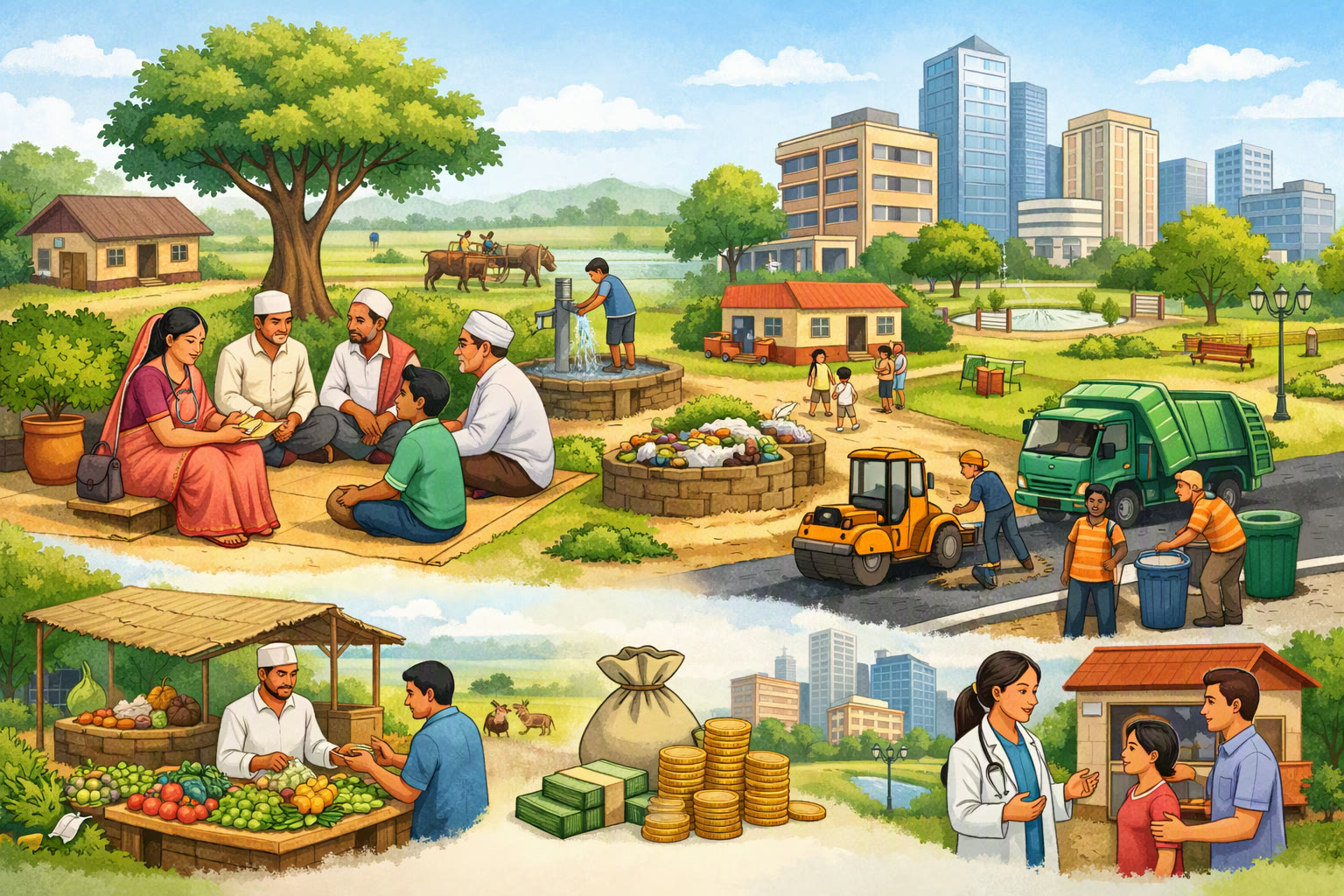
- Providing clean drinking water
- Maintaining roads and infrastructure
- Managing sanitation and waste disposal
- Providing education and healthcare
- Planning for local development
Sources of Revenue
Local governments need money to perform their functions. They get revenue from:
- Taxes (property tax, water tax, etc.)
- Grants from the State Government
- Fees and charges for services
Keep learning, free
Create a free Syllabax account to unlock practice questions and games for this topic.
Visual Learning Enhanced! 🚀
To help you master this topic, we use Advanced Syllabax AI to generate detailed diagrams and visual models.
Note on Visuals: The AI sometimes makes spelling errors in image labels. Please refer to the lesson text for the correct terminology.