Understanding hours, minutes, seconds (Time)
Watch this topic in 60 seconds
Free preview · Lesson 1
Understanding Understanding hours, minutes, seconds (Time)
Understanding Hours, Minutes, and Seconds: A Journey Through Time!
Welcome, young explorers, to the fascinating world of time! We use time every single day, but have you ever stopped to wonder what an hour, a minute, or a second really means? Let's embark on a fun adventure to uncover the secrets of these tiny, yet mighty, units of time!
What is Time?
Imagine time as a long, invisible river flowing constantly. We can't see it, touch it, or hold it, but we can see and feel its effects. Time helps us understand when things happen – like when it's time for breakfast, when school starts, or when your favorite cartoon comes on TV! It helps us organize our day, our week, and even our lives.
The Tiniest Building Blocks: Seconds
Let's start with the smallest unit we'll talk about today: the second. A second is a very, very short amount of time. Think about how quickly you can blink your eyes – that's about one second! Or how fast a tiny ant scurries across the floor – that might take only a few seconds.
Analogy: Think of a second like a single grain of sand falling through an hourglass. It's small, but many grains together make up a bigger amount of sand.
Building Up: Minutes
Now, what happens when we put lots of seconds together? We get a minute! A minute is made up of 60 seconds. That might sound like a lot, but let's make it easier to understand.
Analogy: Imagine you're singing the alphabet song. It takes you about a minute to sing it all the way through. So, the time it takes to sing the alphabet song is roughly one minute!
Another way to think about it: If you can count slowly from 1 to 60, you've just experienced about one minute. It’s enough time to:
- Brush your teeth thoroughly.
- Read a short paragraph in a book.
- Do 10 jumping jacks!
The Bigger Picture: Hours
When we gather 60 minutes together, we create an hour. An hour is a much longer chunk of time. It's about the length of one episode of your favorite TV show, or the time it takes to have a nice playdate with a friend.
Analogy: Think of an hour like a whole school lesson. It's a significant amount of time, usually filled with different activities.
Since there are 60 minutes in an hour, and 60 seconds in a minute, an hour is a lot of seconds! To figure it out, we can multiply: 60 minutes/hour * 60 seconds/minute = 3600 seconds in an hour! That's a lot of tiny sand grains!
An hour is enough time to:
- Eat dinner with your family.
- Finish a chapter in a longer book.
- Go for a bike ride around your neighborhood.
Putting It All Together: The Clock
How do we keep track of all these seconds, minutes, and hours? We use a clock! A clock is like a special tool that shows us where we are in the flow of time.
Most clocks have hands that move to tell us the time:
- The second hand: This is usually the thinnest and fastest hand. It ticks every second!
- The minute hand: This hand moves more slowly. It completes a full circle around the clock face in one hour.
- The hour hand: This is the shortest and slowest hand. It takes 12 hours to go all the way around the clock face once!
Analogy: Imagine the clock hands are like different kinds of runners. The second hand is a speedy sprinter, the minute hand is a steady jogger, and the hour hand is a slow walker.
Day and Night: The 24-Hour Cycle
We often talk about time in 12-hour chunks (like 7 AM or 7 PM). But the whole day, from when the sun comes up to when it goes down and back again, is actually 24 hours long. This is a full day!
Analogy: Think of the 24 hours in a day like a giant pizza. Each hour is a slice. We eat some slices during the day (daylight hours) and some slices during the night (dark hours).
Why is Understanding Time Important?
Knowing about seconds, minutes, and hours helps us do so many things:
- Be on time: We can make sure we arrive at school or appointments when we're supposed to.
- Plan activities: We can decide how much time we need to play, read, or do homework.
- Understand schedules: We can know when our favorite shows are on or when the next bus is coming.
- Measure progress: We can see how long it takes to learn something new or finish a project.
So, the next time you look at a clock, remember the amazing journey of seconds turning into minutes, and minutes turning into hours. Time is all around us, helping us understand and enjoy our world!
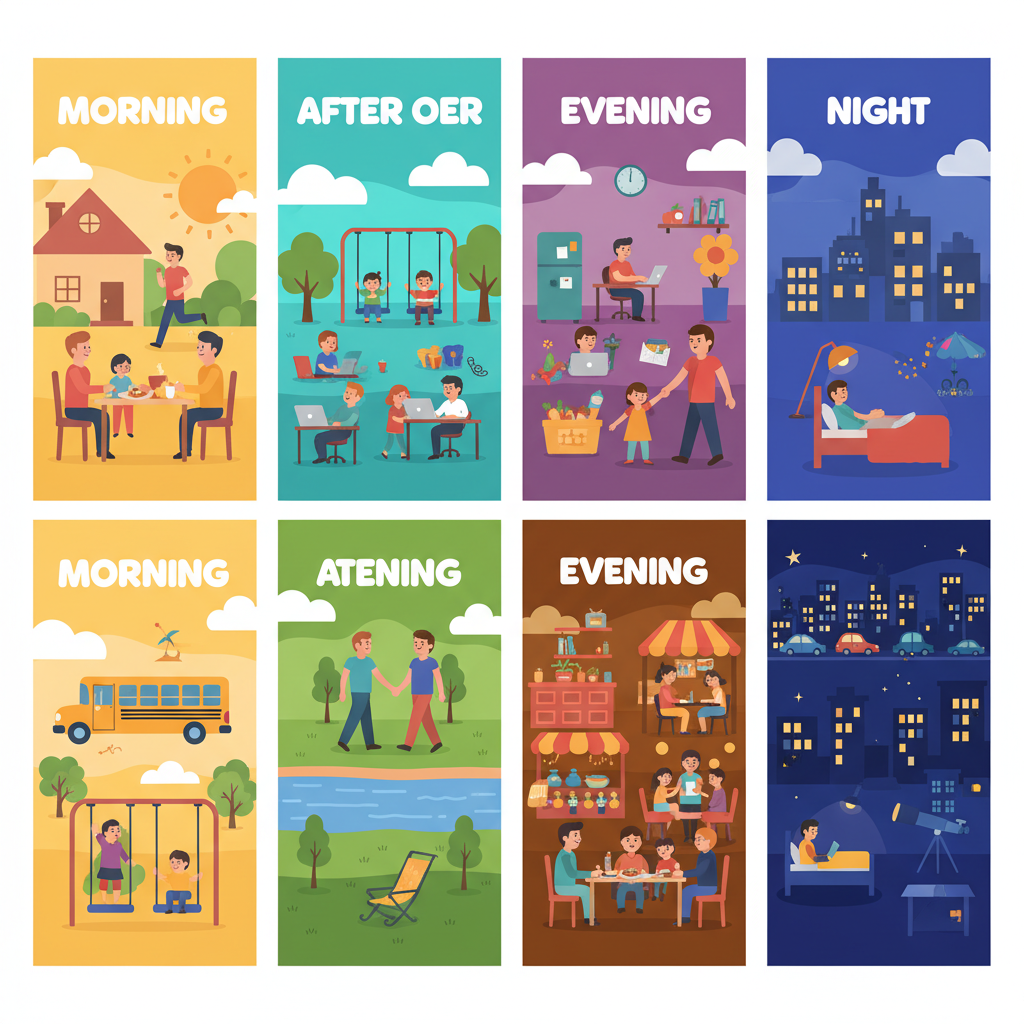 ⚠️ This picture may have spelling mistakes. Trust the words in the lesson.
Keep learning, free
Create a free Syllabax account to unlock practice questions and games for this topic.
Visual Learning Enhanced! 🚀
To help you master this topic, we use Advanced Syllabax AI to generate detailed diagrams and visual models.
Note on Visuals: The AI sometimes makes spelling errors in image labels. Please refer to the lesson text for the correct terminology.