Hot & cold (PHYSICS)
Watch this topic in 60 seconds
Free preview · Lesson 1
Understanding Hot & cold (PHYSICS)
What is Hot and Cold? A Journey into Temperature!
Imagine you're holding a cup of hot chocolate on a chilly morning. It feels warm, right? Now imagine dipping your hand into a bucket of ice water. Brrr! It feels cold. But what exactly makes something feel hot or cold? It all comes down to something called **temperature** and the movement of tiny, invisible particles called **atoms** and **molecules**.
The Secret Lives of Atoms and Molecules: They're Always Dancing!
Everything around us – your toys, your food, even the air you breathe – is made up of incredibly small building blocks called atoms and molecules. These tiny particles are never still; they are always in motion, vibrating, wiggling, and moving around. Think of them like a room full of hyperactive toddlers at a birthday party! They're bumping into each other, spinning, and generally being very busy.
How Movement Creates Heat: The Faster They Dance, The Hotter It Gets!
When things are **hot**, it means their atoms and molecules are moving very, very fast. They have a lot of energy and are jiggling and bouncing around with great enthusiasm. Imagine those toddlers at the party going absolutely wild, running everywhere! This fast movement is what we feel as heat. The hotter something is, the more energy its particles have, and the faster they move.
Analogy: Think of a busy highway. When cars are zooming by quickly, the highway is very active. Similarly, when the particles in an object are moving very fast, the object is hot.
When Things Cool Down: A Slower Dance
When things are **cold**, their atoms and molecules are moving much more slowly. They still have some energy, but it's less than when they were hot. It's like those toddlers have calmed down a bit and are just gently swaying or shuffling their feet. This slower movement is what we feel as cold. The colder something is, the less energy its particles have, and the slower they move.
Analogy: Imagine a quiet library. People are moving slowly and carefully. This is like the particles in a cold object – they are moving, but not very fast.
Temperature: Measuring the Dance Speed
Temperature is simply a measurement of how hot or cold something is. It tells us how much energy the atoms and molecules in an object have and how fast they are moving. We use a tool called a **thermometer** to measure temperature. Thermometers often use a liquid (like mercury or alcohol) that expands when it gets hot and shrinks when it gets cold. This expansion and contraction helps us read the temperature on a scale.
Think of a thermometer like a speedometer for the tiny particle dancers. It tells us how fast they are moving!
Heat Transfer: Sharing the Energy
Heat doesn't just stay put; it likes to move from one place to another. This movement of heat energy is called **heat transfer**. Heat always flows from a warmer object to a cooler object. It's like a generous friend sharing their warmth with someone who is cold.
Analogy: Imagine you have a hot cup of cocoa and a cold glass of water. If you put them next to each other, the heat from the cocoa will gradually move into the water, making the cocoa cooler and the water a little warmer. The heat is being transferred.
Three Ways Heat Likes to Travel: Conduction, Convection, and Radiation
Heat transfer happens in a few main ways:
- Conduction: The 'Touchy-Feely' Way
Conduction is when heat travels through direct contact. Imagine holding a metal spoon in a hot bowl of soup. The heat from the soup travels up the spoon, making the handle hot. The atoms in the spoon bump into each other, passing the heat along. It's like a game of dominoes where one falling domino knocks over the next.
Analogy: Think of a line of people holding hands. If the person at one end gets a tickle, they might wiggle, and that wiggle can travel down the line to the other people.
Why are pot handles often made of plastic or wood? Because materials like plastic and wood are poor conductors of heat (they are called insulators!). This means they don't let heat travel through them easily, so you can hold the handle without getting burned.
- Convection: The 'Moving Fluid' Way
Convection happens in liquids and gases (like water and air) when warmer parts move up and cooler parts move down, creating a current. Think about boiling water. The water at the bottom gets heated by the stove, becomes less dense, and rises. Cooler water from the top sinks down to take its place, gets heated, and rises too. This creates a cycle of movement.
Analogy: Imagine a merry-go-round. The hot water is like the kids on the merry-go-round going up and around, while the cooler water is like the empty seats coming back down to pick up more kids.
Where do we see this? Hot air balloons work because the air inside is heated, making it less dense and causing it to rise. This is convection in action!
- Radiation: The 'Invisible Wave' Way
Radiation is how heat travels through space using invisible waves, like light. The most obvious example is the sun! The sun's heat travels all the way to Earth through empty space as radiation. You can also feel radiation from a campfire or a hot stove burner without touching it.
Analogy: Think of a flashlight. It sends out beams of light. Heat radiation is similar; it sends out invisible waves of heat energy.
Why does a black t-shirt feel hotter in the sun than a white one? Dark colors absorb more heat radiation than light colors.
Solids, Liquids, and Gases: How Particles Behave
The way atoms and molecules move and interact also determines whether something is a solid, a liquid, or a gas.
- Solids: Tightly Packed Dancers
In solids (like ice or a rock), the particles are packed very closely together and mostly just vibrate in place. They don't move around much. This is why solids keep their shape.
- Liquids: Sliding Dancers
In liquids (like water or juice), the particles are still close, but they have enough energy to slide past each other. This allows liquids to flow and take the shape of their container.
- Gases: Wild Dancers!
In gases (like air or steam), the particles are far apart and move very quickly in all directions, bouncing off everything. This is why gases spread out to fill any container they are in.
Putting It All Together: The Big Picture
So, hot and cold are all about the energy and movement of tiny particles. Temperature measures this movement. Heat transfer is how this energy moves around. And the state of matter (solid, liquid, gas) depends on how these particles are behaving!
It's like a big, invisible dance party happening all around us, all the time!
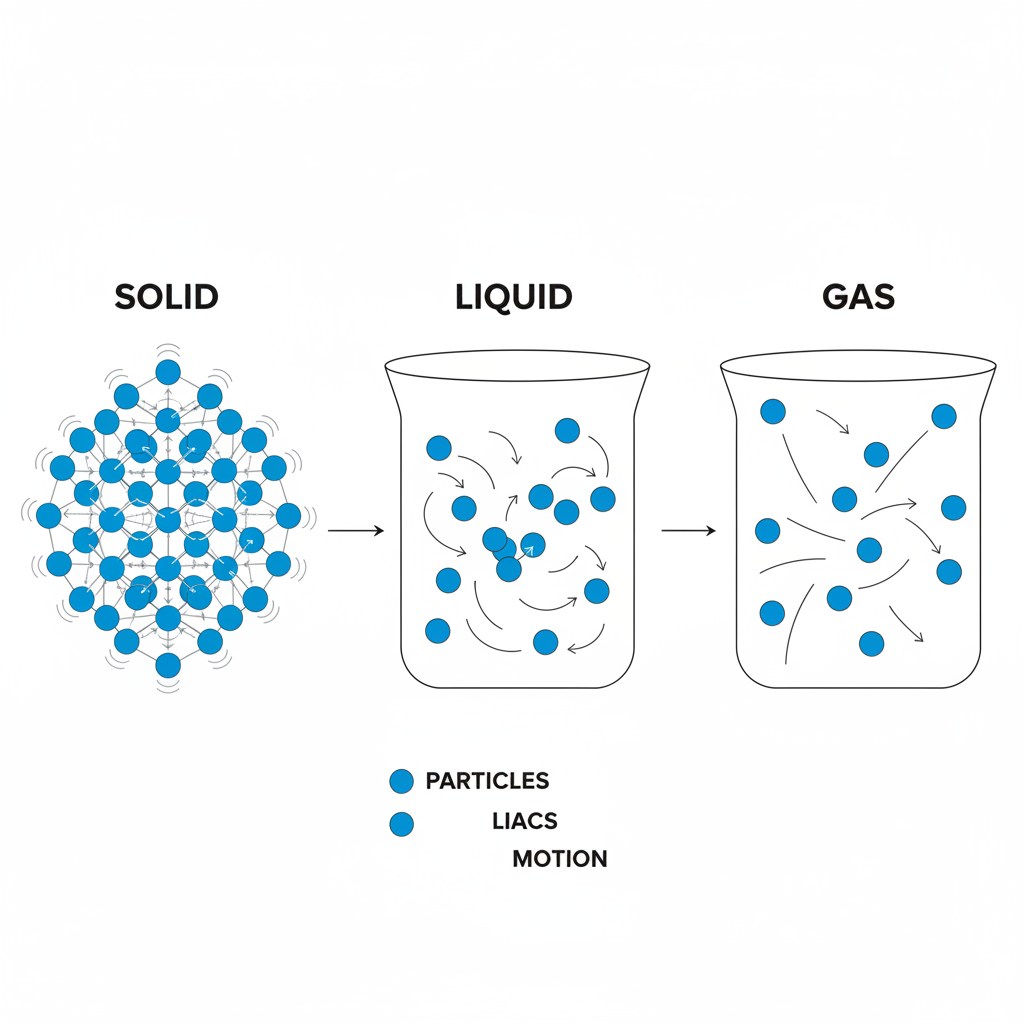 ⚠️ This picture may have spelling mistakes. Trust the words in the lesson.
This diagram shows how particles move differently in solids (vibrating in place), liquids (sliding past each other), and gases (moving freely and rapidly).
Here, you can see examples of conduction (spoon in soup), convection (boiling water), and radiation (sun's rays).
Keep learning, free
Create a free Syllabax account to unlock practice questions and games for this topic.
Visual Learning Enhanced! 🚀
To help you master this topic, we use Advanced Syllabax AI to generate detailed diagrams and visual models.
Note on Visuals: The AI sometimes makes spelling errors in image labels. Please refer to the lesson text for the correct terminology.