Multiplying 2-digit × 1-digit (Multiplication)
Watch this topic in 60 seconds
Free preview · Lesson 1
Understanding Multiplying 2-digit × 1-digit (Multiplication)
Welcome, Math Explorers! Let's Learn About Multiplying 2-Digit by 1-Digit Numbers!
Hello, super students! Today, we're going on an exciting adventure into the world of multiplication. We're going to learn how to multiply a 2-digit number by a 1-digit number. Think of it like counting groups of things! Multiplication is just a fast way to add the same number over and over again.
What is Multiplication?
Imagine you have 3 bags, and each bag has 5 yummy cookies inside. How many cookies do you have in total? You could add 5 + 5 + 5, which equals 15 cookies. But what if you had 30 bags with 5 cookies each? Adding 5 thirty times would take a long time! Multiplication is our superpower that makes this much quicker. Instead of adding 5 thirty times, we can say '30 groups of 5' or 30 multiplied by 5.
The multiplication symbol looks like this: ×. So, 30 × 5 = 150.
Breaking Down 2-Digit by 1-Digit Multiplication
A 2-digit number has two places: the tens place and the ones place. For example, in the number 23, the '2' is in the tens place (meaning 2 groups of ten, or 20) and the '3' is in the ones place (meaning 3 ones).
When we multiply a 2-digit number by a 1-digit number, we can think of the 2-digit number as two separate parts: its tens and its ones. We will multiply each part by the 1-digit number.
Meet Our Magical Tool: The Place Value Chart!
A place value chart helps us keep our numbers organized. It has columns for ones, tens, hundreds, and so on. When we multiply, we can use this chart to make sure we're multiplying the right numbers together.

Our First Example: 12 × 3
Let's multiply 12 by 3. This means we have 3 groups of 12.
We can break down the number 12:
- 12 has 1 ten (which is 10)
- 12 has 2 ones
Now, we multiply each part by 3:
- Multiply the ones: We have 2 ones, and we're multiplying by 3. So, 2 × 3 = 6 ones.
- Multiply the tens: We have 1 ten, and we're multiplying by 3. So, 1 ten × 3 = 3 tens.
Now, let's put our answers together: 3 tens and 6 ones make the number 36!
So, 12 × 3 = 36.
Another Example: 24 × 2
Let's try another one: 24 × 2. This means we have 2 groups of 24.
Break down 24:
- 24 has 2 tens (which is 20)
- 24 has 4 ones
Multiply each part by 2:
- Multiply the ones: We have 4 ones, and we're multiplying by 2. So, 4 × 2 = 8 ones.
- Multiply the tens: We have 2 tens, and we're multiplying by 2. So, 2 tens × 2 = 4 tens.
Combine our answers: 4 tens and 8 ones make the number 48!
So, 24 × 2 = 48.
What Happens When We Get More Than 9 in a Place? (Regrouping!)
Sometimes, when we multiply the ones, we get a number that is 10 or more. This is like having too many candies in one hand – we need to share or carry over!
Let's look at 15 × 4.
Break down 15:
- 15 has 1 ten
- 15 has 5 ones
Multiply each part by 4:
- Multiply the ones: We have 5 ones, and we're multiplying by 4. So, 5 × 4 = 20 ones.
Uh oh! 20 ones is the same as 2 tens and 0 ones. We can't keep 20 ones all in the ones place. So, we write down the 0 in the ones place and 'carry over' the 2 tens to the tens place. This is called regrouping!
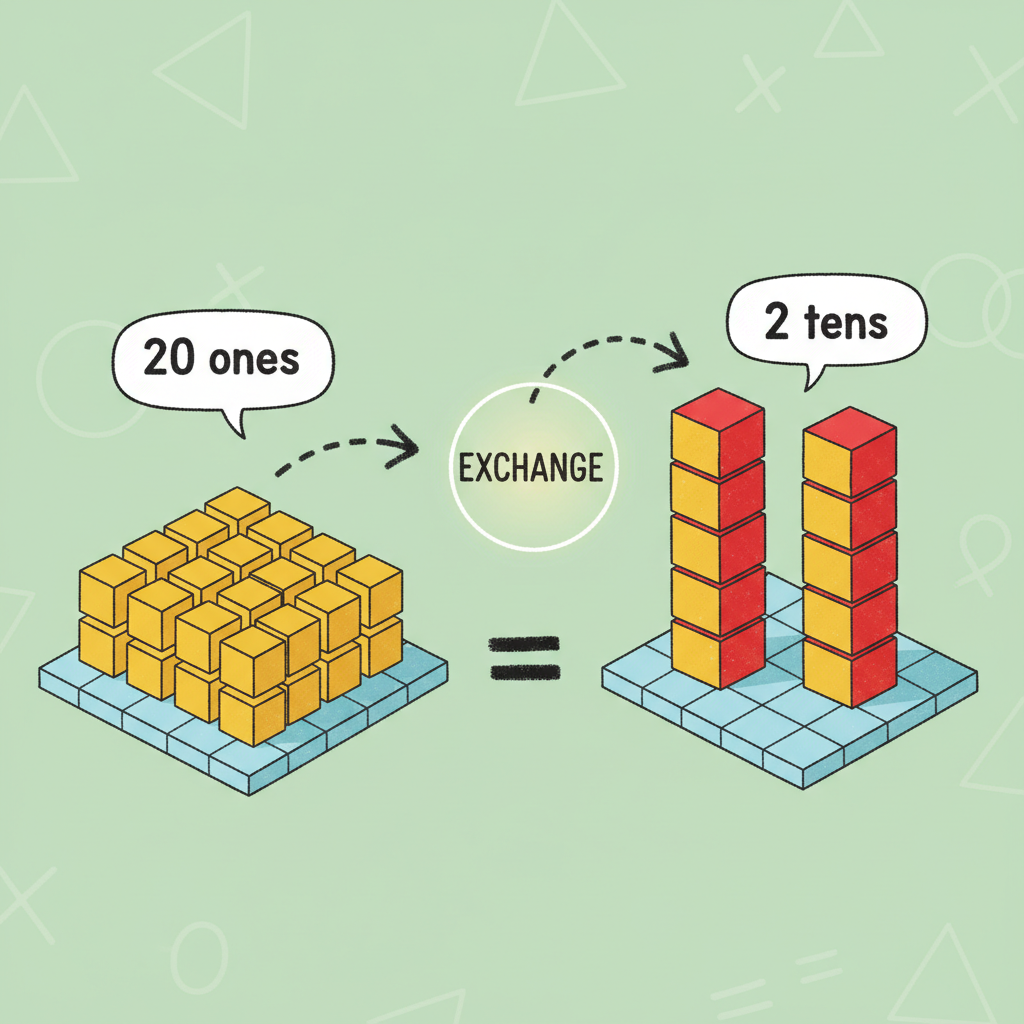
Now, let's continue:
- Multiply the tens: We have 1 ten, and we're multiplying by 4. That's 1 ten × 4 = 4 tens. But wait! We also have the 2 tens we carried over from the ones place. So, we add those together: 4 tens + 2 tens = 6 tens.
Combine our answers: 6 tens and 0 ones make the number 60!
So, 15 × 4 = 60.
Let's Try Another Regrouping Example: 37 × 3
We want to find out what 37 × 3 is.
Break down 37:
- 37 has 3 tens
- 37 has 7 ones
Multiply each part by 3:
- Multiply the ones: We have 7 ones, and we're multiplying by 3. So, 7 × 3 = 21 ones.
21 ones is the same as 2 tens and 1 one. We write down the 1 in the ones place and carry over the 2 tens to the tens place.
- Multiply the tens: We have 3 tens, and we're multiplying by 3. That's 3 tens × 3 = 9 tens. Now, add the 2 tens we carried over: 9 tens + 2 tens = 11 tens.
Remember, 11 tens is the same as 1 hundred and 1 ten. So, our answer is 1 hundred, 1 ten, and 1 one, which is 111.
So, 37 × 3 = 111.
Why Does This Work? The Power of Distributive Property!
This method works because of a cool math idea called the Distributive Property. It simply means that multiplying a number by a sum is the same as multiplying each part of the sum separately and then adding those products.
For example, 12 × 3 can be seen as (10 + 2) × 3. The Distributive Property says:
(10 + 2) × 3 = (10 × 3) + (2 × 3)
= 30 + 6
= 36
When we regroup, we are just trading groups of ten for tens, or hundreds for hundreds, to keep our numbers tidy in their place value spots!
Quick Recap!
- Multiplication is a fast way to add repeated numbers.
- To multiply a 2-digit number by a 1-digit number, multiply the ones place and the tens place separately by the 1-digit number.
- If multiplying the ones gives you 10 or more, regroup the tens! Write down the ones digit and carry over the tens digit to the tens place.
- Always add any carried-over tens to the result of multiplying the tens place.
You are all becoming multiplication superstars! Keep practicing, and you'll master this in no time!
Keep learning, free
Create a free Syllabax account to unlock practice questions and games for this topic.
Visual Learning Enhanced! 🚀
To help you master this topic, we use Advanced Syllabax AI to generate detailed diagrams and visual models.
Note on Visuals: The AI sometimes makes spelling errors in image labels. Please refer to the lesson text for the correct terminology.