Periscope & kaleidoscope[PHYSICS]
Watch this topic in 60 seconds
Free preview · Lesson 1
Understanding Periscope & kaleidoscope[PHYSICS]
Periscopes and Kaleidoscopes: Mirrors and Light!
Have you ever wondered how a submarine can see what's happening above the water without sticking its head out? Or how a toy kaleidoscope can create endless, beautiful patterns from just a few colorful bits? The magic behind both of these is something called reflection, and it's all about how light bounces off surfaces, especially mirrors!
What is Reflection?
Imagine you're playing catch with a ball. When the ball hits a wall, it bounces back, right? Reflection is just like that, but with light! When light hits a smooth surface, like a mirror, it bounces off. The angle at which the light hits the mirror (the angle of incidence) is the same as the angle at which it bounces off (the angle of reflection). Think of it like this: if you throw a ball at a wall at a 30-degree angle, it will bounce back at a 30-degree angle.
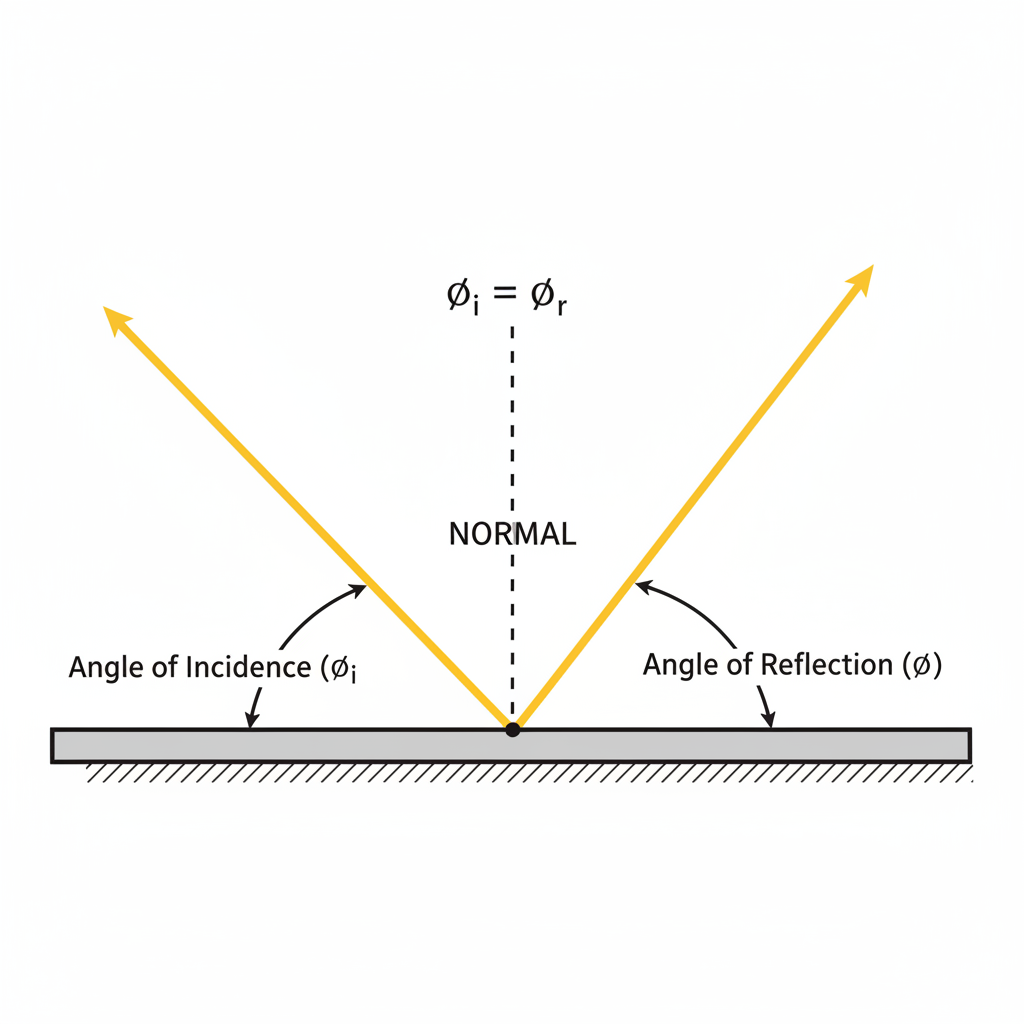
This principle is super important for understanding how periscopes and kaleidoscopes work.
The Periscope: Seeing Around Corners
A periscope is like a spyglass that lets you see things that are normally hidden from view. Submarines use them to see the surface, and soldiers might use them to peek over walls or out of trenches. How does it work?
A simple periscope has two main parts:
- Two Mirrors: These are usually placed at a 45-degree angle inside a long tube.
- A Tube: This holds the mirrors in place and directs your view.
Let's break down the journey of light:
- Light from the Object: Light reflects off the object you want to see (like a ship on the water).
- First Mirror: This light travels down the periscope tube and hits the top mirror. This mirror is tilted at 45 degrees. Because of the angle, it bounces the light straight down the tube. It's like a ramp for the light!
- Second Mirror: The light then travels down and hits the bottom mirror, which is also tilted at 45 degrees. This mirror bounces the light straight out towards your eyes.
- You See the Object: Your eyes receive the light, and it looks like you are seeing the object directly, even though it's far away and possibly hidden!
Think of it like this: you want to pass a message to someone around a corner. You can't go around the corner yourself, but you could have a friend standing around the corner who can then pass the message to you. The mirrors in the periscope act like your friends, redirecting the 'message' of light so you can see what's happening where you can't directly look.
Analogy Time!
The Playground Slide: Imagine a playground slide. The top of the slide is like the object you want to see. The slide itself is like the tube of the periscope. The bottom of the slide where you land is like your eye. But how do you get from the top to the bottom? The mirrors are like two special slides placed one after another, each at a 45-degree angle, to guide the light from the top all the way down to your eyes.
The Secret Passage: A periscope is like a secret passage for light. Light can't go straight to your eyes if there's an obstacle (like the deck of a submarine or a wall), so the mirrors act as clever turns in the passage, guiding the light safely to where you can see it.
The Kaleidoscope: A World of Patterns
Now, let's talk about the kaleidoscope! This is a toy that creates amazing, symmetrical patterns using mirrors and small colorful objects.
A typical kaleidoscope has:
- A Tube: Similar to a periscope, it's a long cylinder.
- Mirrors: Usually, there are three long, thin mirrors placed inside the tube, forming a triangle.
- Colored Objects: At one end of the tube, there's a compartment with small, colorful pieces of glass, beads, or plastic.
- An Eyepiece: This is where you look.
Here's the magic:
- Light Enters: Light shines through the transparent end of the tube, illuminating the colorful objects.
- Multiple Reflections: The light from the colorful objects bounces off the three mirrors inside. Because the mirrors are angled towards each other, the light reflects back and forth, creating many images of the original objects.
- Symmetrical Patterns: The way the mirrors are arranged makes these multiple images form beautiful, repeating, symmetrical patterns. When you rotate the tube, the colorful objects shift, and the mirrors create a completely new pattern.
Think of it like looking into a funhouse mirror, but with a specific arrangement that creates order out of chaos. Instead of one distorted reflection, you get many perfect, repeating reflections.
Analogy Time!
The Infinite Hall of Mirrors: Imagine standing in a room with mirrors on all sides. When you look, you see yourself reflected over and over again, creating an illusion of infinite space and infinite copies of yourself. A kaleidoscope does something similar, but instead of your reflection, it's the reflections of the colorful bits that create the patterns.
The Art Studio: Think of the colorful objects as tiny paint chips. The mirrors in the kaleidoscope are like a special artist's tool that takes those few chips and arranges them into a stunning mosaic or stained-glass window, repeating the colors and shapes in a perfectly balanced way.
Key Concepts Recap
- Reflection: Light bouncing off a surface.
- Angle of Incidence = Angle of Reflection: The angle light hits a mirror is the same as the angle it bounces off.
- Periscope: Uses two mirrors at 45-degree angles to redirect light, allowing you to see around obstacles.
- Kaleidoscope: Uses multiple mirrors (often three) arranged to create multiple, symmetrical reflections of colorful objects.
Keep learning, free
Create a free Syllabax account to unlock practice questions and games for this topic.
Visual Learning Enhanced! 🚀
To help you master this topic, we use Advanced Syllabax AI to generate detailed diagrams and visual models.
Note on Visuals: The AI sometimes makes spelling errors in image labels. Please refer to the lesson text for the correct terminology.