Learning Journey
Free preview · Lesson 1
Understanding Tyndall effect[PHYSICS]
The Tyndall Effect: Unveiling Hidden Paths of Light
Have you ever walked into a dusty room and seen beams of sunlight slicing through the air, making the dust particles sparkle? Or perhaps you've shined a flashlight into a misty morning fog and watched the beam become clearly visible? What you've witnessed in both scenarios is a fascinating phenomenon in physics called the Tyndall effect. It's all about how light interacts with tiny particles suspended in a medium, making the path of light visible.
What is the Tyndall Effect? The Core Idea
At its heart, the Tyndall effect is the scattering of light by particles in a colloid or a fine suspension. Don't worry, we'll break down those fancy words! Imagine light as tiny waves, much like ripples on a pond. When these light waves hit tiny particles that are just the right size, the light doesn't just pass straight through; it gets deflected and scattered in all directions. This scattering is what allows our eyes to 'see' the light beam's path.
Analogy 1: The Invisible Highway
Think of it this way: Imagine a super-fast highway for cars (light waves) that's usually invisible. Now, imagine tiny, reflective balloons (particles) floating all over the highway. When the cars hit these balloons, the balloons bounce around and reflect the light from the cars. If there are enough balloons, you can suddenly see the shape of the highway because of all the light bouncing off them. The Tyndall effect is similar – the particles act like those balloons, scattering the light and revealing its path.
The Key Players: Light, Particles, and Medium
For the Tyndall effect to occur, three main things are needed:
- Light Source: You need light, typically a concentrated beam like from a flashlight, laser pointer, or the sun.
- Particles: These are crucial! The particles must be small enough to stay suspended in a substance but large enough to scatter light. This is where the terms 'colloid' and 'suspension' come in.
- Medium: This is the substance (liquid or gas) in which the particles are dispersed. Examples include air, water, or even jelly.
Let's talk about those particles. In chemistry, we often classify mixtures based on particle size:
- True Solutions: Here, the particles (like salt dissolved in water) are so tiny that they practically become one with the solvent. You can't see them, and they don't scatter light. Think of clear sugar water – the light just passes through.
- Suspensions: These have larger particles that will eventually settle out if left undisturbed (like sand in water). They might block light, but the Tyndall effect isn't ideal here because the particles are too big and the mixture isn't stable.
- Colloids: Ah, the sweet spot for the Tyndall effect! Colloids (like milk, fog, smoke, or gelatin) have particles that are larger than those in true solutions but smaller than those in suspensions. They are just the right size (typically between 1 nanometer and 1000 nanometers) to scatter visible light effectively and remain suspended without settling.
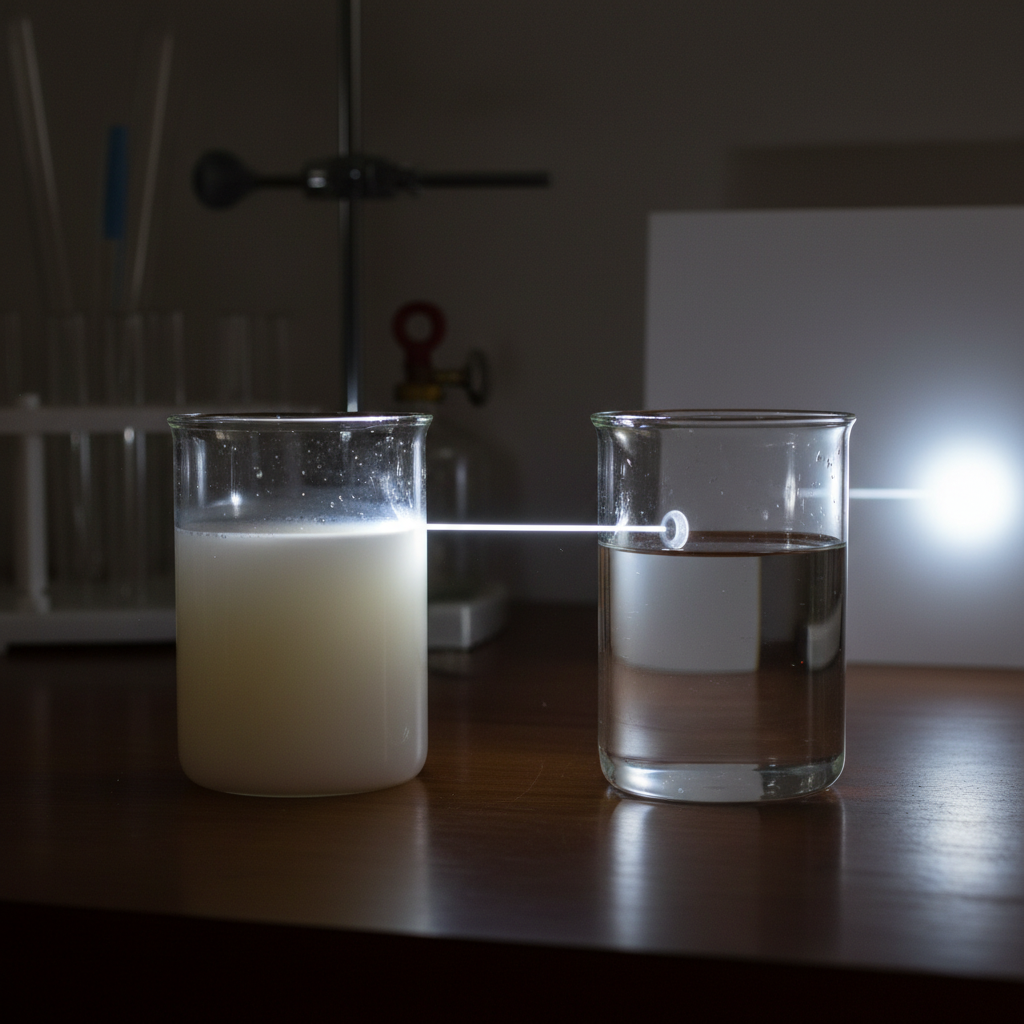
This image demonstrates how a light beam becomes visible when passing through a colloidal solution due to the scattering of light by the suspended particles, a classic example of the Tyndall effect.
 ⚠️ This picture may have spelling mistakes. Trust the words in the lesson.
How Does the Scattering Work?
When a beam of light passes through a true solution (like clear water), the light waves hardly interact with the super-tiny dissolved particles. It's like trying to hit a tiny pebble with an invisible rubber band – most of the time, you miss! So, the light passes straight through, and you can't see its path.
However, when the light hits particles in a colloid, which are larger, the light waves 'bump' into them. These particles then re-emit the light in different directions. This re-emission or scattering is what makes the light beam visible from the side.
Analogy 2: A Football in a Crowd
Imagine a football (your light beam) being thrown through a completely empty hallway (true solution). It goes straight and is hard to track. Now, imagine the same football being thrown through a hallway filled with people (colloidal particles). Each person it hits will slightly deflect it, and critically, each person will 'see' the football because it interacted with them. If you stand to the side, you'd see the football's path much more clearly because it's constantly interacting with the people.
Examples of the Tyndall Effect in Everyday Life
- Sunbeams in a Dusty Room: As mentioned, dust particles in the air are colloids. When sunlight enters, these particles scatter the light, making the beams visible.
- Car Headlights in Fog or Mist: Fog and mist are essentially tiny water droplets suspended in the air – a colloid! When car headlights shine through, the light gets scattered, making the fog appear bright and reducing visibility. This is why you see the 'cone' of light from your headlights.
- Milk: Milk is a colloid (fat globules and protein particles suspended in water). That's why milk looks opaque and white. If you shine a laser pointer through diluted milk, you'll clearly see the laser's path. In pure water, you wouldn't.
- Smoke: Smoke consists of tiny solid particles (like soot) suspended in gases. It effectively scatters light, which is why smoke plumes are visible and why smoke detectors work by sensing scattered light.
- Blue Sky: This is a slightly more complex example, but the Tyndall effect (or more accurately, Rayleigh scattering, which is a specific type of scattering similar to Tyndall) plays a role. Tiny gas molecules and fine dust particles in Earth's atmosphere scatter shorter wavelengths (blue light) more effectively than longer wavelengths (red light), making the sky appear blue.
- Projector Light: When you're watching a movie in a dark room and the projector beam slices through the air, you can often see its path because of dust particles in the room.
Analogy 3: Spotlight on Stage
Think about a concert or a play. When a powerful spotlight shines on the stage, you often see the 'beam' of light cutting through the air, especially if there's a bit of haze or smoke. The haze particles or smoke particles scatter the light, making the path of the spotlight visible to the audience, creating those dramatic effects.
Distinguishing from Other Light Phenomena
It's important not to confuse the Tyndall effect with other ways light interacts with matter:
- Reflection: This is when light bounces off a surface, like a mirror. The Tyndall effect involves scattering *within* a medium, not just off its surface.
- Refraction: This is the bending of light as it passes from one medium to another (e.g., light bending when entering water, making a straw look broken). The Tyndall effect is about light *revealing its path* due to particles, not bending between different clear substances.
- Absorption: This is when light energy is taken in by a substance and converted to other forms (like heat). While some light might be absorbed by the particles, the defining feature of the Tyndall effect is the *scattering* of light.
Conclusion
The Tyndall effect is a common yet profound phenomenon that helps us understand the nature of light and how it interacts with the world around us. From the dust motes dancing in a sunbeam to the reason our skies are blue, this simple scattering of light by tiny particles reveals the invisible paths light takes, making our world a little more illuminated and a lot more fascinating!
Keep learning, free
Create a free Syllabax account to unlock practice questions and games for this topic.
Visual Learning Enhanced! 🚀
To help you master this topic, we use Advanced Syllabax AI to generate detailed diagrams and visual models.
Note on Visuals: The AI sometimes makes spelling errors in image labels. Please refer to the lesson text for the correct terminology.