Fruit & seed formation[BIOLOGY]
Watch this topic in 60 seconds
Free preview · Lesson 1
Understanding Fruit & seed formation[BIOLOGY]
Fruit and Seed Formation: The Amazing Journey from Flower to Food!
Have you ever wondered how juicy apples, crunchy carrots, or tiny sesame seeds come to be? It all starts with a flower! In the world of biology, the journey from a flower to the fruits and seeds we eat is a fascinating process called reproduction. It's how plants make more plants, just like how animals have babies.
The Flower: A Plant's Romantic Picnic
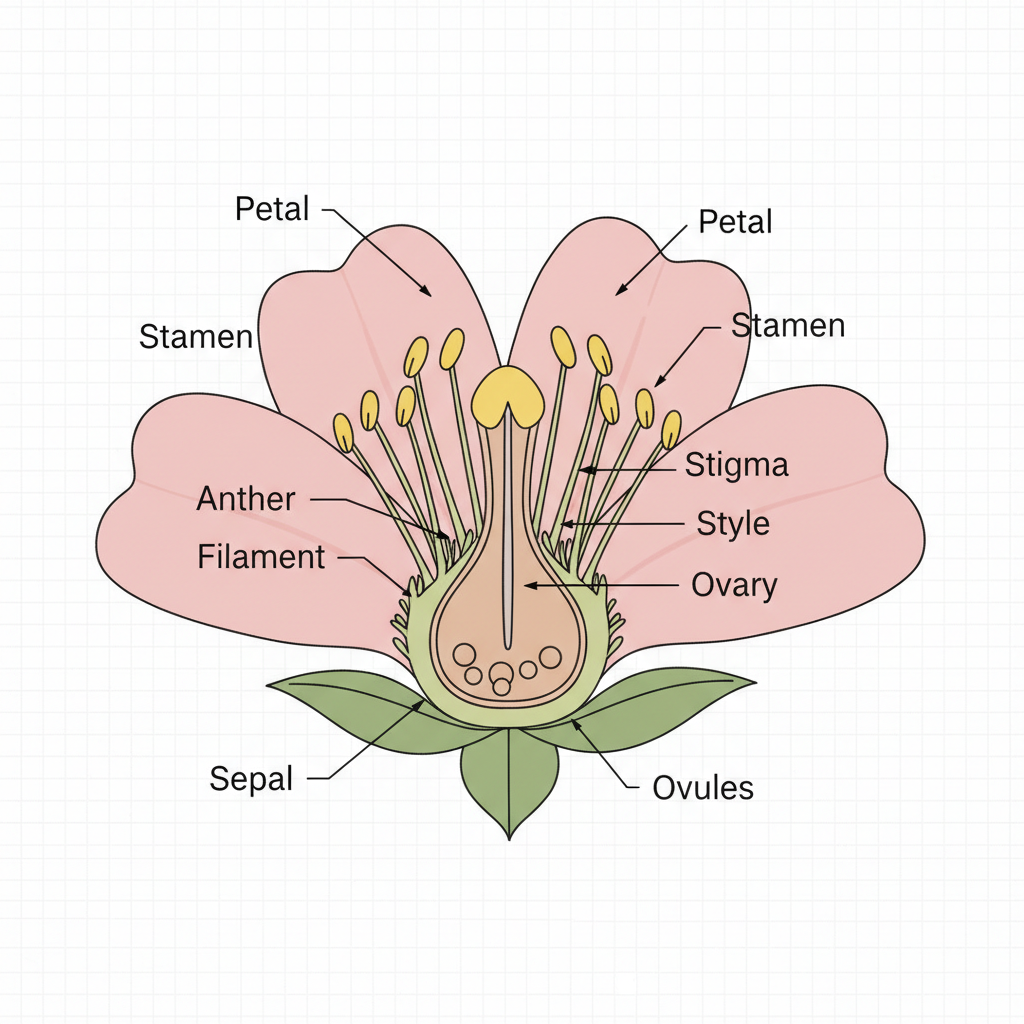
Think of a flower as a plant's way of inviting a special guest over for a picnic. Its main job is to create seeds so that new plants can grow. To do this, flowers have different parts, each with a special role:
- Petals: These are the colorful, often fragrant parts of the flower. Imagine them as the 'welcome mat' or the 'invitation' to attract visitors like bees and butterflies. They are pretty to look at and smell nice to draw in the helpers!
- Sepals: These are usually green, leaf-like structures that protect the flower bud before it opens. Think of them as the 'security guards' or 'protective covers' for the delicate flower before it's ready to be seen.
- Stamen: This is the male part of the flower. It has two main parts:
- Anther: This is like a tiny 'dustbin' that holds pollen. Pollen grains are very important; they contain the male cells needed to make a seed.
- Filament: This is a thin stalk that holds up the anther. It's like the 'handle' of the dustbin, making sure the pollen is in the right place.
- Pistil (or Carpel): This is the female part of the flower. It's usually in the center and has three main parts:
- Stigma: This is the sticky or feathery tip of the pistil. Imagine it as a 'sticky trap' or 'landing pad' for pollen. It needs to catch the pollen!
- Style: This is a tube that connects the stigma to the ovary. Think of it as a 'tunnel' or 'pathway' for the male cells from the pollen to travel down.
- Ovary: This is the swollen base of the pistil. Inside the ovary are small structures called ovules. The ovary is like a 'nursery' where the seeds will develop, and the ovules are like the 'eggs' waiting to be fertilized.
Pollination: The Love Story Begins!
For a seed to form, the male part (pollen) needs to meet the female part (ovule). This transfer of pollen from the stamen to the stigma is called pollination. It's like sending a love letter from one part of the flower to another, or even from one flower to another!
How does pollen travel? Nature has clever ways:
- Wind: Some plants, like grasses and corn, rely on the wind to carry their pollen. Imagine tiny pollen 'parachutes' floating on the breeze.
- Animals (Pollinators): Bees, butterflies, birds, and even bats are like 'delivery services' for pollen. When they visit a flower to drink nectar (a sweet liquid), pollen sticks to their bodies. Then, when they visit another flower, some of that pollen rubs off onto the stigma. It's a win-win: the flower gets pollinated, and the animal gets a tasty snack!
- Water: Some aquatic plants use water currents to move pollen.
- Self-Pollination: Sometimes, pollen from a flower can land on the stigma of the *same* flower or another flower on the *same* plant.
- Cross-Pollination: Pollen from one plant lands on the stigma of a flower on a *different* plant of the same species. This often leads to more diverse and stronger offspring.
Fertilization: The Spark of New Life!
Once the pollen lands on the sticky stigma, a magical event happens. The pollen grain 'germinates' (starts to grow) and sends a tiny tube, called a pollen tube, down through the style towards the ovary. Think of this pollen tube as the 'delivery truck' carrying the male cell.
When this pollen tube reaches an ovule inside the ovary, the male cell from the pollen joins with the female cell inside the ovule. This joining is called fertilization. It's like a tiny 'spark' that ignites the process of creating a new life – the seed!
Seed Formation: Building the Next Generation
After fertilization, the ovule begins to transform. It develops into a seed. The seed is like a 'baby plant' in a protective coat, along with a 'lunchbox' of food to help it grow when it's ready.
- The ovule becomes the seed.
- The outer coat of the ovule becomes the seed coat, which protects the baby plant.
- The part that will grow into the new plant is called the embryo.
- The 'lunchbox' of food is called the endosperm, which provides energy for the embryo when the seed germinates.
Fruit Formation: The Seed's Protective Home
What about the fruit? The fruit develops from the ovary of the flower. As the ovules inside the ovary turn into seeds, the ovary itself swells and ripens, changing into the fleshy, sometimes sweet, part we call a fruit.
Think of the fruit as the 'delivery package' or the 'protective casing' for the seeds. Its main jobs are:
- Protection: The fruit protects the delicate seeds inside from damage, drying out, or being eaten by the wrong creatures.
- Dispersal: Many fruits are tasty and attractive (like berries or apples). Animals eat the fruit, and then they move away and deposit the seeds (often unharmed!) in their droppings. This helps spread the seeds to new places where they can grow into new plants, far from the parent plant. This is called seed dispersal. Other fruits might have wings or float on water to travel.
Examples: Fruits and Their Seeds
Let's look at some common examples:
- Apple: The fleshy part we eat is the fruit (developed from the ovary). The seeds are inside the core.
- Tomato: The juicy part is the fruit, and the tiny seeds are inside.
- Pea Pod: The pod itself is the fruit, and the peas inside are the seeds.
- Sunflower: What we call a sunflower 'seed' is actually the fruit, and inside it is the true seed.
- Corn: Each kernel of corn is a fruit, with the seed inside.
Why is this Important?
This incredible process of fruit and seed formation is essential for life on Earth. It ensures that plants can reproduce, providing us with food, oxygen, and beautiful scenery. It's a constant cycle of life, growth, and continuation, all thanks to the humble flower!
Keep learning, free
Create a free Syllabax account to unlock practice questions and games for this topic.
Visual Learning Enhanced! 🚀
To help you master this topic, we use Advanced Syllabax AI to generate detailed diagrams and visual models.
Note on Visuals: The AI sometimes makes spelling errors in image labels. Please refer to the lesson text for the correct terminology.