Learning Journey
Watch this topic in 60 seconds
Free preview · Lesson 1
Understanding Basic long division (Division)
Mastering Long Division: Sharing Fairly and Finding Out How Many!
Welcome, amazing mathematicians! Today, we're going on an adventure into the world of long division. Don't let the name scare you – it's just a fancy way of saying we're going to learn how to share things into equal groups, especially when we have a lot of things to share or when we need to figure out how many times one number fits into another!
What is Division, Anyway?
Imagine you have a big bag of 12 yummy cookies, and you want to share them equally with your 3 best friends. How many cookies does each person get? Division is like being a super-fair cookie sharer! It helps us answer questions like:
- How many groups can we make?
- How many are in each group?
- How many are left over if we can't share them perfectly?
Division has some special characters and words we use:
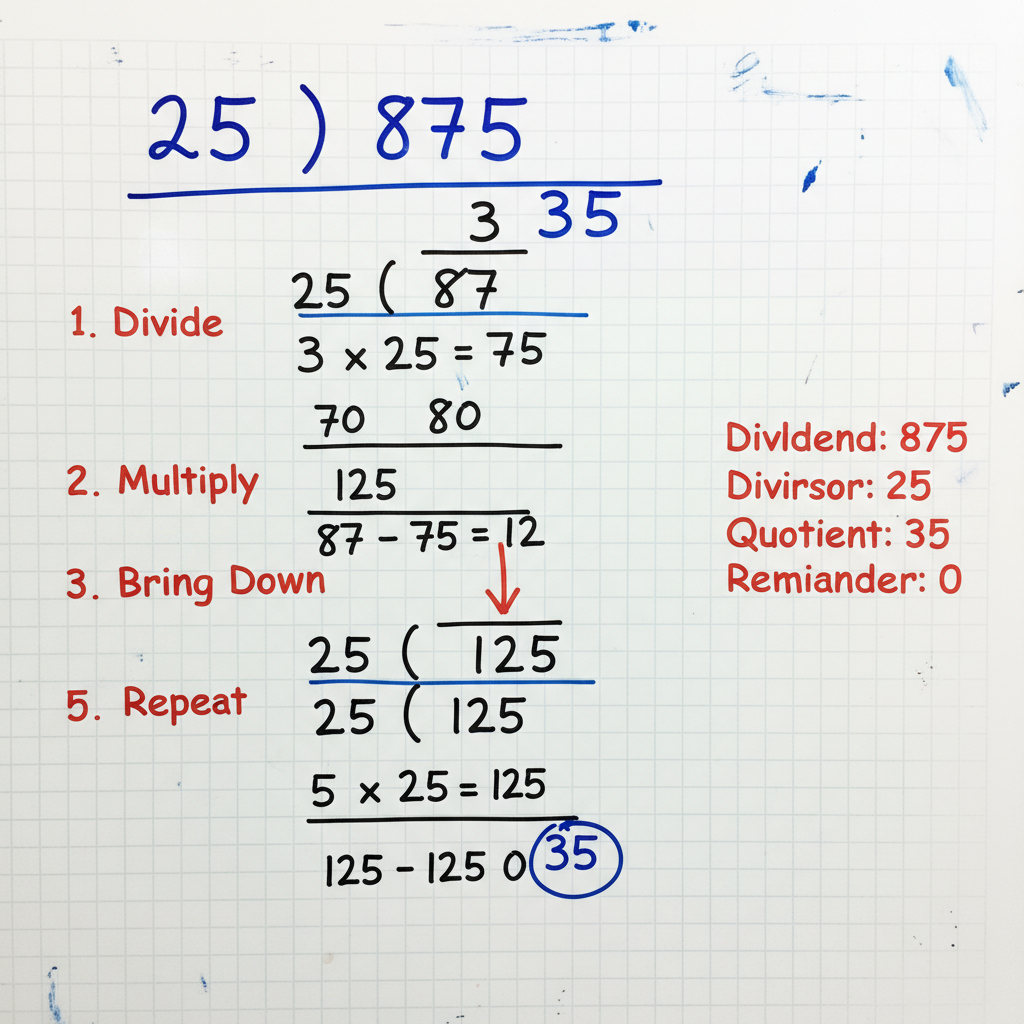
- Dividend: This is the total number of things we are sharing or dividing. In our cookie example, the dividend is 12 cookies.
- Divisor: This is the number of equal groups we want to make, or the size of each group. In our cookie example, if we are sharing with 3 friends (plus ourselves, making 4 people total to share amongst), the divisor would be 4. If we were sharing the cookies into groups of 4, the divisor would be 4.
- Quotient: This is the answer to our division problem – it's how many are in each group or how many groups we made.
- Remainder: Sometimes, when we divide, there are a few things left over that can't be shared equally. This is the remainder.
We write a division problem like this: Dividend ÷ Divisor = Quotient (with a Remainder if any)
So, for our cookies: 12 cookies ÷ 4 people = 3 cookies per person!
Why Do We Need Long Division?
You might be thinking, "I can share 12 cookies easily!" And you're right! For small numbers, we can often figure out division by just thinking about multiplication or drawing pictures. But what if you had 144 pencils to share equally among 12 classmates? Or what if you had 357 stickers to put into sticker books, with **7** stickers on each page? That's where long division comes in handy! It's a step-by-step method that helps us divide even very large numbers accurately.
Think of long division like being a detective. You're trying to solve a mystery about how numbers fit together. Each step of long division is a clue that helps you find the final answer.
The Steps of Long Division: A Detective's Guide
Let's solve a problem together using long division. We'll figure out how to divide 45 ÷ 3. We can write this in a special house-like symbol:
    _____
3 | 45
Our goal is to figure out how many times 3 fits into 45.
Step 1: Divide (The First Clue!)
Look at the first digit of the dividend (the number inside the house), which is 4. Ask yourself: "How many times does the divisor (3) fit into 4 without going over?"
Well, 3 x 1 = 3. And 3 x 2 = 6, which is too big. So, 3 fits into 4 just **1** time. Write this '1' above the '4' in the house.
    1____
3 | 45
Step 2: Multiply (Check Your Work!)
Now, take the number you just wrote on top (1) and multiply it by the divisor (3). Write the answer (3) directly below the 4.
    1____
3 | 45
    3
Step 3: Subtract (Find the Difference!)
Subtract the number you just wrote (3) from the digit above it (4). Write the answer (1) below the line.
    1____
3 | 45
    3
    --
    1
Step 4: Bring Down (Get More Information!)
Now, look at the next digit in the dividend (the 5). "Bring it down" next to the result of your subtraction (1). You now have the number 15.
    1____
3 | 45
    3
    --
    15
Step 5: Repeat the Cycle! (Keep Going Like a Detective!)
Now we repeat the whole process with the new number we have (15). Ask yourself:
- Divide: How many times does the divisor (3) fit into 15 without going over?
Let's think: 3 x 1 = 3, 3 x 2 = 6, 3 x 3 = 9, 3 x 4 = 12, 3 x 5 = 15. Aha! It fits exactly **5** times. Write this '5' above the '5' in the dividend (next to the '1' we already wrote).
    15___
3 | 45
    3
    --
    15
- Multiply: Multiply the new number on top (5) by the divisor (3). 5 x 3 = 15. Write 15 below the other 15.
    15___
3 | 45
    3
    --
    15
    15
- Subtract: Subtract 15 from 15. 15 - 15 = 0. Write 0 below the line.
    15___
3 | 45
    3
    --
    15
    15
    --
     0
Since we have a 0 and there are no more digits to bring down, we are finished! The answer (the quotient) is the number on top: **15**. So, 45 ÷ 3 = 15.
This means if you have 45 stickers and want to put 3 stickers on each page, you'll fill up 15 pages!
 ⚠️ This picture may have spelling mistakes. Trust the words in the lesson.
What About Remainders?
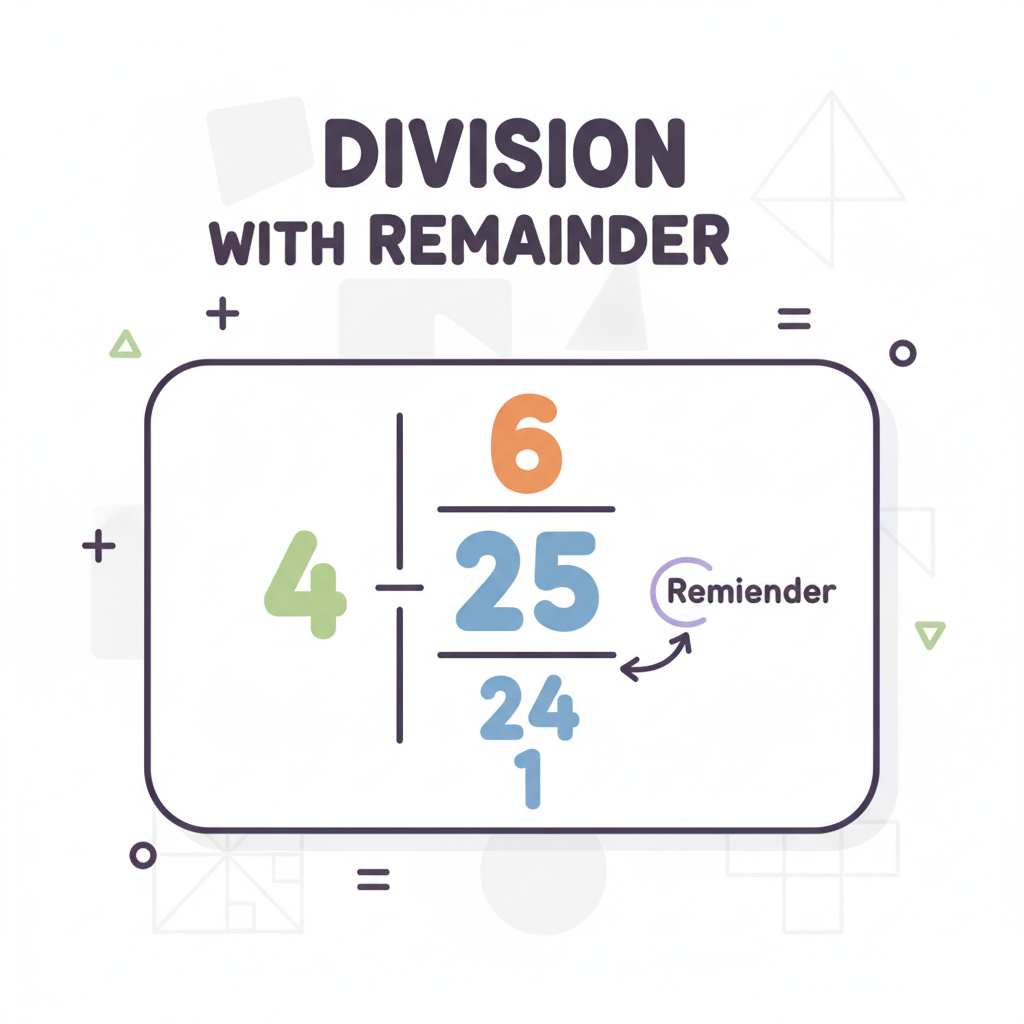
Sometimes, numbers don't divide perfectly. Let's try 17 ÷ 4.
    ____
4 | 17
Follow the steps:
- Divide: How many times does 4 fit into 1 without going over? Zero. So we look at the first two digits: How many times does 4 fit into 17 without going over?
- 4 x 1 = 4, 4 x 2 = 8, 4 x 3 = 12, 4 x 4 = 16, 4 x 5 = 20 (too big!). So, 4 fits **4** times. Write 4 above the 7.
    4___
4 | 17
- Multiply: 4 x 4 = 16. Write 16 below 17.
    4___
4 | 17
    16
- Subtract: 17 - 16 = 1. Write 1 below the line.
    4___
4 | 17
    16
    --
     1
- Bring Down: Are there any more digits to bring down? No.
We are done! We have a number left over (1) after subtracting, and no more digits to bring down. This leftover number is our remainder. We write it like this: 4 R 1.
So, 17 ÷ 4 = 4 with a remainder of 1. This means if you have 17 apples and want to make bags of 4 apples each, you can make 4 full bags, and you'll have 1 apple left over.
 ⚠️ This picture may have spelling mistakes. Trust the words in the lesson.
Recap: The Long Division Dance!
Remember the steps like a little dance:
- Divide
- Multiply
- Subtract
- Bring Down
- Repeat!
You've got this! Keep practicing, and soon you'll be a long division superstar!
Keep learning, free
Create a free Syllabax account to unlock practice questions and games for this topic.
Visual Learning Enhanced! 🚀
To help you master this topic, we use Advanced Syllabax AI to generate detailed diagrams and visual models.
Note on Visuals: The AI sometimes makes spelling errors in image labels. Please refer to the lesson text for the correct terminology.