Particle nature of matter[CHEMISTRY]
Watch this topic in 60 seconds
Free preview · Lesson 1
Understanding Particle nature of matter[CHEMISTRY]
Understanding the World: The Particle Nature of Matter (Grade 9 Chemistry)
Have you ever wondered what everything around you is made of? The air you breathe, the water you drink, the desk you sit at, even you yourself! For centuries, thinkers have pondered this question. Today, in chemistry, we have a clear and powerful answer: everything is made of tiny, invisible particles. This fundamental idea is called the Particle Nature of Matter.
Imagine you have a big pile of sand. From a distance, it looks like a continuous, smooth mass. But if you zoom in really close, what do you see? Tiny, individual grains of sand, right? Matter is a bit like that sand. What appears to be solid, liquid, or gas is actually made up of countless unimaginably small 'grains' or particles.
Let's dive deeper into this fascinating concept and explore the key characteristics of these particles.
1. What Exactly is Matter?
Before we talk about particles, let's quickly define matter. In chemistry, matter is anything that has mass and occupies space. So, your textbook, a cloud, the air in a balloon – they are all matter. Light and sound, however, are forms of energy, not matter, because they don't have mass or take up space in the same way.
2. The Core Idea: Particles are Everywhere!
The particle nature of matter states that all matter is composed of extremely small, discrete (separate) particles. These particles could be atoms, molecules, or ions, but for now, let's just think of them as tiny building blocks. Think of them like LEGO bricks – you can build almost anything with them, but each brick is a separate unit.
Consider a drop of water. It looks like a continuous, whole thing. But that tiny drop contains billions upon billions of individual water molecules, each made of even smaller atoms! It's mind-boggling how small these particles are.
3. Key Characteristics of Particles of Matter
These tiny particles aren't just sitting still; they have some very important characteristics that explain almost everything we observe about matter. Let's explore them:
Characteristic A: Particles of Matter are Very, Very Small
How small? Imagine taking a single grain of sugar. Now, imagine dividing that grain into a million pieces. Then divide one of those pieces into a million more! You'd still probably not be at the size of an atom or molecule. They are so small that we cannot see them even with the most powerful optical microscopes. We need special instruments like electron microscopes to get a hint of their presence.
Analogy: Think about the stars in the night sky. From Earth, they look like tiny pinpricks of light. But we know they are enormous suns, incredibly far away. Our particles of matter are even tinier and closer, but still invisible to our naked eye.
Characteristic B: Particles of Matter Have Space Between Them (Interparticle Space)
This is a crucial characteristic! Even in what appears to be a solid object, there is space between its particles. These spaces are called interparticle spaces.
Analogy 1: Imagine a classroom full of students. If everyone is standing shoulder-to-shoulder, there's not much space. But if everyone sits at their desk, there's more space between them. Even when they are packed, there are still tiny gaps. In matter, these spaces are always present, though their size varies greatly depending on the state of matter.
Analogy 2: Think about dissolving sugar in water. When you stir sugar into water, the sugar 'disappears,' and the water level doesn't usually overflow (unless you add a lot!). This is because the tiny sugar particles move into the spaces between the water particles. It's like pouring small pebbles into a jar of sand – the pebbles fit into the gaps between the sand grains.
Characteristic C: Particles of Matter are Continuously Moving (Kinetic Energy)
The particles that make up matter are never truly still. They are always in constant, random motion. This motion is due to their kinetic energy (energy of motion). The hotter a substance is, the faster its particles move and the more kinetic energy they have.
Analogy 1: Imagine a group of restless children in a play area. They aren't standing still; they're running, jumping, and bumping into each other. Particles are similar, constantly moving and colliding.
Analogy 2: How do you smell freshly baked cookies from another room? Or the perfume someone sprayed a few minutes ago? The tiny particles of the cookie aroma or the perfume spread out by moving randomly and mixing with the air particles. This spreading phenomenon is called diffusion, and it's direct evidence of particle movement.
Characteristic D: Particles of Matter Attract Each Other (Interparticle Forces)
Particles of matter are not isolated; they exert forces of attraction on each other. These forces are called interparticle forces or intermolecular forces. These forces hold the particles together.
Analogy 1: Think of magnets. Opposite poles attract each other, pulling them together. Particles have similar (though much weaker) attractive forces.
Analogy 2: Imagine a group of friends holding hands. The stronger they hold hands, the harder it is to pull them apart. If they're just loosely touching, it's easy to separate them. Similarly, the strength of the attractive forces between particles determines how tightly they are held together.
The strength of these attractive forces varies from one substance to another and also depends on the state of matter.
4. How Particle Characteristics Explain States of Matter
These four characteristics – size, space, movement, and attraction – are incredibly important because they explain why matter exists in different states: solids, liquids, and gases.
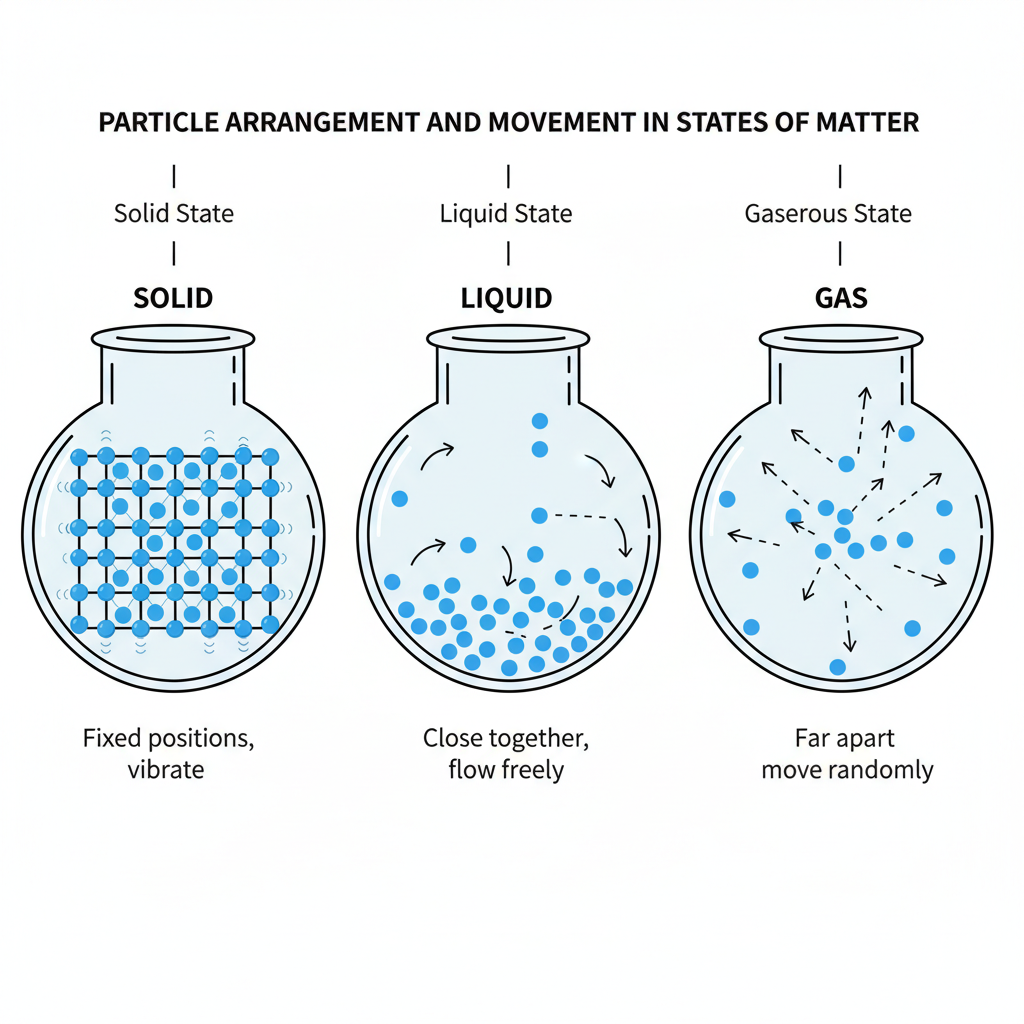 ⚠️ This picture may have spelling mistakes. Trust the words in the lesson.
-
Solids: Packed and Organized
In solids (like an ice cube or a rock), the particles are very tightly packed together in fixed positions. The attractive forces between them are very strong, holding them firmly in place. They can only vibrate about their fixed positions, like people stuck in a very crowded elevator swaying slightly. Because of this, solids have a definite shape and a definite volume.
Analogy: A solid is like a disciplined army parade where soldiers (particles) are standing in perfect formation, close together, and only allowed to wiggle slightly.
-
Liquids: Flowing but Still Close
In liquids (like water or oil), the particles are still quite close to each other, but the attractive forces are weaker than in solids. This allows the particles to slide past one another and move more freely. They don't have a fixed position but are still held within a certain volume. This is why liquids have a definite volume but take the shape of their container.
Analogy: A liquid is like a bustling marketplace. People (particles) are close to each other but can move and weave past one another, taking the shape of the market boundaries.
-
Gases: Free and Far Apart
In gases (like air or steam), the particles are very far apart from each other. The attractive forces between them are extremely weak, almost negligible. This means the particles move very rapidly and randomly in all directions, constantly colliding with each other and the walls of their container. Gases have neither a definite shape nor a definite volume; they expand to fill whatever container they are in.
Analogy: A gas is like a group of hyperactive bees in a large, empty room. They fly around randomly, bouncing off the walls and each other, filling the entire space.
5. Diffusion Revisited: A Dance of Particles
We mentioned diffusion earlier as evidence of particle movement. Let's look at it more closely. Diffusion is the spontaneous mixing of particles of two or more substances due to the random motion of their particles.
When you drop a crystal of potassium permanganate (a purple solid) into water, over time, the purple color spreads throughout the entire water column, even without stirring. This happens because the potassium permanganate particles move from an area where they are highly concentrated (near the crystal) to an area where they are less concentrated (the rest of the water), mixing with the water particles until they are evenly distributed.
This process is faster at higher temperatures because the particles have more kinetic energy and move more rapidly.
Conclusion
The particle nature of matter is a cornerstone of chemistry. Understanding that everything is made of tiny, constantly moving particles with spaces between them and forces of attraction linking them helps us explain a vast array of everyday phenomena, from why sugar dissolves to why steam rises. It's the microscopic explanation for the macroscopic world we observe!
Keep learning, free
Create a free Syllabax account to unlock practice questions and games for this topic.
Visual Learning Enhanced! 🚀
To help you master this topic, we use Advanced Syllabax AI to generate detailed diagrams and visual models.
Note on Visuals: The AI sometimes makes spelling errors in image labels. Please refer to the lesson text for the correct terminology.