Learning Journey
Watch this topic in 60 seconds
Free preview · Lesson 1
Earthquakes, Volcanoes & Tsunamis -World Geography (Foundational)
Earthquakes, Volcanoes & Tsunamis: A Foundational Overview
Introduction
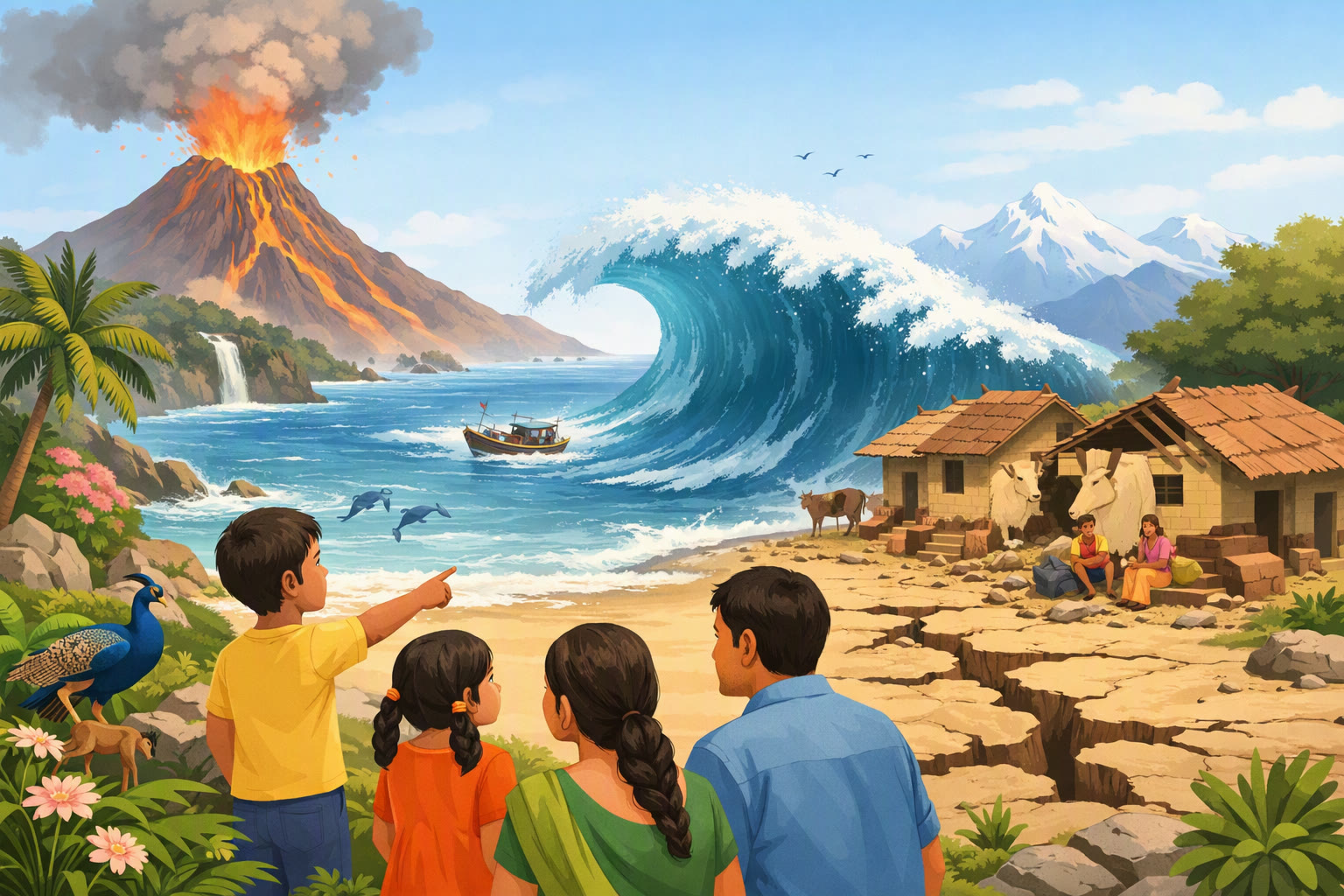
Earthquakes, volcanoes, and tsunamis are powerful natural phenomena that can dramatically reshape the Earth's surface and impact human populations. This lesson provides a foundational understanding of these events, focusing on their causes, effects, and basic geographical distribution.
Earthquakes: Shaking the Earth
An earthquake is a sudden shaking of the ground caused by the movement of Earth's tectonic plates. These plates are constantly moving, albeit very slowly. When these plates grind against each other, pressure builds up. When the pressure exceeds the strength of the rocks, they break, releasing energy in the form of seismic waves, which we experience as an earthquake.
Key Terms
- Focus: The point beneath the Earth's surface where the earthquake originates.
- Epicenter: The point on the Earth's surface directly above the focus.
- Magnitude: A measure of the energy released by an earthquake, often measured using the Richter scale.
Volcanoes: Earth's Fiery Vents
A volcano is a vent in the Earth's crust through which molten rock (magma), ash, and gases erupt. Volcanoes are typically found at plate boundaries where tectonic plates are either colliding (convergent boundaries) or moving apart (divergent boundaries).
Key Terms
- Magma: Molten rock beneath the Earth's surface.
- Lava: Molten rock that erupts onto the Earth's surface.
- Crater: A bowl-shaped depression at the summit of a volcano.
Tsunamis: Giant Ocean Waves
A tsunami is a series of powerful ocean waves caused by large-scale disturbances, most commonly underwater earthquakes. When an earthquake occurs on the ocean floor, it can displace a massive volume of water, generating a tsunami. These waves can travel across entire oceans, reaching tremendous heights as they approach the shoreline.
Key Terms
- Wave Height: The vertical distance between the crest (highest point) and the trough (lowest point) of a wave. Tsunamis often have small wave heights in the open ocean, but they increase dramatically as they approach land.
- Run-up: The height a tsunami reaches above sea level on land.
Geographical Distribution
Earthquakes and volcanoes are not randomly distributed around the world. They are primarily concentrated along plate boundaries. The most well-known example is the Pacific Ring of Fire, a zone encircling the Pacific Ocean characterized by frequent earthquakes and volcanic eruptions. Tsunamis are most common in the Pacific and Indian Oceans due to the high frequency of underwater earthquakes in these regions.
A map showing the approximate location of the Ring of Fire.
Keep learning, free
Create a free Syllabax account to unlock practice questions and games for this topic.
Visual Learning Enhanced! 🚀
To help you master this topic, we use Advanced Syllabax AI to generate detailed diagrams and visual models.
Note on Visuals: The AI sometimes makes spelling errors in image labels. Please refer to the lesson text for the correct terminology.