Reflection of sound & echo[PHYSICS]
Watch this topic in 60 seconds
Free preview · Lesson 1
Understanding Reflection of sound & echo[PHYSICS]
Understanding Reflection of Sound & Echoes
Welcome, young scientists! Today, we're going to explore a fascinating phenomenon that happens all around us: the reflection of sound. Have you ever shouted in a large, empty hall and heard your own voice come back to you? Or perhaps you've noticed how sound seems clearer in a small, cozy room compared to a big, open space? These experiences are all thanks to the reflection of sound, and they help us understand something called an 'echo'.
What is Sound, Anyway?
Before we dive into reflection, let's quickly remember what sound is. Imagine you drop a pebble into a still pond. What happens? Ripples spread out from where the pebble hit, right? Sound is a bit like those ripples, but instead of water, it's a 'wave' of vibrations traveling through air, water, or even solid objects. When you speak, your vocal cords vibrate, pushing and pulling on the air molecules around them. These vibrating molecules then bump into their neighbors, passing the vibration along, much like a domino effect. This 'traveling vibration' is what we perceive as sound.
Think of a Bouncing Ball: An Analogy for Reflection
To understand reflection, let's use a simple analogy. Imagine you're playing catch with a friend, but instead of throwing the ball to your friend, you throw it against a sturdy wall. What happens? The ball bounces off the wall and comes back towards you! This 'bouncing back' is exactly what reflection means. The wall acts as a barrier that the ball cannot pass through, so the ball's path is changed, and it heads back in the opposite direction.
Reflection of Sound: Sound Bounces Back!
Just like our bouncing ball, sound waves can also bounce back when they hit a hard surface. When sound waves traveling through the air encounter an obstacle – like a wall, a mountain, or even a large piece of furniture – they can't simply pass through it. Instead, a part of the sound energy is absorbed by the surface, and the rest 'bounces back' into the space from where it came. This phenomenon of sound waves bouncing off a surface is called the reflection of sound.
Think about walking into an empty house versus a furnished house. In an empty house, sounds often seem to 'ring' or 'reverberate' more. That's because there are many hard, bare surfaces (walls, floors, ceilings) for the sound to reflect off. In a furnished house, carpets, curtains, sofas, and even books on shelves absorb a lot of the sound energy, reducing the reflections and making the room sound 'duller' or 'quieter'.
The surface that reflects the sound is called the reflector. Good reflectors of sound are hard, smooth, and rigid surfaces like concrete walls, large rocks, or metal sheets. Soft, porous, or uneven surfaces like carpets, curtains, or foam are generally poor reflectors because they absorb more sound energy.
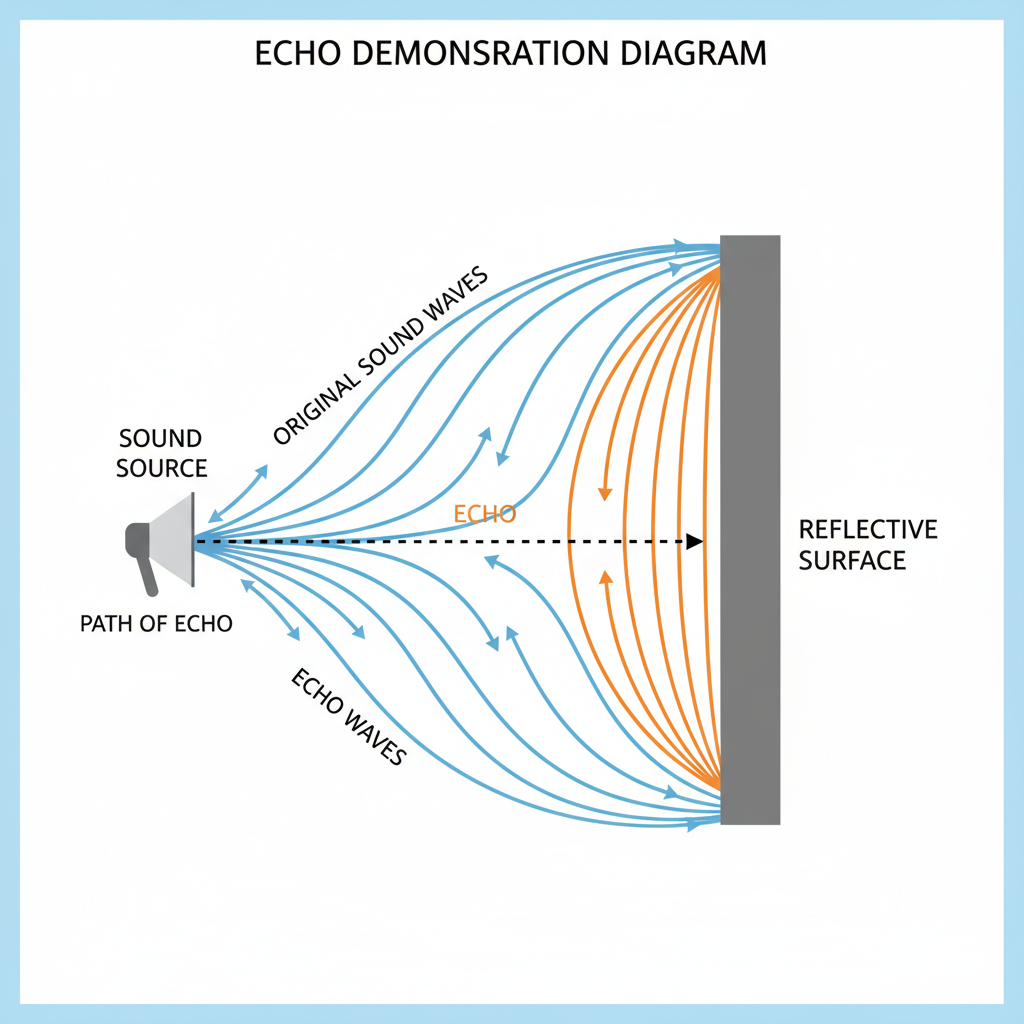
What is an Echo?
An echo is a specific type of reflected sound. It's when you hear the reflected sound distinctly from the original sound. Imagine you shout, and a moment later, you hear your own voice repeat itself. That repetition, that distinct 'copy' of your original sound, is an echo!
So, not all reflected sound is an echo. For you to hear an echo, two main conditions must be met:
- Sufficient Time Gap: Your brain needs a small amount of time to process a sound. If the reflected sound comes back too quickly, your brain can't distinguish it from the original sound; it just sounds like a prolonged or louder original sound. Scientists have found that the minimum time gap required for the human ear to distinguish between two sounds is about 0.1 seconds (one-tenth of a second).
- Sufficient Distance: For there to be a 0.1-second time gap, the sound has to travel a certain distance to the reflector and back. Sound travels at a speed of approximately 343 meters per second in air at room temperature (around 20°C). So, in 0.1 seconds, sound travels 34.3 meters (343 m/s * 0.1 s = 34.3 m). Since the sound has to travel TO the reflector AND BACK to your ear, the total distance covered is twice the distance to the reflector. Therefore, the minimum distance required between the source of sound and the reflecting surface to hear a distinct echo is roughly half of 34.3 meters, which is about 17.15 meters (or approximately 17 meters).
This is why you don't hear echoes in your living room, but you might in a huge, empty gym or in front of a distant mountain! The walls in your living room are too close for the sound to travel there and back in more than 0.1 seconds.
Conditions that Favor Echoes:
- Large and Hard Reflecting Surface: The bigger and harder the surface, the more sound it can reflect clearly.
- Sufficient Distance: As discussed, at least 17 meters is generally needed.
- Absence of Obstacles Between Source and Reflector: Other objects might absorb or scatter the sound before it reaches the main reflector.
- High Intensity of Original Sound: A louder sound has more energy and is more likely to be reflected with enough strength to be heard.
Where Do We Use Reflection of Sound? (Real-World Applications)
The principles of sound reflection and echoes aren't just for fun; they have many important practical applications:
- Megaphones and Horns: Devices like megaphones, trumpets, and car horns are designed to direct sound in a specific direction. Their conical shapes cause the sound waves to undergo multiple reflections inside, focusing them into a narrow beam, making the sound travel farther and louder in that direction.
- Stethoscopes: Doctors use stethoscopes to listen to heartbeats and breathing sounds. The tube of the stethoscope reflects the sound waves multiple times, guiding them from the patient's body to the doctor's ears with minimal loss of intensity.
- Concert Halls and Auditoriums: Architects design concert halls very carefully, using sound-absorbing materials and reflective surfaces strategically. Curved ceilings and walls are often used to reflect sound waves evenly throughout the hall, ensuring that everyone in the audience hears clear and well-distributed sound. This careful reflection is called 'reverberation'.
- SONAR (Sound Navigation And Ranging): This technology uses ultrasound (sound waves with frequencies higher than humans can hear) to detect objects underwater and measure the depth of the sea. Ships send out ultrasound waves, which reflect off the seabed or underwater objects. By measuring the time it takes for the echo to return, the distance can be calculated.
- Ultrasound Imaging: In medicine, ultrasound is used for imaging internal organs, monitoring pregnancies, and detecting medical conditions. High-frequency sound waves are sent into the body, and their reflections are used to create detailed images without using harmful radiation.
- Echolocation (Bats and Dolphins): Nature's original SONAR! Bats and dolphins emit high-frequency sound waves and listen for the echoes. By interpreting the echoes, they can navigate, find prey, and avoid obstacles in complete darkness or murky water.
So, the next time you hear an echo or see a megaphone, remember that you're witnessing the fascinating physics of sound reflection at work!
Keep learning, free
Create a free Syllabax account to unlock practice questions and games for this topic.
Visual Learning Enhanced! 🚀
To help you master this topic, we use Advanced Syllabax AI to generate detailed diagrams and visual models.
Note on Visuals: The AI sometimes makes spelling errors in image labels. Please refer to the lesson text for the correct terminology.