Understanding m, cm, kg, g, L, ml (Length, Weight & Capacity)
Watch this topic in 60 seconds
Free preview · Lesson 1
Understanding Understanding m, cm, kg, g, L, ml (Length, Weight & Capacity)
Measuring Our World: Meters, Centimeters, Kilograms, Grams, Liters, and Milliliters!
Hello, Super Measurers! Have you ever wondered how tall a building is, how much a bag of apples weighs, or how much juice is in a carton? We use special tools and words to measure all sorts of things around us. Today, we're going to become measurement detectives and learn about some of the most common measuring words: meters (m), centimeters (cm), kilograms (kg), grams (g), liters (L), and milliliters (ml). These words help us talk about how long things are, how heavy things are, and how much space things take up!
Part 1: Measuring Length - How Long is It?
Imagine you want to know how long your pencil is, or how tall your best friend is. For these kinds of measurements, we talk about length. Length tells us how far it is from one end to another.
Centimeters (cm): For the Little Things!
Think about a tiny ladybug, your fingernail, or a crayon. These things are usually quite small, so we measure them using centimeters, or cm for short. A centimeter is like a tiny step. If you put 100 of these tiny steps together, you'd make a bigger step!
Analogy Time! Imagine a chain made of LEGO bricks. Each LEGO brick is like a centimeter. You can count how many LEGO bricks are in the chain to know how long it is. Your ruler at school is marked with centimeters. You can use it to measure your pencil, your eraser, or even the width of your hand!
Meters (m): For Bigger Things!
Now, what about things that are much bigger than a pencil? Like a doorway, a rug in your living room, or maybe even a small tree? For these things, we use meters, or m. A meter is a much bigger measurement than a centimeter. In fact, if you line up 100 centimeters (our LEGO bricks!), you get one whole meter!
Analogy Time! Think about a jump rope. A jump rope is usually about 1 meter long. If you wanted to measure the length of your bedroom rug, you could lay out a few jump ropes end-to-end to see how many meters long it is. Meters help us measure things that are medium-sized to quite large.
Quick Recap on Length:
- cm (centimeters) are for small things (like a bug or a crayon).
- m (meters) are for bigger things (like a doorway or a jump rope).
- 100 cm = 1 m (Lots of small steps make one big step!)
Part 2: Measuring Weight - How Heavy is It?
Have you ever helped carry groceries, or noticed how much heavier a big book is than a small feather? When we talk about how much something weighs, we are measuring its weight. It's like asking, 'How much 'stuff' is packed inside this object?'
Grams (g): For the Light Stuff!
Think about a single paperclip, a small button, or maybe even a single grape. These are very light things. We measure these light things using grams, or g. A gram is a very small amount of weight.
Analogy Time! Imagine a tiny ant. That ant weighs just a tiny bit, maybe only 1 gram! Or think about a sugar cube – it weighs about 3 grams. Grams are used for things that feel almost weightless or only have a little bit of heaviness to them.
Kilograms (kg): For the Heavier Stuff!
What about things that are heavier, like a bag of flour, a watermelon, or even you? For these, we use kilograms, or kg. A kilogram is much heavier than a gram. In fact, it takes 1000 grams to make just one kilogram!
Analogy Time! Imagine a bowling ball. A bowling ball is quite heavy, and it might weigh around 5 kilograms. If you wanted to know how much your pet cat weighs, you'd likely use kilograms. Kilograms help us measure things that have a noticeable amount of weight.
Quick Recap on Weight:
- g (grams) are for light things (like a paperclip or a sugar cube).
- kg (kilograms) are for heavier things (like a watermelon or a cat).
- 1000 g = 1 kg (Lots of tiny weights make one big weight!)
Part 3: Measuring Capacity - How Much Can It Hold?
Have you ever poured water into a glass, or seen how much milk goes into a carton? When we talk about how much liquid something can hold, we are measuring its capacity. It's like asking, 'How much can fit inside?'
Milliliters (ml): For Small Amounts of Liquid!
Think about a small sip of water, the amount of medicine in a dropper, or a tiny drop of paint. These are very small amounts of liquid. We measure these small amounts using milliliters, or ml. A milliliter is a tiny amount of liquid space.
Analogy Time! Imagine a single drop of rain. That single drop is very small, maybe only 1 milliliter! Or think about a teaspoon – it holds about 5 ml of liquid. Milliliters are perfect for measuring small sips or tiny amounts of liquid.
Liters (L): For Larger Amounts of Liquid!
Now, what about bigger containers, like a bottle of soda, a jug of juice, or even a swimming pool? For these, we use liters, or L. A liter is a much bigger measure of capacity than a milliliter. It takes 1000 milliliters to fill up one whole liter!
Analogy Time! Think about a big soda bottle you buy from the store – it's often 2 liters! Or imagine filling up a bucket with water – you might measure it in liters. Liters help us measure how much liquid fits in larger containers.
Quick Recap on Capacity:
- ml (milliliters) are for small amounts of liquid (like a drop of rain or a sip).
- L (liters) are for larger amounts of liquid (like a soda bottle or a bucket).
- 1000 ml = 1 L (Lots of tiny drops make one big volume!)
Putting It All Together!
It's like having different-sized boxes for your toys! You use a tiny box for small LEGOs (cm), a medium box for action figures (m), a very light bag for feathers (g), a sturdy backpack for books (kg), a tiny cup for a sip of water (ml), and a big water cooler bottle for a party (L).
Remember these key ideas:
Length is about how long or tall something is.
- cm for small things
- m for big things
Weight is about how heavy something is.
- g for light things
- kg for heavy things
Capacity is about how much liquid something can hold.
- ml for small amounts of liquid
- L for large amounts of liquid
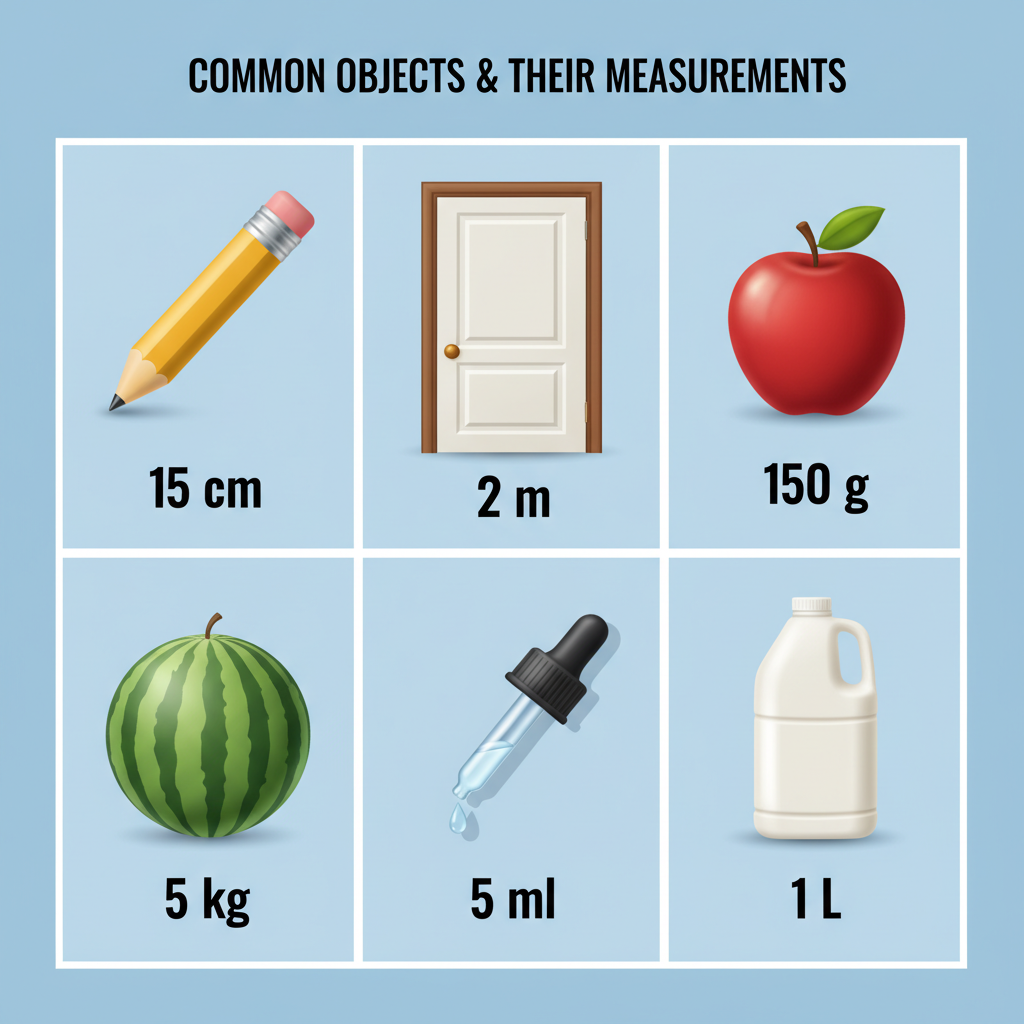
You are now a measurement expert! Keep looking around you and think about what units you would use to measure different things. Happy measuring!
Keep learning, free
Create a free Syllabax account to unlock practice questions and games for this topic.
Visual Learning Enhanced! 🚀
To help you master this topic, we use Advanced Syllabax AI to generate detailed diagrams and visual models.
Note on Visuals: The AI sometimes makes spelling errors in image labels. Please refer to the lesson text for the correct terminology.