Musical instruments (PHYSICS)
Watch this topic in 60 seconds
Free preview · Lesson 1
Understanding Musical instruments (PHYSICS)
Making Music: How Instruments Work (Physics for 5th Graders)
Have you ever wondered how a guitar makes its twangy sound, or how a trumpet can play a loud, clear note? It all comes down to something called physics, which is the science of how things move and interact in the world around us. Even though it sounds complicated, the basic ideas behind how musical instruments make sound are actually quite simple and fun to explore!
What is Sound?
Before we talk about instruments, let's think about sound itself. Sound is made when something vibrates, or wiggles back and forth very quickly. Imagine plucking a guitar string. It doesn't just stay still; it shakes! This shaking makes the air around it shake too. These tiny wiggles in the air are called sound waves. They travel from the instrument, through the air, and into your ears, which is how you hear music!
Think of it like dropping a pebble into a still pond. The pebble makes ripples that spread out across the water. Sound waves are similar, but instead of water, they travel through the air. Your ears are like tiny receivers that catch these ripples of air and tell your brain what sounds you're hearing.
How Instruments Make Different Sounds
Different instruments make sound in different ways, but they all rely on vibration. We can group most musical instruments into a few main families based on how they create these vibrations:
1. String Instruments (Chordophones)
These instruments make sound when you pluck, strum, or bow a string. Think of guitars, violins, pianos, and harps.
- How it works: When you touch a string (by plucking, bowing, or hitting it), it starts to vibrate. The faster the string vibrates, the higher the sound (like the tiny strings on a violin). The slower the string vibrates, the lower the sound (like the thick strings on a guitar or the big strings on a piano).
- Analogy: Imagine a jump rope. If you wiggle it very fast, it makes lots of quick waves. If you move it slowly, it makes long, slow waves. The speed of the wiggle is like the speed of the string's vibration, which affects how high or low the sound is.
- Making it louder: Most string instruments have a hollow body (like the body of a guitar or a violin). This body acts like an amplifier! The vibrations from the strings shake the body of the instrument, which then shakes more air, making the sound louder.
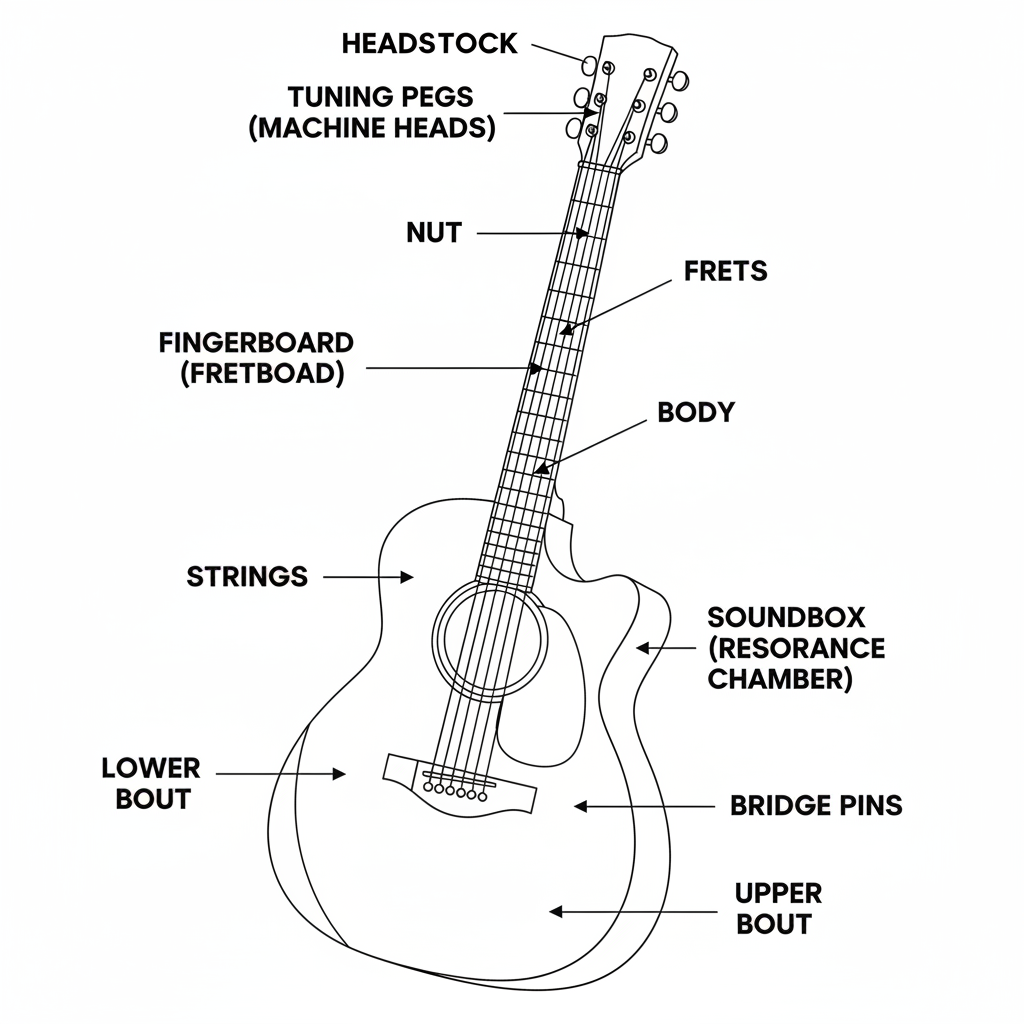 ⚠️ This picture may have spelling mistakes. Trust the words in the lesson.
2. Wind Instruments (Aerophones)
These instruments make sound when you blow air through them. Examples include flutes, trumpets, clarinets, and even your own voice when you sing!
- How it works: In wind instruments, you blow air to make something vibrate. This could be a reed (like in a clarinet or saxophone), your lips (like in a trumpet or trombone), or just the air itself moving over an edge (like in a flute or recorder). These vibrations create sound waves in the air inside the instrument.
- Analogy: Think about blowing across the top of a soda bottle. You can make a sound! If you blow harder or softer, or change the way you blow, the sound changes. The air inside the bottle vibrates.
- Changing the pitch (highness/lowness): How do you make a trumpet play different notes? By changing the length of the column of vibrating air! On a trumpet, you press valves that open up extra tubes, making the air column longer and the sound lower. On a flute, you cover holes with your fingers to make the air column shorter or longer.
- Analogy: Imagine a long tube versus a short tube. If you blow into both, the longer tube will make a deeper sound (like blowing across a big bottle) and the shorter tube will make a higher sound (like blowing across a tiny bottle).
3. Percussion Instruments (Membranophones and Idiophones)
These are instruments you hit, shake, or scrape to make sound. This group is very large and includes drums, cymbals, xylophones, maracas, and triangles.
- How it works: The sound comes from something being struck. This could be a stretched skin (like on a drum, called a membrane) or the instrument itself (like a xylophone bar or a triangle). When you hit these things, they vibrate and make sound.
- Analogy: Imagine tapping on a table. The table vibrates! If you tap it harder, it vibrates more. If you tap a thicker part versus a thinner part, the sound might be different.
- Drums: When you hit a drum, the 'skin' (the drumhead) vibrates. Bigger drums have lower sounds because their membranes vibrate more slowly. Smaller drums vibrate faster and make higher sounds.
- Xylophones and Glockenspiels: These instruments have bars of different lengths made of wood or metal. When you hit them with mallets, the bars vibrate. Longer bars vibrate slower and make lower notes, while shorter bars vibrate faster and make higher notes.
Putting it All Together: The Physics of Music
So, the next time you hear music, remember that it’s all about:
- Vibration: Something has to wiggle!
- Sound Waves: These vibrations travel through the air.
- Instrument Design: How the instrument is built helps make the sound loud or soft, high or low.
Physics is the amazing science that explains how all this magic happens. Keep listening and exploring the wonderful world of sound!
Keep learning, free
Create a free Syllabax account to unlock practice questions and games for this topic.
Visual Learning Enhanced! 🚀
To help you master this topic, we use Advanced Syllabax AI to generate detailed diagrams and visual models.
Note on Visuals: The AI sometimes makes spelling errors in image labels. Please refer to the lesson text for the correct terminology.