Unit conversions (simple) (Length, Weight & Capacity)
Watch this topic in 60 seconds
Free preview · Lesson 1
Understanding Unit conversions (simple) (Length, Weight & Capacity)
Measuring Our World: Understanding Simple Unit Conversions (Length, Weight, and Capacity)
Welcome, super sleuths of measurement! Today, we're going on an exciting adventure to explore how we measure different things around us. Have you ever wondered how tall a tree is, how heavy your backpack feels, or how much juice is in a carton? All these questions involve measurement! And to make sure everyone understands the same size, we use special tools called units. Think of units like the secret code that tells us what we're measuring and how much of it there is.
What are Units?
Imagine you want to tell your friend how long your new toy car is. You could say, 'It's long!' But that's not very helpful, is it? Your friend might think it's the size of a real car! To be clear, you'd say, 'It's 5 inches long.' Inches are our unit here. Units give us a standard way to describe size, weight, or amount. Without them, it would be like trying to play a game without any rules – confusing!
Length: How Long or Tall Something Is
Length is all about measuring how far apart two points are, or how tall or wide something is. Think about:
- The height of a skyscraper
- The distance to the playground
- The width of your desk
We have different units for length, depending on how big or small the thing we're measuring is. The most common units for length in our everyday lives are:
Inches (in)
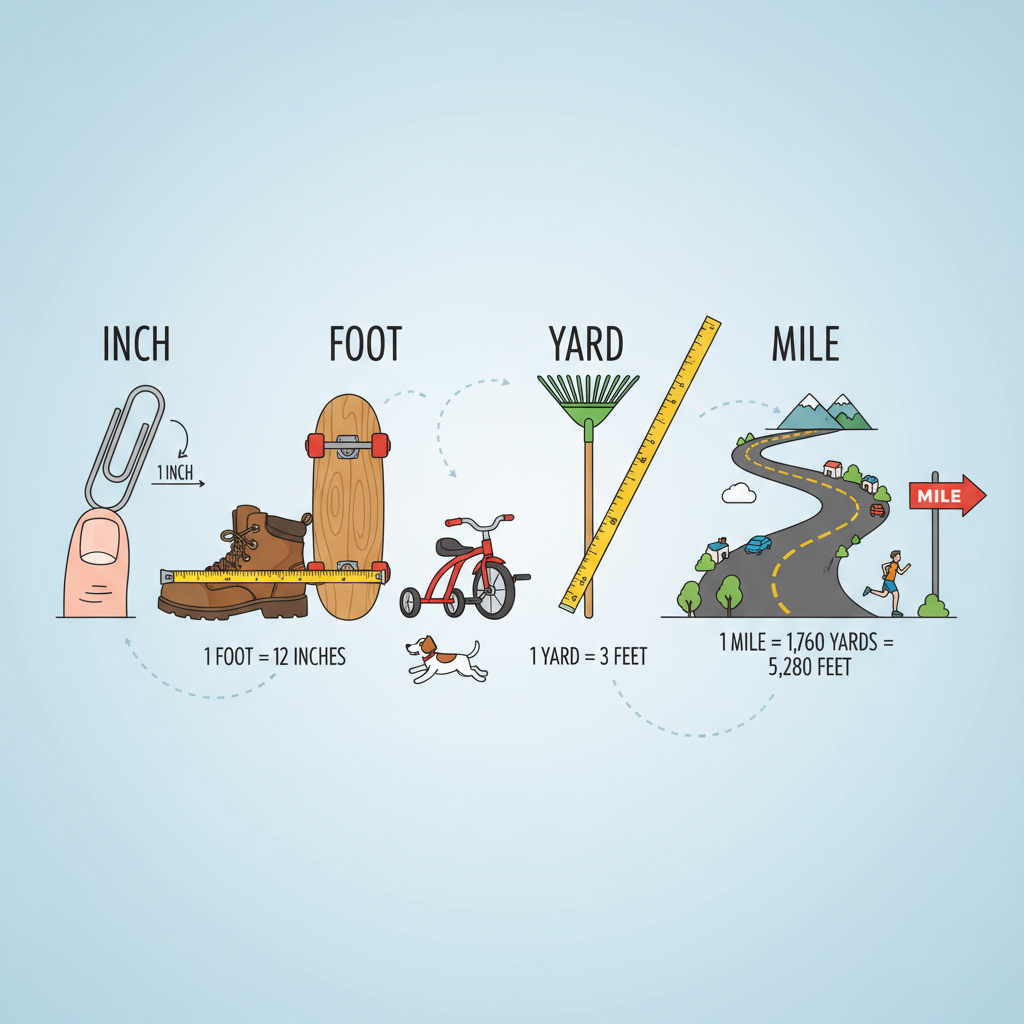
An inch is a small unit of length. Think about the tip of your finger to the first knuckle – that's roughly an inch! A ruler is usually marked with inches. We use inches to measure smaller things, like the length of a pencil, the size of a book, or how wide a coin is.
Analogy: Imagine you're building a LEGO castle. Each little LEGO brick is like an inch. You use many small bricks (inches) to build something bigger!
Feet (ft)
A foot is longer than an inch. It's about the length of a grown-up's shoe. There are 12 inches in 1 foot. So, if something is 12 inches long, you can say it's 1 foot long. We use feet to measure things that are bigger than a pencil but not super huge, like the length of a room, the height of a small table, or the length of a skateboard.
Analogy: Think of a foot as a big step. If you take 12 small steps (inches), you've walked the distance of one big step (foot).
Yards (yd)
A yard is even longer! It's about the length of a big stride you might take when you're walking. There are 3 feet in 1 yard. So, if something is 3 feet long, you can say it's 1 yard long. We use yards to measure longer distances, like the length of a football field (which is 100 yards long!), the height of a doorway, or the width of a small garden.
Analogy: Imagine a yard is like three of your big strides put together. It covers more ground than just one stride!
Miles (mi)
Miles are for really, really long distances! A mile is much longer than a yard. There are 1,760 yards in 1 mile. We use miles to measure how far apart cities are, or how far you travel on a long car ride. It would take a very, very long time to walk a mile!
Analogy: Think of a mile as a whole journey. If a yard is one step, a mile is like walking many, many blocks in your neighborhood.
Weight: How Heavy or Light Something Is
Weight tells us how much 'stuff' is in an object. Is it heavy like a rock, or light like a feather? We use units to describe weight too.
Ounces (oz)
An ounce is a small unit of weight. Think about a slice of bread or a small handful of chips – they might weigh a few ounces. We use ounces for lighter things, like the weight of a letter you mail, a small candy bar, or a feather.
Analogy: Imagine a single feather. That's super light, maybe just an ounce or two.
Pounds (lb)
A pound is heavier than an ounce. A pound is like the weight of a small bag of sugar or a carton of milk. There are 16 ounces in 1 pound. We use pounds to measure the weight of things like a bag of apples, a cat, or your own body weight! When you step on a scale, it usually tells you your weight in pounds.
Analogy: If an ounce is like a single feather, a pound is like a whole pillow made of many feathers – much heavier!
Tons (T)
Tons are for extremely heavy things! A ton is super, super heavy. There are 2,000 pounds in 1 ton. We use tons to measure the weight of really big things, like a car, a truck, or even a whale!
Analogy: If a pound is like a bag of sugar, a ton is like weighing hundreds and hundreds of bags of sugar all together!
Capacity: How Much a Container Can Hold
Capacity is about how much liquid (or other stuff) a container can hold. Think about:
- How much water fits in a swimming pool
- How much milk is in a jug
- How much juice is in a cup
We measure capacity using units that tell us the volume inside a container.
Fluid Ounces (fl oz)
Fluid ounces measure the amount of liquid. A small juice box might hold about 6 fluid ounces. It's a smaller amount of liquid compared to bigger containers.
Analogy: A fluid ounce is like a tiny sip of water.
Cups (c)
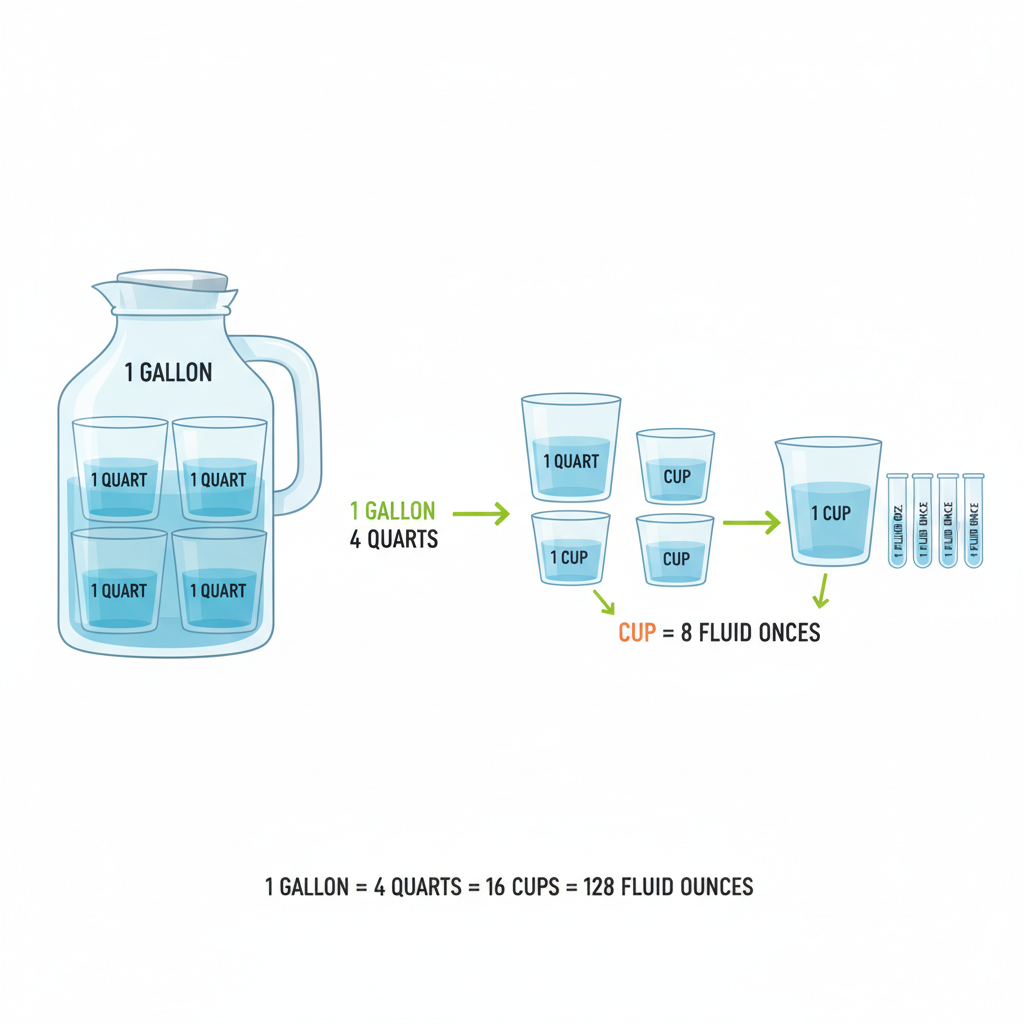
A cup is a common measure for liquids, especially when baking or cooking. Your drinking mug is probably about 8 fluid ounces, which is 1 cup! There are 8 fluid ounces in 1 cup. We use cups to measure ingredients like flour, sugar, or water for recipes.
Analogy: A cup is like a standard drink you might have at breakfast.
Quarts (qt)
A quart is a larger amount of liquid than a cup. A carton of ice cream is often a quart. There are 4 cups in 1 quart. We use quarts to measure things like milk (a gallon of milk has 4 quarts in it!), paint, or soup.
Analogy: If a cup is like one small bowl of soup, a quart is like four of those small bowls put together.
Gallons (gal)
A gallon is a very large amount of liquid. Think of a big jug of milk or a bucket full of water. There are 4 quarts in 1 gallon. So, a gallon holds a lot of liquid! We use gallons for things like large amounts of gasoline, water for a fish tank, or cleaning supplies.
Analogy: A gallon is like a whole bucket of water – enough to fill up many cups and quarts!
Why Do We Need to Convert Units?
Sometimes, the units we need don't match the units we have. Imagine you're baking a cake and the recipe calls for 2 cups of flour, but all you have is a measuring spoon that measures tablespoons. You need to know how many tablespoons are in a cup to make the recipe correctly! This is called unit conversion. It's like translating one language into another so everyone understands.
For simple conversions, we just need to remember the basic relationships:
- Length: 12 inches = 1 foot, 3 feet = 1 yard, 1760 yards = 1 mile
- Weight: 16 ounces = 1 pound, 2000 pounds = 1 ton
- Capacity: 8 fluid ounces = 1 cup, 4 cups = 1 quart, 4 quarts = 1 gallon
By understanding these simple relationships, we can easily switch between different units and measure anything with confidence! Keep practicing, and you'll become a measurement master in no time!
Keep learning, free
Create a free Syllabax account to unlock practice questions and games for this topic.
Visual Learning Enhanced! 🚀
To help you master this topic, we use Advanced Syllabax AI to generate detailed diagrams and visual models.
Note on Visuals: The AI sometimes makes spelling errors in image labels. Please refer to the lesson text for the correct terminology.