Train problems (Speed, Time & Distance)
Watch this topic in 60 seconds
Free preview · Lesson 1
Understanding Train problems (Speed, Time & Distance)
Choo-Choo! All Aboard for Train Problems (Speed, Time & Distance)!
Hello, future mathematicians! Have you ever watched a train whiz by and wondered how fast it's going? Or how long it takes to cross a really long bridge? These are the kinds of questions we'll learn to answer today! 'Train problems' are a fun way to understand how Speed, Time, and Distance all work together. Don't worry, we'll break it down into simple, easy-to-understand pieces, just like building with LEGOs!
The Three Musketeers: Speed, Time, and Distance
Imagine you're going on a trip. There are three main things you always think about:
- Speed: How fast are you going? (e.g., 60 kilometers per hour, or 10 meters per second)
- Time: How long does the journey take? (e.g., 2 hours, or 30 minutes)
- Distance: How far do you travel? (e.g., 120 kilometers, or 500 meters)
These three are connected by simple formulas, like secret codes that unlock the answers!
1. Speed: How Fast Are We Going?
Definition: Speed tells us how much distance is covered in a certain amount of time. Think of it like how many pages you can read in one minute. If you read 10 pages in 1 minute, your reading speed is 10 pages/minute!
Formula: Speed = Distance / Time
Units: We usually measure speed in kilometers per hour (km/h) or meters per second (m/s). Make sure you always use consistent units!
2. Distance: How Far Did We Travel?
Definition: Distance is simply how much ground you cover. Imagine walking from your house to a friend's house – that's the distance!
Formula: Distance = Speed × Time
Units: We measure distance in kilometers (km) or meters (m).
3. Time: How Long Did It Take?
Definition: Time is the duration of the journey. It's how many minutes or hours passed while you were moving.
Formula: Time = Distance / Speed
Units: We measure time in hours (h) or seconds (s) or minutes (min).
Important Pit Stop: Unit Conversions!
Sometimes, problems might give you speed in km/h and ask for time in seconds, or distance in meters. You need to be a super-sleuth and convert units so everything matches!
- Kilometers per hour (km/h) to Meters per second (m/s): Multiply by
5/18.
Why? Because 1 km = 1000 m, and 1 hour = 3600 seconds. So, (1000 m) / (3600 s) = 10/36 m/s = 5/18 m/s. - Meters per second (m/s) to Kilometers per hour (km/h): Multiply by
18/5.
Analogy: Imagine you have a recipe that asks for ingredients in cups, but your measuring tools only have milliliters. You need to convert cups to milliliters to make the recipe work! Same with units in math problems.
Train-Specific Adventures: When Trains Meet Things!
Now, let's get to the fun part: how these concepts apply to trains! Trains are special because they have a length. This length matters a lot when calculating distance!
1. Train Passing a Stationary Object (Pole, Man, Tree)
Imagine a very long snake crawling past a tiny pebble. When does the snake 'finish' passing the pebble? Only when its entire body, from head to tail, has gone past the pebble!
Rule: When a train passes a point-like object (something with negligible length like a pole, a standing man, or a tree), the distance covered by the train is equal to the length of the train itself.
Distance = Length of the Train
2. Train Passing a Platform, Bridge, or Tunnel
Now, imagine our long snake crawling past a long stick. For the snake to completely pass the stick, its head has to reach the start of the stick, then its entire body has to crawl along the stick, and finally, its tail has to leave the end of the stick. So, it covers its own length PLUS the length of the stick!
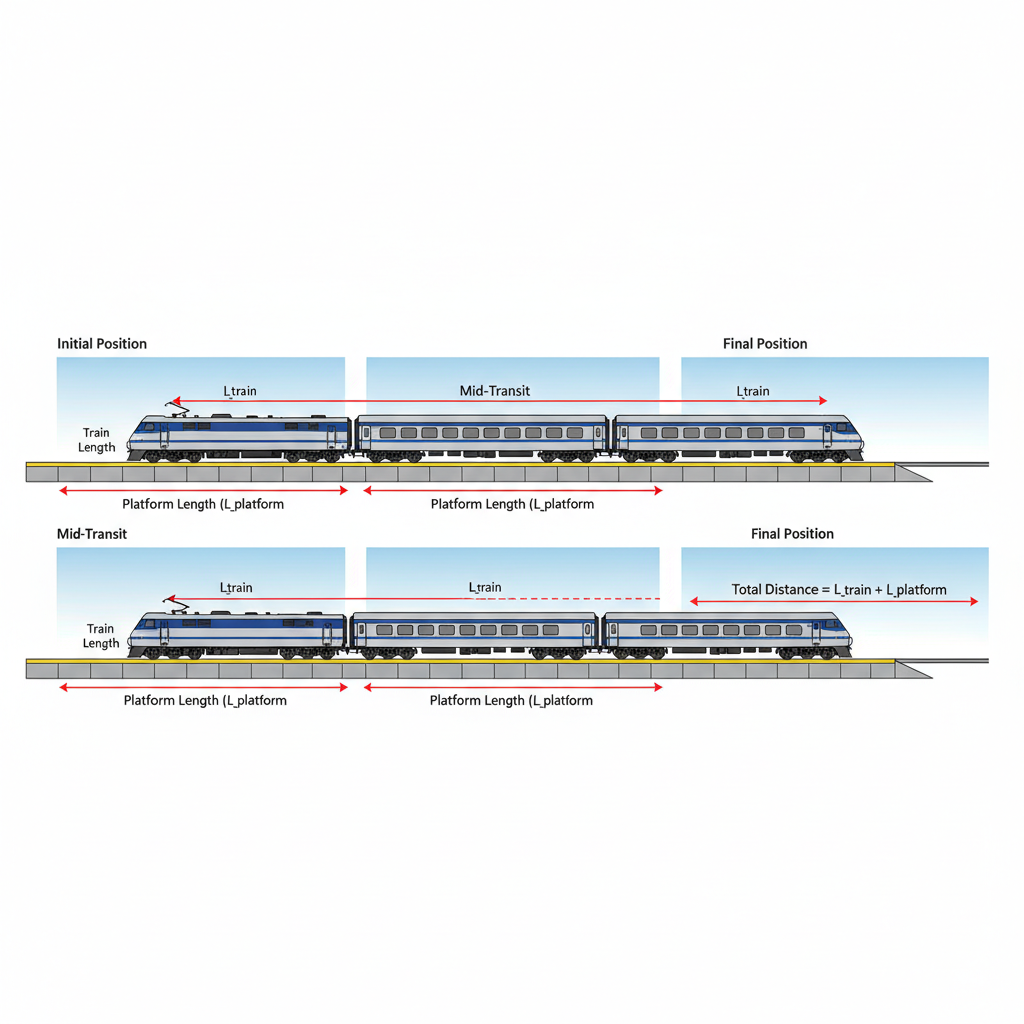
Rule: When a train passes a longer object (like a platform, bridge, or tunnel), the distance covered by the train is equal to the length of the train + the length of the object it's passing.
Distance = Length of the Train + Length of the Platform/Bridge/Tunnel
3. When Two Trains Are Moving (Relative Speed)
What happens when two trains are moving? Things get a little trickier, but still manageable! We need to think about their 'relative speed' – how fast they are moving with respect to each other.
a) Trains Moving in the Same Direction
Imagine two friends running in a race. If one friend is running at 10 km/h and the other at 8 km/h, they are both moving forward, but the faster friend is only gaining on the slower friend by 2 km/h (10 - 8). The difference in their speeds is what matters for them to 'catch up' or 'pull away'.
Rule: If two trains are moving in the same direction, their relative speed is the difference between their individual speeds.
Relative Speed = Speed of Train 1 - Speed of Train 2 (if Train 1 is faster)
When one train overtakes another, the distance covered is usually the sum of their lengths.
b) Trains Moving in Opposite Directions
Now, imagine two friends running towards each other on a track. They will meet much, much faster because their speeds are adding up! If one runs at 10 km/h and the other at 8 km/h, they are closing the gap between them at a combined speed of 18 km/h (10 + 8).
Rule: If two trains are moving in opposite directions (towards each other or away from each other), their relative speed is the sum of their individual speeds.
Relative Speed = Speed of Train 1 + Speed of Train 2
When two trains cross each other (pass completely), the total distance covered for them to fully pass is the sum of their lengths.
Putting It All Together: Steps to Solve Train Problems
- Read Carefully: Understand what the problem is asking for (Time? Distance? Speed?).
- Identify Given Information: What speeds, lengths, or times are provided?
- Check Units: Make sure all units are consistent (e.g., all m/s and m, or all km/h and km). Convert if necessary! This is crucial.
- Choose the Right Formula/Rule: Is the train passing a pole or a platform? Are two trains moving in the same or opposite directions?
- Solve: Plug in the numbers and do the math!
- Double-Check: Does your answer make sense?
You're now equipped with the foundational knowledge to tackle many train problems! Remember to practice, and soon you'll be a train problem master!
Keep learning, free
Create a free Syllabax account to unlock practice questions and games for this topic.
Visual Learning Enhanced! 🚀
To help you master this topic, we use Advanced Syllabax AI to generate detailed diagrams and visual models.
Note on Visuals: The AI sometimes makes spelling errors in image labels. Please refer to the lesson text for the correct terminology.