Introduction to Probability
Watch this topic in 60 seconds
Free preview · Lesson 1
Understanding Introduction to Probability
Introduction to Probability: Understanding Chance in Our World
Have you ever checked the weather forecast and seen a "40% chance of rain"? Or played a board game where you needed a specific number on a die to win? Or wondered about your chances of winning a lottery? All these situations involve probability – the mathematical way of understanding and measuring how likely something is to happen.
In this lesson, we're going to dive into the foundational concepts of probability. We'll learn the language mathematicians use to talk about chance and discover simple methods to calculate how likely various events are. Don't worry, we'll use lots of everyday analogies to make these ideas clear and easy to grasp!
What is Probability? The Language of Likelihood
At its heart, probability is a branch of mathematics that quantifies the likelihood of an event occurring. It gives us a number between 0 and 1 (or 0% and 100%) to represent this likelihood:
- A probability of 0 means the event is absolutely impossible.
- A probability of 1 means the event is absolutely certain to happen.
- A probability of 0.5 (or 50%) means the event is equally likely to happen or not happen, like a "50/50" chance.
Analogy: Think of probability as a "likelihood meter." If the meter is at 0, it's a definite "no way." If it's at 1, it's a definite "yes." Anywhere in between tells you how strongly the needle points towards "yes" versus "no." For example, a 0.8 (80%) chance of rain means the needle is strongly pointing towards rain, but it's not a complete certainty.
Core Concepts & Vocabulary – Your Probability Toolkit
Before we can calculate probabilities, we need to understand some key terms. Think of these as the essential tools in your probability toolkit:
1. Experiment
- Definition: An "experiment" in probability is any process or action that has a well-defined set of possible outcomes. It's the activity you perform or observe.
- Examples: Flipping a coin, rolling a standard six-sided die, drawing a marble from a bag, spinning a spinner, choosing a card from a deck.
- Analogy: Imagine you're a scientist, and the experiment is the "test" you're conducting. You set it up, you run it, and then you see what happens.
2. Outcome
- Definition: An "outcome" is a single possible result of an experiment. It's what actually happens when you perform the experiment.
- Examples: If your experiment is flipping a coin, "Heads" is an outcome, and "Tails" is another outcome. If your experiment is rolling a die, "rolling a 3" is an outcome.
- Analogy: After you run your scientific test (experiment), the outcome is the specific "data point" or result you record.
3. Sample Space (S)
- Definition: The "sample space," denoted by S, is the set of *all* possible outcomes of an experiment. It lists every single thing that *could* happen, without exception.
- Examples:
- For flipping a coin: S = {Heads, Tails}
- For rolling a standard six-sided die: S = {1, 2, 3, 4, 5, 6}
- For choosing a letter from the word "MATH": S = {M, A, T, H}
- Analogy: Imagine you go to a restaurant, and the sample space is the *entire menu* of everything you could possibly order. It's the complete list of options.
4. Event (E)
- Definition: An "event" is a specific outcome or a collection (subset) of outcomes from the sample space that we are interested in. It's what we want to find the probability of.
- Examples:
- From the coin flip experiment, an event could be "getting Heads."
- From the die roll experiment, an event could be "rolling an even number" (this includes outcomes {2, 4, 6}). Another event could be "rolling a 5" (this includes just outcome {5}).
- From choosing a letter from "MATH", an event could be "choosing a vowel" (outcomes {A}).
- Analogy: Following the restaurant analogy, if the sample space is the entire menu, an event is a *specific dish* you decide to order (e.g., "the spaghetti"), or a *category of dishes* you're considering (e.g., "any pasta dish").
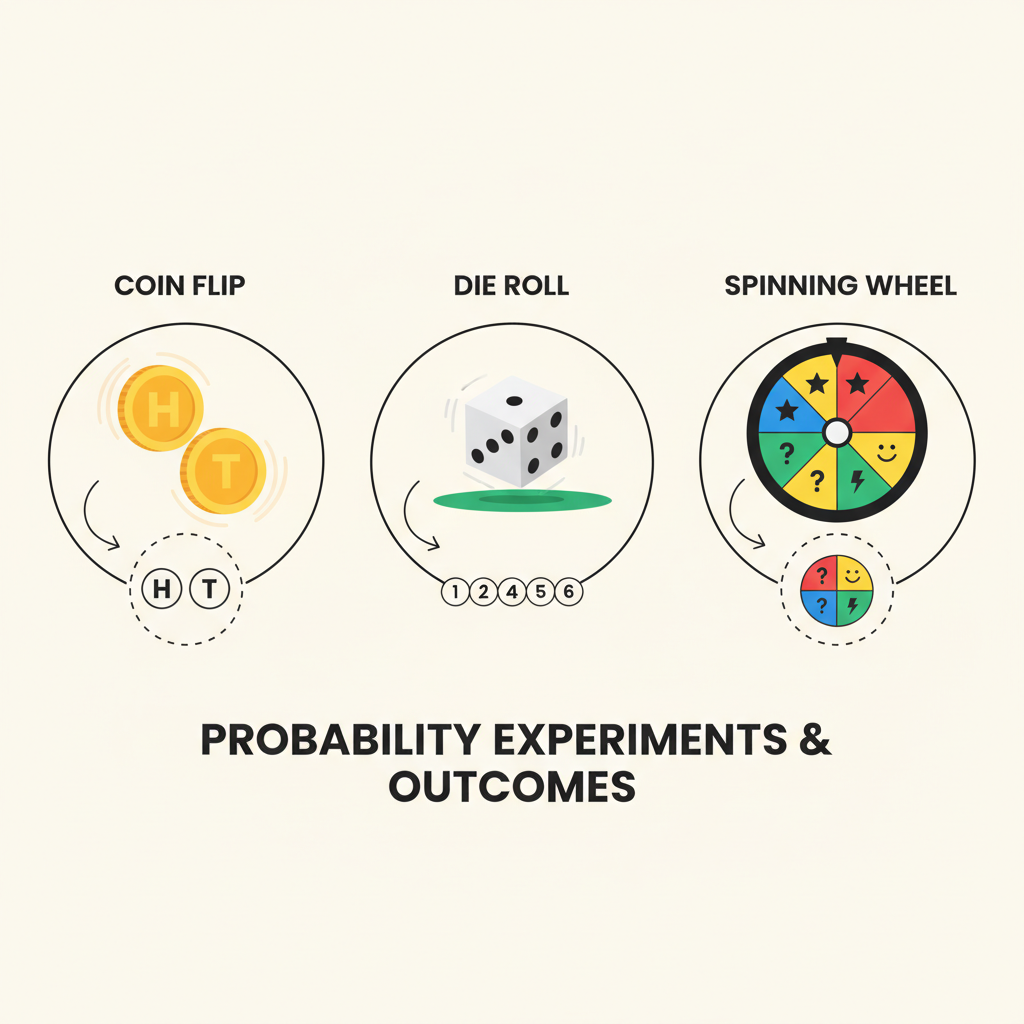
Calculating Simple Probability: The Formula for Likelihood
Now that we know the basic terms, we can calculate the probability of a simple event. The fundamental formula is:
P(Event) = (Number of Favorable Outcomes) / (Total Number of Possible Outcomes)
- P(Event) stands for "The Probability of the Event occurring."
- "Number of Favorable Outcomes" refers to how many outcomes in the sample space satisfy our event (the ones we are interested in).
- "Total Number of Possible Outcomes" is simply the total number of items in our sample space (all the things that could possibly happen).
Let's put this formula into action with some examples:
1. Flipping a Coin
- Experiment: Flipping a fair coin once.
- Sample Space (S): {Heads, Tails}. Total possible outcomes = 2.
- Event (E): Getting Heads.
- Favorable Outcomes: {Heads}. Number of favorable outcomes = 1.
- Calculation: P(Heads) = 1 / 2 = 0.5 or 50%.
- Analogy: If you have two doors, and a prize is behind only one, your chance of picking the prize door is 1 out of 2.
2. Rolling a Standard Six-Sided Die
- Experiment: Rolling a fair six-sided die once.
- Sample Space (S): {1, 2, 3, 4, 5, 6}. Total possible outcomes = 6.
- Event (E1): Rolling a 4.
- Favorable Outcomes: {4}. Number of favorable outcomes = 1.
- Calculation: P(Rolling a 4) = 1 / 6.
- Event (E2): Rolling an even number.
- Favorable Outcomes: {2, 4, 6}. Number of favorable outcomes = 3.
- Calculation: P(Rolling an even number) = 3 / 6 = 1 / 2 = 0.5 or 50%.
- Analogy: Imagine a small lottery with 6 tickets, and 1 of them wins. Your chance of winning with one ticket is 1/6. If 3 tickets were winning tickets, your chance would be 3/6.
3. Drawing Marbles from a Bag
- Experiment: You have a bag containing 3 red marbles and 7 blue marbles. You randomly draw one marble.
- Sample Space (S): Total marbles = 3 (red) + 7 (blue) = 10 marbles.
- Event (E1): Drawing a red marble.
- Favorable Outcomes: {Red, Red, Red}. Number of favorable outcomes = 3.
- Calculation: P(Drawing a Red Marble) = 3 / 10 = 0.3 or 30%.
- Event (E2): Drawing a blue marble.
- Favorable Outcomes: {Blue, Blue, Blue, Blue, Blue, Blue, Blue}. Number of favorable outcomes = 7.
- Calculation: P(Drawing a Blue Marble) = 7 / 10 = 0.7 or 70%.
- Analogy: Think of choosing a specific flavor from a bag of mixed candies. If there are more of one flavor, you're more likely to pick it.
The Range of Probability: From Impossible to Certain
As mentioned, probability values always fall between 0 and 1 (inclusive). Let's look at the extremes:
P = 0 (Impossible Event)
- An event that absolutely cannot happen. There are zero favorable outcomes.
- Example: Rolling a 7 on a standard six-sided die. (The sample space only goes up to 6, so there's no way to roll a 7).
- Analogy: Trying to sprout wings and fly to the moon. It's impossible.
P = 1 (Certain Event)
- An event that is guaranteed to happen. All outcomes in the sample space are favorable outcomes.
- Example: Rolling a number less than 7 on a standard six-sided die. (Every outcome {1, 2, 3, 4, 5, 6} is less than 7, so it's guaranteed).
- Analogy: The sun rising tomorrow morning (barring an unforeseen global catastrophe!). It's a certainty.
P between 0 and 1
- Most events fall into this category. They are possible, but not certain.
- Example: Flipping a coin and getting heads (P=0.5). Rolling an odd number on a die (P=0.5).
- Analogy: Your favorite sports team winning their next game. It's possible and perhaps even likely, but not a guarantee.
Complementary Events: The "Either/Or" Scenario
Sometimes, we're interested in an event *not* happening. This leads us to the concept of complementary events.
- Definition: Two events are complementary if one event happening means the other cannot happen, and together they cover all possible outcomes in the sample space. If 'A' is an event, then 'not A' (often written as A' or Ac) is its complement.
- Formula: The sum of the probability of an event and the probability of its complement is always 1: P(A) + P(not A) = 1
- Example:
- Event A: Rolling an even number on a die. P(A) = 3/6 = 0.5.
- Event 'not A': Rolling an odd number on a die. P(not A) = 3/6 = 0.5.
- P(Even) + P(Odd) = 0.5 + 0.5 = 1.
- Analogy: It's either raining or it's not raining. These are complementary situations. If the probability of rain is 30% (0.3), then the probability of it *not* raining is 1 - 0.3 = 0.7 or 70%.
Why Study Probability? Life's a Game of Chances!
Probability isn't just an abstract math concept; it's a powerful tool for understanding and navigating the real world:
- Weather Forecasting: Meteorologists use complex probability models to predict rain, snow, or sunshine, helping us plan our days.
- Games and Sports: Understanding odds in card games, lotteries, or sports betting is all about probability. It helps you make more informed decisions (or at least understand your chances of winning!).
- Medical Decisions: Doctors use probability to assess the risk of diseases, the effectiveness of treatments, or the chances of side effects.
- Insurance: Insurance companies calculate premiums based on the probability of events like accidents, fires, or natural disasters occurring.
- Science and Research: Scientists use probability to analyze data from experiments, draw conclusions, and determine the reliability of their findings.
- Everyday Decisions: From deciding whether to take an umbrella to choosing a safe investment, a basic understanding of probability can guide many of your daily choices.
By grasping these foundational concepts, you're not just learning math; you're developing a powerful tool for understanding and navigating the uncertainties of the world around you. Welcome to the fascinating world of probability!
Keep learning, free
Create a free Syllabax account to unlock practice questions and games for this topic.
Visual Learning Enhanced! 🚀
To help you master this topic, we use Advanced Syllabax AI to generate detailed diagrams and visual models.
Note on Visuals: The AI sometimes makes spelling errors in image labels. Please refer to the lesson text for the correct terminology.