Learning Journey
Watch this topic in 60 seconds
Free preview · Lesson 1
Understanding Equivalent fractions [Fractions]
Understanding Equivalent Fractions: The Same Slice, Different Size!
Welcome, super mathematicians! Today, we're going on an exciting journey to explore a super cool concept called equivalent fractions. Don't let the big word scare you! It just means fractions that look different but represent the exact same amount. Think of it like having different pizza boxes, but inside each box, you have the same amount of pizza!
What is a Fraction, Anyway?
Before we dive into equivalent fractions, let's quickly remember what a fraction is. A fraction is a way to show a part of a whole. It has two important numbers:
- The Numerator: This is the top number. It tells us how many parts we have or are talking about.
- The Denominator: This is the bottom number. It tells us how many equal parts the whole is divided into.
For example, if you have a chocolate bar broken into 4 equal pieces (the denominator is 4) and you eat 1 piece (the numerator is 1), you've eaten 1/4 of the chocolate bar. If you eat 2 pieces, you've eaten 2/4 of the chocolate bar.
Introducing Equivalent Fractions: Same Amount, Different Names!
Imagine you have a sandwich. You cut it in half, and you eat one half. That's 1/2 of the sandwich. Now, imagine your friend has the exact same sandwich, but they cut it into four equal pieces and eat two of them. They ate 2/4 of their sandwich.
Who ate more sandwich? If you think about it, you both ate the same amount of sandwich! 1/2 is the same amount as 2/4. These are equivalent fractions. They have different numerators and denominators, but they represent the same value or the same part of a whole.
Visualizing Equivalent Fractions: Pizza Power!
Let's use our pizza analogy. Imagine a pizza cut into 2 equal slices. If you eat 1 slice, you've eaten 1/2 of the pizza.
Now, imagine another pizza, exactly the same size, but this one is cut into 4 equal slices. If you eat 2 of those slices, you've eaten 2/4 of the pizza.
Look at the pictures (or imagine them!). Eating 1 slice out of 2 looks exactly the same as eating 2 slices out of 4. They cover the same amount of pizza! So, 1/2 and 2/4 are equivalent fractions.
What if we cut the pizza into 8 equal slices? How many slices would you need to eat to have the same amount as 1/2? You would need to eat 4 slices! So, 4/8 is also equivalent to 1/2 and 2/4.
Here's a way to visualize this:
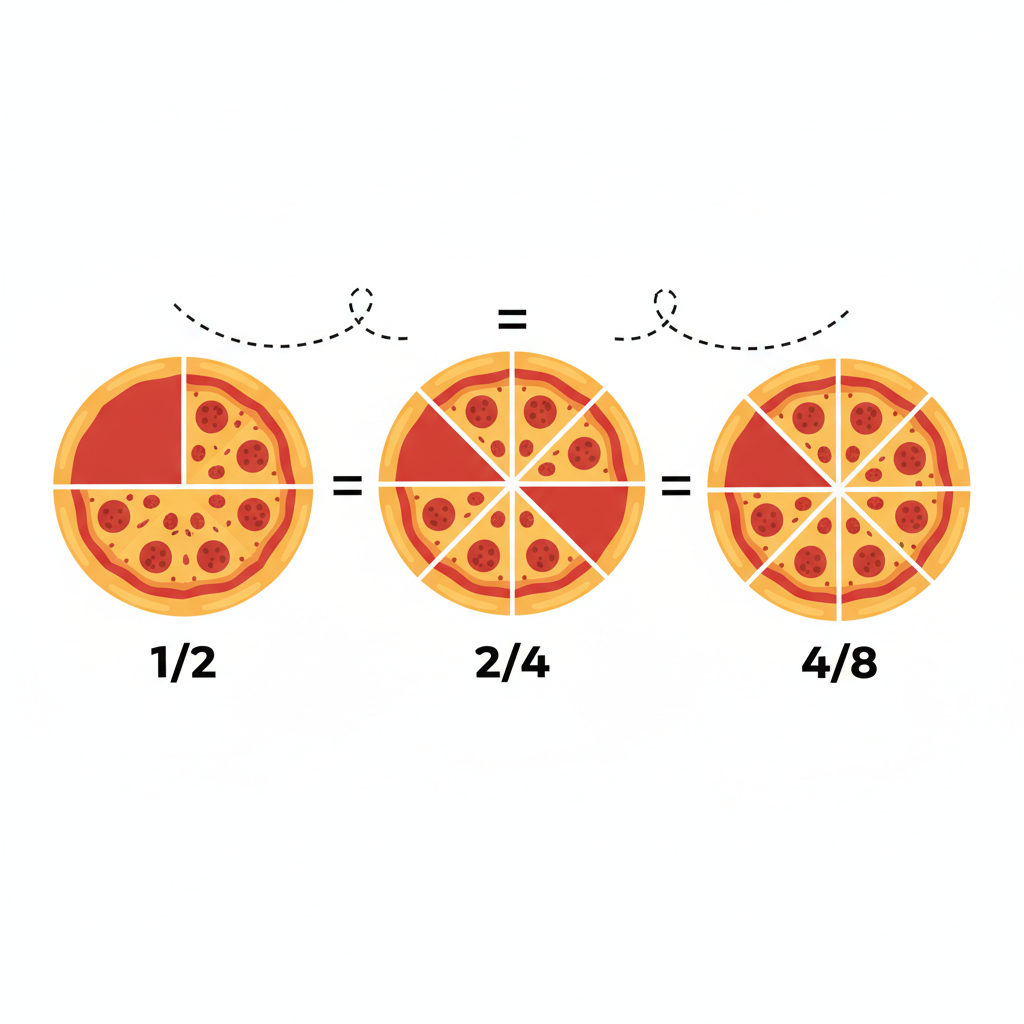
As you can see in the illustration, 1/2, 2/4, and 4/8 all cover the same amount of the pizza. They are just divided into more (or fewer) pieces.
How to Find Equivalent Fractions: The Magic Trick!
There's a simple mathematical trick to find equivalent fractions. You can multiply both the numerator and the denominator by the same number. This is like cutting each existing slice into smaller, equal pieces. The total amount of pizza doesn't change, just the number of slices!
Example 1: Finding a fraction equivalent to 1/3
- Let's multiply the numerator (1) and the denominator (3) by 2:
- Numerator: 1 × 2 = 2
- Denominator: 3 × 2 = 6
- So, 2/6 is equivalent to 1/3. Imagine a cake cut into 3 slices, and you eat 1. Now imagine the same cake cut into 6 slices; you would eat 2 slices to have the same amount.
Example 2: Finding a fraction equivalent to 3/4
- Let's multiply the numerator (3) and the denominator (4) by 3:
- Numerator: 3 × 3 = 9
- Denominator: 4 × 3 = 12
- So, 9/12 is equivalent to 3/4. If you had a pie cut into 4 pieces and ate 3, it's the same as a pie cut into 12 pieces where you eat 9.
Why Are Equivalent Fractions Useful?
Equivalent fractions are super helpful when we want to compare fractions or add and subtract them later on. Sometimes, fractions are easier to work with when they have the same denominator (the same size pieces). Finding equivalent fractions helps us make that happen!
Key Concepts Recap
- Fraction: A part of a whole (numerator/denominator).
- Numerator: The top number; how many parts you have.
- Denominator: The bottom number; how many equal parts make the whole.
- Equivalent Fractions: Fractions that look different but represent the same amount.
- Finding Equivalents: Multiply the numerator AND the denominator by the SAME number.
Keep practicing, and you'll become a master of equivalent fractions in no time!
Keep learning, free
Create a free Syllabax account to unlock practice questions and games for this topic.
Visual Learning Enhanced! 🚀
To help you master this topic, we use Advanced Syllabax AI to generate detailed diagrams and visual models.
Note on Visuals: The AI sometimes makes spelling errors in image labels. Please refer to the lesson text for the correct terminology.