Learning Journey
Watch this topic in 60 seconds
Free preview · Lesson 1
Understanding Story-based word problems (HOTS)
Story-Based Word Problems: Thinking Deeper!
Hello young mathematicians! Today, we're going on an adventure into the exciting world of word problems. These aren't just numbers on a page; they are like mini-stories that ask us to be detectives and solve a mystery using math!
What are Word Problems?
Imagine your favorite storybook. It has characters, a setting, and a plot, right? Word problems are like that, but instead of a long story, they are short stories that have numbers and a question for us to answer. They help us understand how math is used in real life, like when you're sharing cookies with friends or counting your toys.
Why are they called "Story-Based"?
Because, just like a story, they have characters and a situation. For example, a word problem might be about Lily who has 5 red balloons and 3 blue balloons. Lily is the character, and having balloons is the situation. The problem will then ask us something about Lily's balloons, like "How many balloons does Lily have in total?"
What does "HOTS" mean?
HOTS stands for "Higher-Order Thinking Skills." This sounds fancy, but it just means we need to think a little bit more deeply, like a super-smart detective! Instead of just looking for numbers, we need to understand what the story is asking us to do. Are we adding things together? Taking things away? Or maybe comparing two groups?
Think of it like this: If someone asks you to count how many apples are in a basket, that's a simple skill. But if someone tells you a story about picking apples, and then asks how many apples you'd have *left* if you gave some away, you need to use your HOTS! You need to read the story, understand what happened, and then figure out the math.
Let's Meet Our Math Detectives!
Our math detectives are very special. They know how to:
- Read Carefully: They don't just skim the words; they read every single word to catch all the clues.
- Understand the Story: They figure out what's happening. Is someone getting more? Is something being lost?
- Find the Math Clues: They look for numbers and words that tell them what to do (like "altogether," "left," "more than").
- Choose the Right Operation: They decide if they need to add (+), subtract (-), multiply (*), or divide (÷). For second grade, we mostly focus on addition and subtraction.
- Solve the Mystery: They do the math calculation to find the answer.
- Check Their Work: They make sure their answer makes sense in the story!
Analogies to Help Us Think!
Word problems can be tricky, but analogies make them easier to understand. Think of them like these:
1. A Recipe:
A word problem is like a recipe for solving a math problem. The story gives you the ingredients (the numbers and information), and the question tells you what dish you need to make (the answer). You have to follow the steps (the math operations) to get the delicious result!
2. A Treasure Map:
Imagine you found a treasure map! The map tells a story of clues leading you to hidden treasure. The word problem is like the map. The words are the clues, and the numbers are important landmarks. Your job is to follow the clues, use your math skills, and find the hidden treasure – the answer!
3. A Detective's Case File:
Just like a detective collects evidence for a case, you collect information from the word problem. Each sentence is a piece of evidence. You need to put all the evidence together to solve the case, which is finding the answer to the question.
 ⚠️ This picture may have spelling mistakes. Trust the words in the lesson.
Key Words to Look For (Math Clues!):
These words are like secret signals in the story that tell you what math operation to use.
- For Addition (+): altogether, in all, total, sum, combined, plus, more than (when asking for the new total)
- For Subtraction (-): left, remaining, difference, how many more/less, take away, minus, fewer than
Let's Look at an Example!
Story: Sarah baked 8 cookies. Her brother, Tom, baked 5 cookies. They want to put all their cookies on one plate.
Detective Steps:
- Read Carefully: Sarah has 8 cookies. Tom has 5 cookies. They want to put them together.
- Understand the Story: We are combining two groups of cookies.
- Find the Math Clues: The numbers are 8 and 5. The word "all" or "together" (implied by putting them on one plate) tells us to add.
- Choose the Right Operation: Addition (+).
- Solve the Mystery: 8 + 5 = 13.
- Check Your Work: If they put cookies together, they should have more than 8 or 5. 13 is more than both. It makes sense!
Answer: They will have 13 cookies on the plate.
Another Example: Thinking Deeper!
Story: There were 10 birds sitting on a tree branch. 3 birds flew away.
Detective Steps:
- Read Carefully: 10 birds started. 3 birds left.
- Understand the Story: Some birds left the branch, so there are fewer birds now.
- Find the Math Clues: The numbers are 10 and 3. The words "flew away" tell us that some birds are gone, meaning we subtract.
- Choose the Right Operation: Subtraction (-).
- Solve the Mystery: 10 - 3 = 7.
- Check Your Work: If birds flew away, there should be fewer birds. 7 is less than 10. It makes sense!
Answer: There are 7 birds left on the branch.
Thinking about "How Many More?"
Sometimes, word problems ask us to compare. For example:
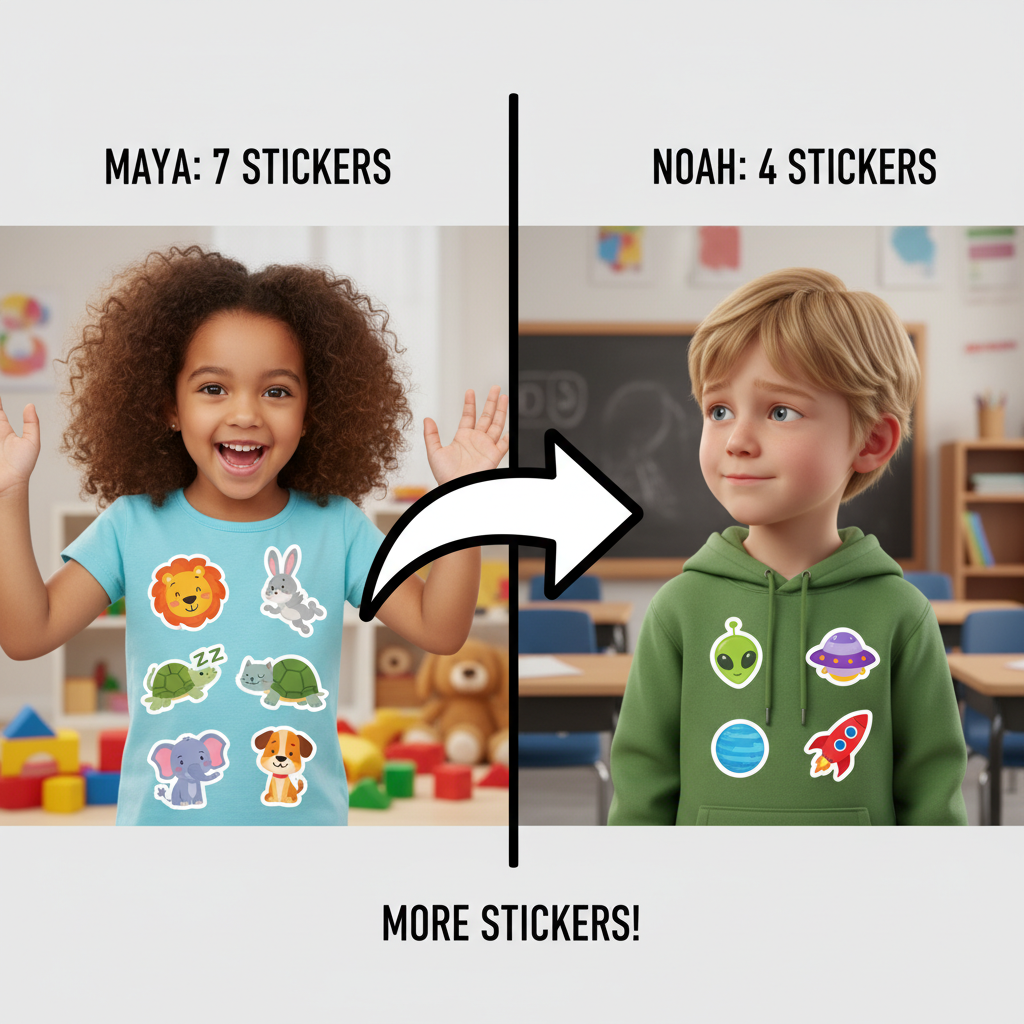
Story: Maya has 7 stickers. Noah has 4 stickers. How many more stickers does Maya have than Noah?
Detective Steps:
- Read Carefully: Maya has 7. Noah has 4. We need to find the difference.
- Understand the Story: We are comparing two amounts to see how much bigger one is than the other.
- Find the Math Clues: The numbers are 7 and 4. The words "how many more" are a big clue that we need to find the difference. This means subtraction!
- Choose the Right Operation: Subtraction (-).
- Solve the Mystery: 7 - 4 = 3.
- Check Your Work: Maya has more stickers than Noah, so the difference should be a positive number. 3 is positive. It makes sense!
Answer: Maya has 3 more stickers than Noah.
Practice Time!
Now it's your turn to be the math detective! Read each story carefully, find the clues, and solve the mystery!
Keep learning, free
Create a free Syllabax account to unlock practice questions and games for this topic.
Visual Learning Enhanced! 🚀
To help you master this topic, we use Advanced Syllabax AI to generate detailed diagrams and visual models.
Note on Visuals: The AI sometimes makes spelling errors in image labels. Please refer to the lesson text for the correct terminology.