Finding the Middle Data
Watch this topic in 60 seconds
Free preview · Lesson 1
Understanding Finding the Middle Data
Hello, young mathematicians! Have you ever wondered what's 'normal' or 'typical' in a group of things? Imagine you have a bunch of friends, and you want to know who is the 'middle child' in terms of height. Or maybe you have a collection of toys, and you want to know what's the typical number of wheels on your toy cars. This is where 'Finding the Middle Data' comes in! It's a super useful trick to understand a group of numbers.
Think of it like this: You and your friends line up to play a game. The person right in the very center is special, right? They're the 'middle person.' In math, we can find a 'middle number' for a group of numbers. This middle number tells us a lot about the whole group, kind of like how the middle person in a line gives us a good idea of the average height of everyone standing around them.
Getting Ready: Order, Order! (Like Lining Up Your Toys!)
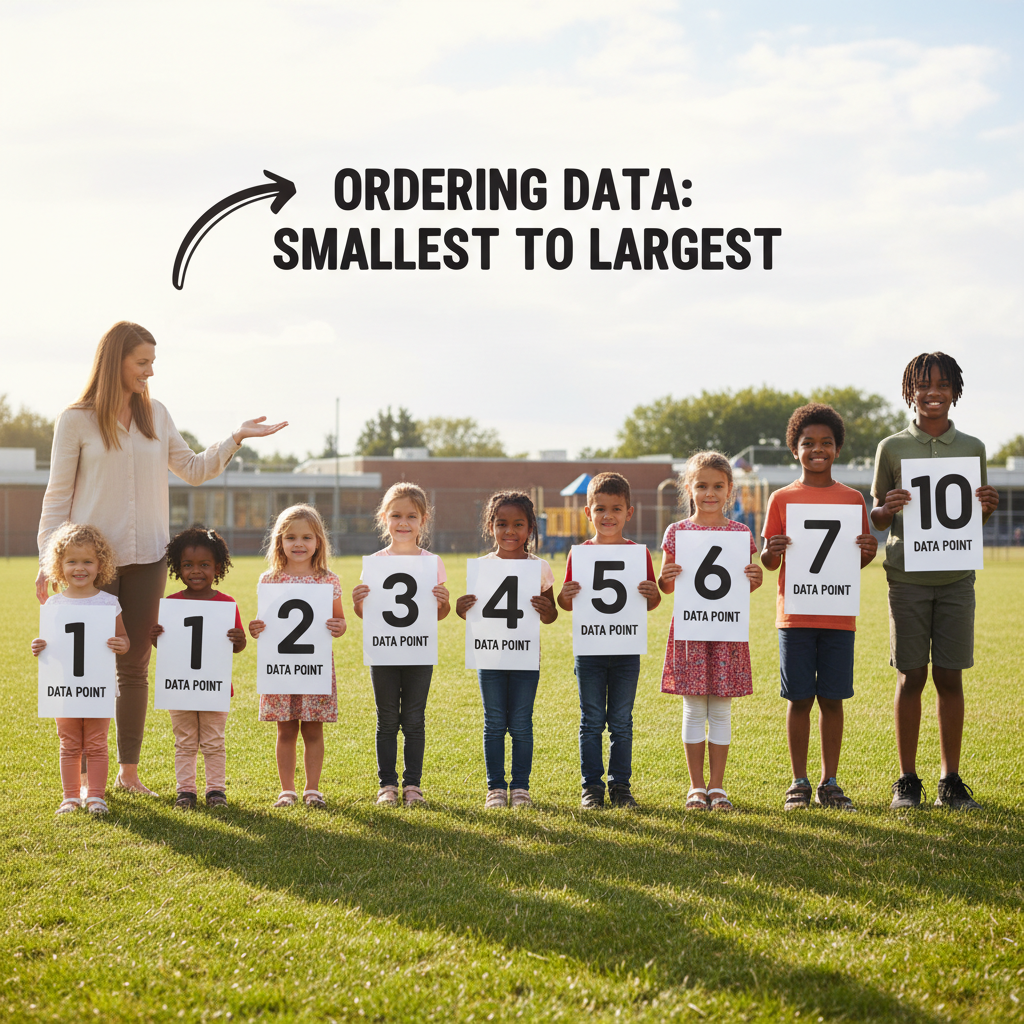
Before we can find the middle of anything, there's one super important step, just like tidying up your toys before you play. We need to put all our numbers in ORDER! This means arranging them from the SMALLEST to the BIGGEST. Just like when you line up with your friends, you wouldn't just stand anywhere; you'd likely line up from the shortest person to the tallest person, right? It makes everything much clearer!
Let's say you have these numbers: 5, 2, 8, 3, 1. If you just look at them like that, it's hard to tell what's in the middle. But if you put them in order, it becomes: 1, 2, 3, 5, 8. Now it's much, much easier to see things!
This step is called 'ordering your data.' 'Data' is just a fancy word for all the numbers or information we collect. So, remember this golden rule: Always order your data from smallest to largest first! It's like sorting your crayons by color or lining up your books by size – it helps you find what you need easily.
Finding the Middle (When There's an Odd Number of Items)
Okay, now that our numbers are neatly in order, finding the middle is like a treasure hunt, but much easier! Let's start with a group where there's an ODD number of items. This means when you count all your numbers, the total is something like 3, 5, 7, 9, and so on. An odd number means you can always find ONE person or ONE number that is perfectly in the middle.
Imagine you have 5 friends standing in a line. If you count them: one, two, three, four, five. Who is the person exactly in the middle? It's the third person, right? There are two people before them and two people after them. They are the true 'middle child' of the group!
Let's try with numbers! Suppose you collected data on how many books your friends read last week:
Numbers: 7, 3, 9, 2, 5
Step 1: Order them! Smallest to largest:
2, 3, 5, 7, 9
Step 2: Find the middle! You can point to the numbers, one from each end, until you meet in the middle. It’s like playing 'hot and cold' with numbers, crossing them off until you find the central one!
- Cross out 2 and 9 (one from each end)
- Now you have: 3, 5, 7
- Cross out 3 and 7 (one from each end)
- What's left? 5!
So, the middle data for 2, 3, 5, 7, 9 is 5. It's the number right in the center, with the same amount of numbers on its left and its right. This 'middle number' has a special math name: the Median. Don't worry too much about the big word right now, just remember it means 'the middle!'
Finding the Middle (When There's an Even Number of Items)
Now, what happens if you have an EVEN number of items? Like if you have 4 friends or 6 toy cars? If you line up 4 friends, can you find *one* person who is exactly in the middle? Not really! There will be two people in the middle, standing side-by-side.
When there's an even number of data points, we will have TWO numbers in the middle. Our job is to find the number that lives exactly halfway between those two middle numbers. Think of it like two friends standing next to each other in the middle of the line. Where would they meet if they had to find one exact spot to stand together? They'd find the spot right in between them.
Let's try with numbers. Suppose you collected data on the number of cookies your family ate over 6 days:
Numbers: 4, 8, 2, 6, 10, 12
Step 1: Order them! Smallest to largest:
2, 4, 6, 8, 10, 12
Step 2: Find the two middle numbers! Again, cross them out from the ends, moving inwards:
- Cross out 2 and 12
- Now you have: 4, 6, 8, 10
- Cross out 4 and 10
- What are left? 6 and 8! These are our two middle numbers.
Step 3: Find the number exactly in between the two middle numbers. What number is exactly halfway between 6 and 8? Count up from 6: 6... 7... 8. Yes, it's 7! Seven is right in the middle.
So, the middle data for 2, 4, 6, 8, 10, 12 is 7. It's like finding the exact meeting spot for those two middle numbers. For 3rd grade, we'll mostly focus on finding the middle for odd sets or for even sets where the middle value is a whole number (like between 6 and 8, the answer is 7).
Let's try one more example for finding the middle when you have two numbers in the center. If your two middle numbers were 10 and 12, what number is exactly in the middle? You got it – 11!
Why is Finding the Middle Data Important?
Finding the middle data, or the Median, is super helpful! It gives us a great idea of what's 'typical' or 'most common' in a group of numbers, without being tricked by numbers that are super big or super small. Imagine a classroom where most kids are 8 years old, but there's one tiny baby brother who is 1 and one very tall big sister who is 12. If you find the middle age, it would likely still be 8, which tells us more about the typical age of the kids in the classroom than just adding them all up (which would give a different kind of 'average').
So, next time you see a bunch of numbers, you'll know how to find their special middle number and understand your data better!
Keep learning, free
Create a free Syllabax account to unlock practice questions and games for this topic.
Visual Learning Enhanced! 🚀
To help you master this topic, we use Advanced Syllabax AI to generate detailed diagrams and visual models.
Note on Visuals: The AI sometimes makes spelling errors in image labels. Please refer to the lesson text for the correct terminology.