History of Computers
Watch this topic in 60 seconds
Free preview · Lesson 1
Understanding History of Computers
The Journey of the Computer: From Counting Sticks to Smart Devices
Welcome to the fascinating story of computers! Today, computers are everywhere – from your smartphone to the vast networks powering the internet. But where did they come from? How did we go from needing to count on our fingers to having devices that can translate languages, solve complex equations, and connect us with people across the globe? This journey is a testament to human ingenuity, problem-solving, and a relentless drive to make calculations faster and more accurate. Think of it like learning the history of a car: it didn't just appear as a sleek sports model; it evolved from simple carts and steam engines over hundreds of years. The computer's story is just as dramatic!
The Seeds of Calculation: Early Mechanical Aids (Pre-19th Century)
Humans have always needed to count and calculate. Before electronic computers, people used a variety of clever tools to help them. These were the earliest ancestors of what we now call a computer, even though they looked nothing like what we recognize today.
The Abacus (Ancient Times)
Imagine needing to add very large numbers or keep track of goods in a bustling marketplace. That's where the abacus came in! It's one of the oldest known calculating devices, essentially a frame with rods and beads. By sliding the beads, people could perform additions, subtractions, multiplications, and divisions. It's still used in some parts of the world today.
Think of the abacus as the world's first 'manual spreadsheet' – a simple, physical way to organize and manipulate numbers.
Napier's Bones (Early 17th Century)
Invented by Scottish mathematician John Napier, Napier's Bones were a set of numbered rods used to simplify multiplication and division. You would arrange the rods according to the numbers you wanted to multiply, and then read off the result by adding diagonal entries.
These were like a clever, early form of multiplication tables built into physical sticks, making complex multiplication a bit easier than doing it all in your head.
The Pascaline (Mid-17th Century)
Blaise Pascal, a brilliant French mathematician and philosopher, invented the Pascaline in 1642 to help his father, a tax collector, with tedious calculations. It was one of the first mechanical calculators that could add and subtract by using a series of gears and wheels. You would input numbers by rotating dials.
The Pascaline was like the world's first mechanical odometer for numbers – it literally 'counted up' by turning gears, just like an old car's mileage counter.
Leibniz Calculator (Late 17th Century)
Gottfried Wilhelm Leibniz, a German mathematician, improved upon the Pascaline. His 'Stepped Reckoner' could not only add and subtract but also multiply, divide, and even find square roots. It was more complex and reliable than Pascal's design.
If the Pascaline was a basic calculator, Leibniz's machine was like upgrading to a scientific calculator, adding more powerful functions to its mechanical gears.
The Visionaries of Programmability (19th Century)
While early devices helped with calculations, the idea of a 'programmable' machine – one that could follow a sequence of instructions to perform different tasks – was revolutionary. This era truly laid the theoretical groundwork for modern computers.
Jacquard Loom (Early 19th Century)
Though not a calculator, Joseph Marie Jacquard's loom (1801) was incredibly influential. It used punch cards to automate the weaving of complex patterns. Each hole in the card represented an instruction, telling the loom which threads to use and in what order. This meant that the loom could be 'reprogrammed' by simply changing the cards to weave a different pattern.
Imagine a player piano, where holes in a paper roll tell the piano which notes to play. Jacquard's loom was doing the same thing for fabric patterns, making it the first machine to use a 'program' stored on cards.
Charles Babbage: The Father of the Computer (Mid-19th Century)
Charles Babbage, a British mathematician, is often called the 'Father of the Computer' because he conceived of machines that had all the essential parts of a modern computer, centuries before they could be built.
- Difference Engine: Babbage designed this machine to automatically calculate mathematical tables (like logarithm tables) with extreme accuracy, to eliminate human error. It was never fully completed in his lifetime, but parts of it worked.
- Analytical Engine: This was Babbage's most groundbreaking idea. It was designed to be a general-purpose, programmable computing machine. It had an 'Arithmetic Logic Unit' (the 'mill'), 'conditional branching' (making decisions), 'loops' (repeating actions), and 'integrated memory' (the 'store') – all concepts central to modern computers. It was to be powered by steam and use punch cards for input and programming, just like the Jacquard Loom.
Babbage's Analytical Engine was like drawing up the complete blueprints for a skyscraper, even though the technology to build it wouldn't exist for another hundred years. He envisioned the core structure long before anyone else.
Ada Lovelace: The First Programmer (Mid-19th Century)
Augusta Ada King, Countess of Lovelace (daughter of the poet Lord Byron), worked closely with Babbage. She translated and expanded on his notes about the Analytical Engine, and in doing so, she wrote what is considered the world's first computer program – an algorithm designed for the Analytical Engine to calculate a sequence of Bernoulli numbers. She understood that Babbage's machine could do more than just crunch numbers; it could manipulate symbols and follow logical instructions.
If Babbage built the first 'super oven,' Ada Lovelace wrote the first detailed recipe for it, showing how it could bake not just one cake, but many different kinds of desserts by following specific instructions.
Electromechanical Era & Early Electronic Computers (Late 19th - Mid 20th Century)
The turn of the 20th century saw advancements that moved beyond purely mechanical parts to incorporate electricity, making calculations much faster. This was the transition from gears and levers to switches and circuits.
Herman Hollerith and the Tabulating Machine (Late 19th Century)
To process the massive amount of data from the 1890 US Census, Herman Hollerith developed an electromechanical tabulating machine that used punch cards to store and sort data. This significantly reduced the time it took to complete the census from many years to just a few.
Hollerith's machine was like a super-efficient automatic filing and sorting system for data, replacing armies of clerks with a powerful, automated punch-card reader.
Hollerith later founded the Tabulating Machine Company, which eventually merged with other companies to become IBM (International Business Machines), a giant in the computer industry.
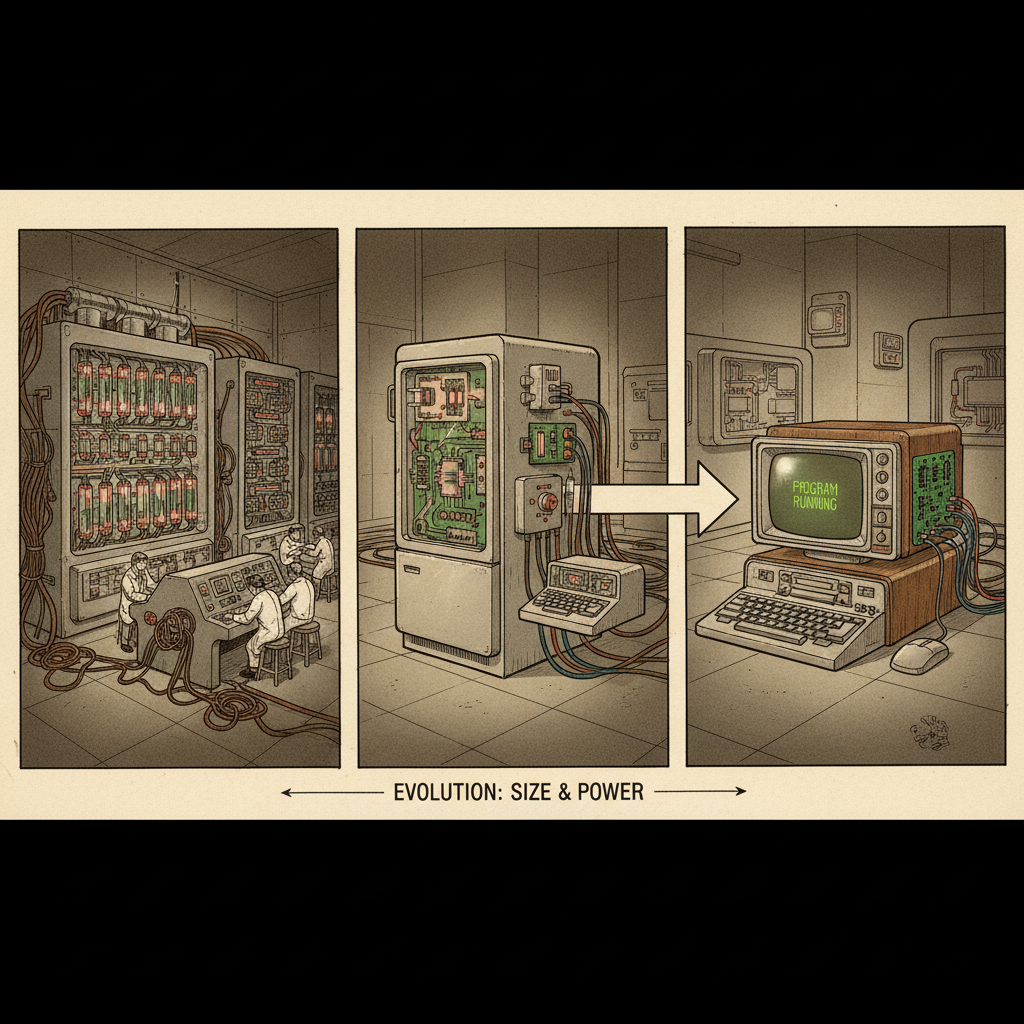 ⚠️ This picture may have spelling mistakes. Trust the words in the lesson.
Konrad Zuse and the Z3 (1941)
In Germany, Konrad Zuse built the Z3, which is often considered the world's first working, programmable, fully automatic digital computer. It used electromechanical relays (electrical switches) instead of gears.
The Z3 was like the first 'robot' that could actually follow a series of instructions on its own, without a human constantly turning cranks or pushing buttons for each step.
The Atanasoff-Berry Computer (ABC - 1937-1942)
John Atanasoff and Clifford Berry at Iowa State University built the ABC, considered the first electronic digital computing device. It used vacuum tubes for calculations and was specifically designed to solve systems of linear equations. It was digital (used binary numbers, 0s and 1s) and utilized regenerative memory.
The ABC was the first 'lightbulb moment' for electronic computing, using electricity to perform calculations directly, rather than mechanical parts.
ENIAC (Electronic Numerical Integrator and Computer - 1946)
Built at the University of Pennsylvania during World War II, the ENIAC was the first general-purpose *electronic* digital computer. It was enormous, weighing 30 tons, occupying 1,800 square feet, and containing over 17,000 vacuum tubes. It consumed a massive amount of power and generated a lot of heat, often causing its vacuum tubes to burn out.
ENIAC was like a giant, room-sized super-brain, capable of calculations hundreds of times faster than any mechanical machine, but it was temperamental and needed constant care, like a powerful but delicate giant.
Generations of Computing: The Era of Electronics and Miniaturization
The history of electronic computers is often divided into 'generations,' each marked by a significant technological leap that made computers faster, smaller, cheaper, and more powerful.
First Generation (1940s-1950s): Vacuum Tubes
Technology: These computers, like ENIAC and UNIVAC I, used vacuum tubes for their internal circuitry. Vacuum tubes are glass bulbs that control electric current, similar to old light bulbs, but much larger and hotter.
Characteristics: They were enormous, generated a lot of heat, consumed vast amounts of electricity, were very expensive, and often broke down. Programming was done in 'machine language,' a very low-level set of instructions specific to each computer.
Imagine trying to light up a city using thousands of huge, fragile, hot light bulbs. That's what a first-generation computer was like!
Second Generation (1950s-1960s): Transistors
Technology: The invention of the transistor at Bell Labs in 1947 was a game-changer. Transistors are tiny semiconductor devices that amplify or switch electronic signals and electrical power. They replaced bulky vacuum tubes.
Characteristics: Computers became much smaller, faster, more reliable, consumed less power, and were cheaper. This allowed them to be used more widely in business and scientific research. High-level programming languages like FORTRAN and COBOL were developed, making programming easier.
Replacing vacuum tubes with transistors was like swapping those giant light bulbs for tiny, efficient LED lights – smaller, cooler, and much more durable.
Third Generation (1960s-1970s): Integrated Circuits (ICs)
Technology: The next big leap was the Integrated Circuit (IC), or 'microchip.' Invented by Jack Kilby and Robert Noyce, an IC combined many transistors and other electronic components onto a single, tiny silicon chip.
Characteristics: Computers became even smaller, incredibly faster, more powerful, and cheaper to produce. This allowed for the development of minicomputers and the first operating systems, which managed the computer's resources and allowed multiple programs to run.
An Integrated Circuit was like taking an entire room full of electronic components and shrinking them down to fit onto a single postage stamp. Suddenly, a whole network of switches and wires could exist in a minuscule space.
Fourth Generation (1970s-Present): Microprocessors
Technology: This generation is defined by the microprocessor – an entire Central Processing Unit (CPU) on a single, tiny chip. Intel's 4004 chip (1971) was the first. This innovation led directly to personal computers.
Characteristics: This is the era of desktop computers, laptops, and later, smartphones. Computers became accessible to the general public, leading to the rise of software applications, graphical user interfaces (GUIs), networking, and the internet. Computers became incredibly powerful and affordable.
The microprocessor was like shrinking the entire 'brain' of a computer onto a single, tiny, affordable chip. This meant everyone could eventually have their own personal 'brain' on their desk, leading to a revolution in how we work, communicate, and learn.
Fifth Generation (Present & Future): Artificial Intelligence and Beyond
Technology: This generation focuses on developing computers that can understand natural language, learn, make decisions, and interact more intelligently with humans. This includes advancements in Artificial Intelligence (AI), parallel processing (computers doing many things at once), neural networks, and eventually quantum computing.
Characteristics: Computers are becoming even more intuitive, capable of tasks like voice recognition, image analysis, and complex problem-solving. We see this in virtual assistants, self-driving cars, and advanced medical diagnostics.
This generation aims to create computers that can not only follow instructions but also 'think' and 'understand' in ways that mimic human intelligence, making them true partners in problem-solving.
The Takeaway
From simple counting tools to incredibly complex smart devices, the history of computers is a story of continuous innovation. Each step, from mechanical gears to tiny microchips, has pushed the boundaries of what's possible, fundamentally changing the world we live in. Understanding this journey helps us appreciate the amazing technology we often take for granted today!
Keep learning, free
Create a free Syllabax account to unlock practice questions and games for this topic.
Visual Learning Enhanced! 🚀
To help you master this topic, we use Advanced Syllabax AI to generate detailed diagrams and visual models.
Note on Visuals: The AI sometimes makes spelling errors in image labels. Please refer to the lesson text for the correct terminology.