Advantages & disadvantages[PHYSICS]
Watch this topic in 60 seconds
Free preview · Lesson 1
Understanding Advantages & disadvantages[PHYSICS]
Understanding Forces: Advantages and Disadvantages
Welcome to our exploration of forces in physics! Forces are all around us, pushing and pulling objects, making things move, and keeping them in place. Think of a force as a push or a pull. When you kick a soccer ball, you're applying a force to it. When gravity pulls an apple down from a tree, that's a force too! Understanding forces helps us understand how the world works.
What is a Force?
A force is an interaction that, when unopposed, will change the motion of an object. It can cause an object with mass to change its velocity (which includes being put into motion where it was previously at rest, or stopping an object that was in motion). Forces can also be used to overcome inertia, deform an object, or even make it spin.
Imagine you have a toy car. If you don't push it, it just sits there. But when you push it (apply a force!), it starts to move. If you pull on a rope, you're applying a force. Forces are everywhere!
Types of Forces
There are many types of forces, but for now, let's focus on a few common ones:
- Contact Forces: These forces happen when objects touch each other. Think of pushing a box across the floor. Your hands are touching the box.
- Non-Contact Forces (or Action-at-a-Distance Forces): These forces act even when objects aren't touching. Gravity is a great example. The Earth pulls you down even though you're not touching it! Magnetism is another non-contact force.
Advantages of Forces
Forces are essential for almost everything we do and experience. They are the 'movers and shakers' of the universe!
- Making Things Move: Without forces, nothing would ever start moving. Imagine trying to walk without pushing your feet against the ground, or trying to ride a bike without pedaling. Forces allow us to initiate motion. Think of a car engine using forces to push the car forward.
- Stopping Things: Forces are also crucial for slowing down or stopping moving objects. When you apply the brakes on a bicycle, you're using friction (a type of contact force) to slow the wheels down. This is super important for safety! Imagine trying to stop a runaway train without any brakes – that would be a disaster!
- Changing Direction: Forces can change the direction of a moving object. When a baseball player hits a ball, they apply a force to change its direction. Steering a car also involves applying forces to change its direction.
- Holding Things Together: Forces keep things from falling apart. Gravity holds us to the Earth. The forces between atoms hold materials together, like the glue that holds your book together. The force of friction between your shoes and the ground prevents you from slipping.
- Performing Work: In physics, 'work' is done when a force causes an object to move a certain distance. So, any time a force makes something move, it's doing work. This is how machines help us – they use forces to do work more easily. Think of a crane lifting heavy objects; it uses forces to do work.
Disadvantages (or Challenges) of Forces
While forces are incredibly useful, sometimes they can cause problems or present challenges.
- Wear and Tear: Friction, which is so useful for stopping things, can also cause wear and tear on objects. The tires on your bike wear down over time due to friction with the road. Engine parts rub against each other, causing them to wear out. This means things need to be replaced or repaired.
- Resistance and Effort: Sometimes, forces can resist motion, making it harder for us to do something. Imagine trying to push a heavy piece of furniture across a rough carpet. The friction is high, and you have to apply a lot of force to move it. This requires more effort and energy.
- Damage and Destruction: Very large forces can cause damage. A strong wind (which is moving air applying force) can damage buildings. A car crash involves very large forces that can cause significant damage to the vehicles and their occupants. Earthquakes involve massive forces that can reshape the land and destroy structures.
- Unwanted Effects: Sometimes, forces can have unintended consequences. For example, the force of air resistance slows down airplanes and cars, making them less efficient. While we can't eliminate air resistance, we design vehicles to minimize it.
- Requiring Energy: To apply a force that causes motion, we often need to use energy. This could be our own energy (like when we walk) or energy from a source (like electricity for a motor). Sometimes, generating this energy can have its own drawbacks, such as pollution from burning fossil fuels.
Analogy Time!
Let's think about forces using some everyday examples:
Pushing a Swing:
- Advantage: When you push a swing, you apply a force to make it move back and forth. This is fun! You're using force to create motion and keep the swing going.
- Disadvantage: If you push too hard or at the wrong time, the person on the swing might get scared or fall off! Also, the ropes or chains holding the swing might eventually wear out due to the repeated motion (friction and stress).
Magnets:
- Advantage: Magnets can attract or repel each other without touching! This is useful in many devices, like refrigerator magnets holding notes or in more complex things like magnetic levitation trains that float above the tracks.
- Disadvantage: If you're trying to put two magnets together the wrong way, they'll push each other apart (repel), making it difficult. Also, strong magnets can accidentally attract and damage electronic devices if they get too close.
Gravity:
- Advantage: Gravity is what keeps your feet on the ground, the moon in orbit around the Earth, and the Earth in orbit around the Sun. It holds everything together! It's essential for life as we know it.
- Disadvantage: Gravity can also make things difficult. Lifting heavy objects requires overcoming gravity, which takes effort. If you fall, gravity pulls you down, which can cause injury. On other planets with stronger gravity, it would be much harder to move around.
Visualizing Forces
Forces have both a strength (how big the push or pull is) and a direction. We often represent forces using arrows. The longer the arrow, the stronger the force. The way the arrow points shows the direction of the force.
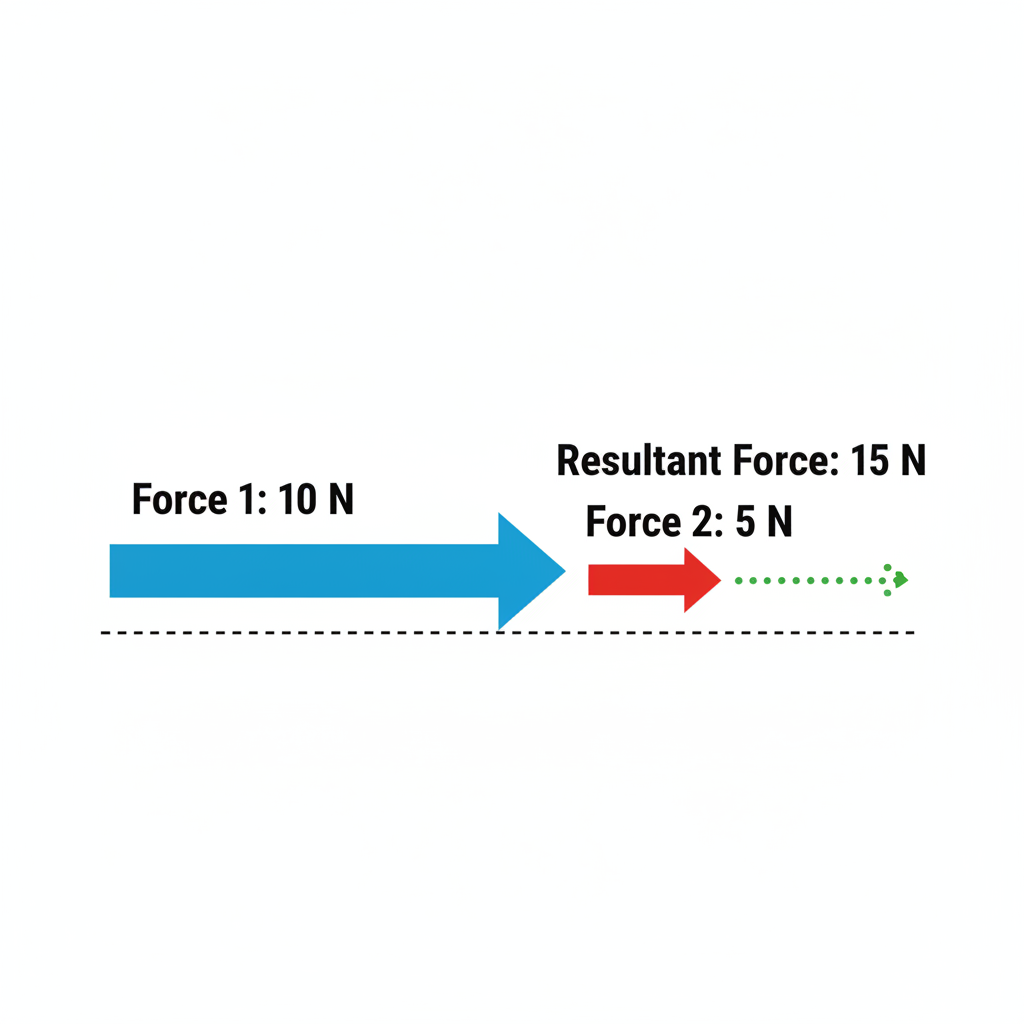
Understanding the advantages and disadvantages of forces helps us build better machines, design safer structures, and simply understand the physical world around us more deeply. Forces are fundamental to physics, and by learning about them, you're learning the language of how the universe operates!
Keep learning, free
Create a free Syllabax account to unlock practice questions and games for this topic.
Visual Learning Enhanced! 🚀
To help you master this topic, we use Advanced Syllabax AI to generate detailed diagrams and visual models.
Note on Visuals: The AI sometimes makes spelling errors in image labels. Please refer to the lesson text for the correct terminology.