What is Coding?
Watch this topic in 60 seconds
Free preview · Lesson 1
Understanding What is Coding?
Unlocking the Digital World: What is Coding? (For 6th Graders)
Have you ever wondered how your favorite video games work? Or how websites like YouTube or TikTok know exactly what videos to show you? What about the apps on your phone that help you chat with friends or learn new things? The secret behind all these amazing digital creations is something called coding!
Think of Coding Like Giving Instructions
Imagine you want to bake a batch of delicious cookies. You wouldn't just throw ingredients into a bowl and hope for the best, right? No, you'd follow a recipe! A recipe is a set of step-by-step instructions that tells you exactly what to do, in what order, to get those yummy cookies.
Coding is just like writing a recipe, but for a computer! Instead of telling a chef how to bake, you're telling a computer exactly what to do, step by tiny step. Computers are incredibly smart, but they're also very literal. They don't understand hints or suggestions; they need clear, precise instructions for every single action.
Analogy 1: The Cookie Recipe
If you tell a computer, "Make me a game!" it would have no idea what to do. It would be like telling your friend, "Make me food!" without saying what food or how to make it. But if you code, "First, draw a character. Second, make the character move right when the 'D' key is pressed. Third, make the character jump when the spacebar is pressed..." then the computer understands!
What Language Do Computers Speak?
We humans speak many different languages, like English, Spanish, or Mandarin. Computers also have their own languages. The computer's most basic language is made up of just two things: 0s and 1s. This is called binary code, like an on/off switch. Imagine trying to write a whole game using only 0s and 1s – it would be super hard and take forever!
That's why brilliant people invented programming languages. These are special languages, like Python, JavaScript, or Scratch, that are easier for humans to understand and write. They let us give instructions to computers using words and symbols that make more sense to us, and then a special program translates those instructions into the 0s and 1s that the computer understands.
Analogy 2: Translators for Computers
Think of programming languages as a translator. If you speak English and want to talk to someone who only speaks French, you'd need a translator, right? Programming languages are like those translators, converting your ideas into something the computer can act upon. Each programming language is designed for different types of tasks, like building websites, creating games, or making apps.
What Can You Create with Coding?
The possibilities with coding are almost endless! Anything digital you interact with, from your smartwatch to a self-driving car, has code behind it. Here are just a few examples:
- Video Games: Every character, every jump, every level, every score – it's all built with code.
- Websites: The pages you browse, the buttons you click, the videos you watch online.
- Mobile Apps: From social media to learning apps, they all run on code.
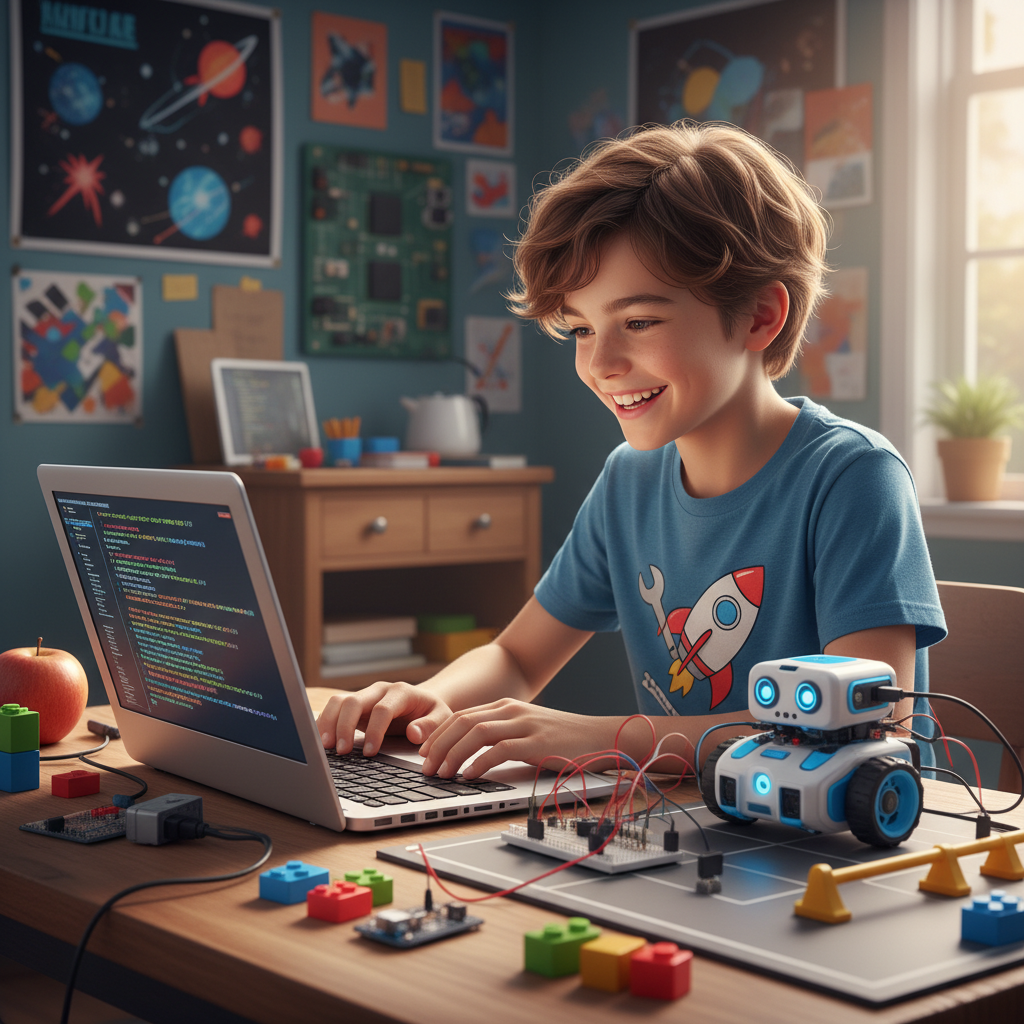
- Robotics: Telling robots how to move, what to pick up, or how to react to their environment.
- Animation & Movies: Special effects in movies often involve complex coding.
- Smart Devices: Your smart home devices, like light bulbs you control with your voice, use code.
Coding is like having a superpower that lets you bring your ideas to life in the digital world. You're not just using technology; you're building it!
Why is Coding Important?
Learning to code isn't just about becoming a computer programmer (though that's a cool job!). It teaches you many valuable skills that are useful in every part of life:
- Problem-Solving: When your code doesn't work, you have to figure out why and how to fix it. This is called 'debugging' and it's like solving a puzzle!
- Logical Thinking: You learn to break down big problems into smaller, manageable steps. This is a process called creating an algorithm (which is just a fancy word for a step-by-step plan).
- Creativity: Coding is a fantastic way to express your ideas and build something entirely new from scratch.
- Attention to Detail: Computers need exact instructions, so coding helps you be precise.
- Future Skills: The world around us is becoming more and more digital. Understanding how code works gives you a powerful advantage in almost any future career.
Analogy 3: Building with LEGOs
Think of coding like building with LEGOs. Each line of code is a small brick. By carefully putting these bricks together in the right order and configuration, you can build anything from a simple car to an enormous castle. Your imagination is the only limit!
In Summary: Your Journey Begins!
Coding is the exciting process of giving computers precise, step-by-step instructions using special languages to create everything from games and apps to websites and robots. It's a powerful tool that helps you develop critical thinking, problem-solving, and creativity. Get ready to become a digital architect and build the future!
Keep learning, free
Create a free Syllabax account to unlock practice questions and games for this topic.
Visual Learning Enhanced! 🚀
To help you master this topic, we use Advanced Syllabax AI to generate detailed diagrams and visual models.
Note on Visuals: The AI sometimes makes spelling errors in image labels. Please refer to the lesson text for the correct terminology.