4-digit, 5-digit, and early 6-digit numbers (Number Sense)
Watch this topic in 60 seconds
Free preview · Lesson 1
Understanding 4-digit, 5-digit, and early 6-digit numbers (Number Sense)
Understanding Big Numbers: 4-Digit, 5-Digit, and Early 6-Digit Numbers (Number Sense)
Welcome, young mathematicians! Today, we're going on an adventure into the world of big numbers. We've already explored numbers with one, two, and three digits, like 7, 35, and 123. Think of those as small steps on a path. Now, we're going to take bigger leaps and understand numbers with four, five, and even the beginnings of six digits!
What is Number Sense?
Before we dive into the big numbers, let's talk about "number sense." Imagine you have a big bag of marbles. Number sense is like having a superpower that helps you guess how many marbles are in the bag without counting every single one. It's about understanding how numbers work, how big or small they are, and how they relate to each other. It's like knowing that 10 is more than 5, or that 100 is much bigger than 20.
Let's Start with 4-Digit Numbers (Thousands!)
Remember 3-digit numbers? The biggest one is 999. What happens if we add just one more to it? 999 + 1 = 1000! This is our first 4-digit number. The '1' is in a new place: the thousands place.
Think of numbers like building blocks. For 3-digit numbers, we had ones, tens, and hundreds. For 4-digit numbers, we add a new, bigger block: the thousands block.
- Ones Place: The rightmost digit, just like before.
- Tens Place: The second digit from the right.
- Hundreds Place: The third digit from the right.
- Thousands Place: The fourth digit from the right. This is where the '1' sits in 1000.
Analogy: Imagine you're collecting stickers. You have books for 10 stickers (tens), notebooks for 100 stickers (hundreds). Now, you get a big album that holds 1000 stickers! That album is like the thousands place. When you have 10 of those big albums, you're ready for even bigger collections!
So, 1000 means one group of a thousand. What about 2000? That's two groups of a thousand. And 5000? Five groups of a thousand. What about 3456? This means:
- 3 thousands (3000)
- 4 hundreds (400)
- 5 tens (50)
- 6 ones (6)
Put it all together: 3000 + 400 + 50 + 6 = 3456. We read this as "three thousand, four hundred fifty-six." We use a comma after the thousands digit to help us read these big numbers more easily.
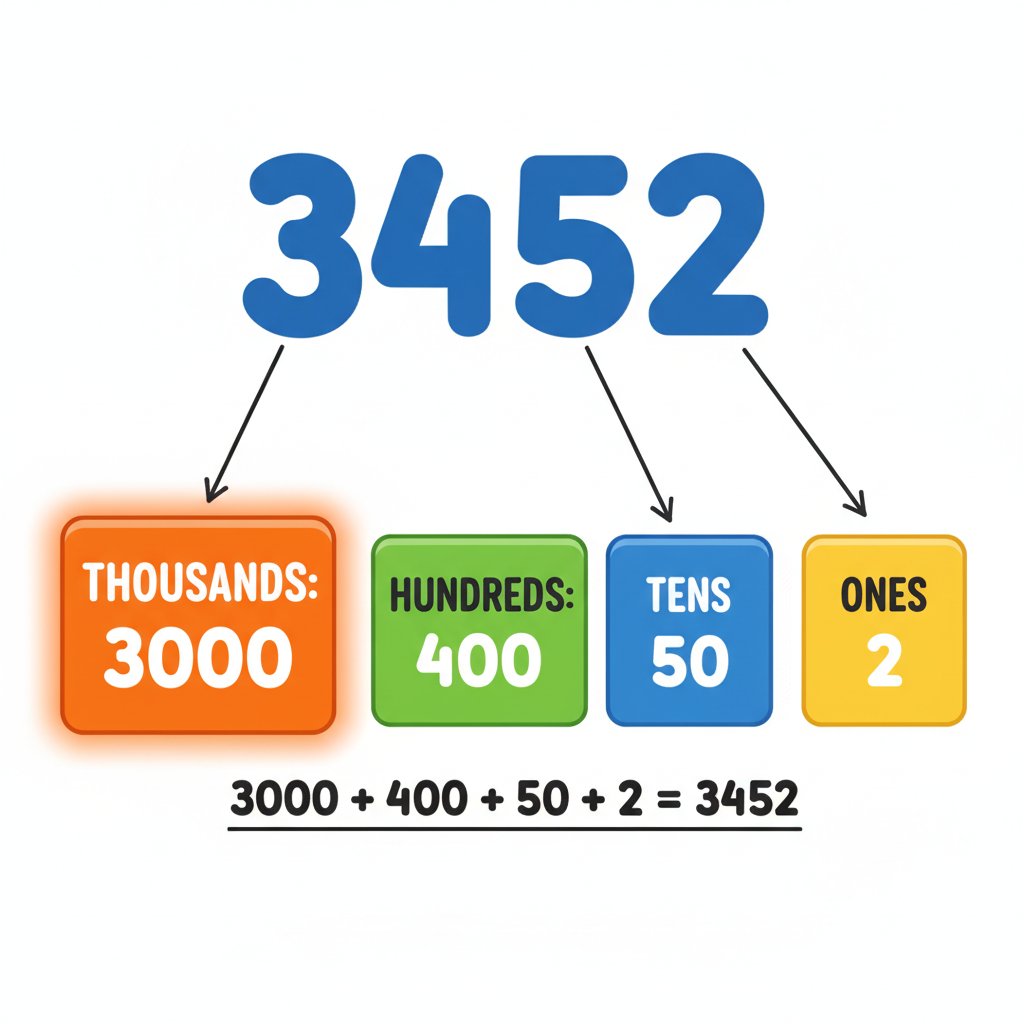 ⚠️ This picture may have spelling mistakes. Trust the words in the lesson.
Moving to 5-Digit Numbers (Ten Thousands!)
What happens after 9999? If we add 1 to it, we get 10000! This is our first 5-digit number. Now, we have a new place value: the ten thousands place.
Think of it this way: we had one big album for 1000 stickers. Now, imagine we have 10 of those big albums, all bundled together. That bundle is like 10,000 stickers. The '1' in 10000 is in the ten thousands place.
- Ones Place
- Tens Place
- Hundreds Place
- Thousands Place
- Ten Thousands Place: The fifth digit from the right.
Analogy: Let's go back to our sticker collection. A thousand stickers filled one big album. Now, imagine you have 10 of those big albums. That collection of 10 albums is like 10,000 stickers. The '1' in 10,000 represents one of these bundles of ten albums. If you have 20,000, you have two bundles of ten albums. If you have 50,000, you have five bundles of ten albums.
What about a number like 34567? This means:
- 3 ten thousands (30,000)
- 4 thousands (4,000)
- 5 hundreds (500)
- 6 tens (60)
- 7 ones (7)
Put it together: 30,000 + 4,000 + 500 + 60 + 7 = 34567. We read this as "thirty-four thousand, five hundred sixty-seven." Notice the comma after the ten thousands digit, separating the ten thousands and thousands from the rest of the number. It helps us group the numbers.
The Beginning of 6-Digit Numbers (Hundred Thousands!)
We're getting really big now! What comes after 99999? Adding 1 gives us 100000. This is our first 6-digit number! The '1' is in the hundred thousands place.
Let's use our sticker analogy again. We had bundles of 10 albums (10,000 stickers). Now, imagine we have 10 of *those* bundles. That's 10 x 10,000 = 100,000 stickers! The '1' in 100000 represents one group of one hundred thousand.
- Ones Place
- Tens Place
- Hundreds Place
- Thousands Place
- Ten Thousands Place
- Hundred Thousands Place: The sixth digit from the right.
Analogy: Think about building a giant tower with toy blocks. Each block is worth 1. A stack of 10 blocks is like 10. A stack of 100 blocks is like 100. A stack of 1000 blocks is like 1000. A stack of 10,000 blocks is like 10,000. Now, imagine you have 10 stacks of 10,000 blocks. That's 100,000 blocks in total! The '1' in 100,000 is like having one giant group made of those 100,000 blocks.
A number like 567890 means:
- 5 hundred thousands (500,000)
- 6 ten thousands (60,000)
- 7 thousands (7,000)
- 8 hundreds (800)
- 9 tens (90)
- 0 ones (0)
Put it all together: 500,000 + 60,000 + 7,000 + 800 + 90 + 0 = 567890. We read this as "five hundred sixty-seven thousand, eight hundred ninety." We use two commas for 6-digit numbers: one after the hundred thousands digit and one after the thousands digit. This breaks the number into chunks: 567,890.
Comparing Big Numbers
How do we know if one big number is bigger than another? It's like comparing heights!
- Count the Digits: The number with more digits is usually bigger. For example, 10,000 (5 digits) is bigger than 999 (3 digits).
- Compare from Left to Right: If the numbers have the same number of digits, start from the leftmost digit (the biggest place value) and compare them. The number with the larger digit in that place is the bigger number.
Example: Which is bigger, 45,678 or 42,987?
- Both numbers have 5 digits.
- Start from the leftmost digit: Both have '4' in the ten thousands place. They are the same.
- Move to the next digit to the right: The first number has '5' in the thousands place, and the second has '2'.
- Since 5 is bigger than 2, 45,678 is bigger than 42,987.
Number Lines for Big Numbers
Just like we used number lines for smaller numbers, we can use them for bigger ones too! We just need to make the jumps much larger. Instead of jumping by 1s or 10s, we might jump by 1000s or 10000s.
Analogy: Imagine a road trip. Your starting point is 0. You might drive 1000 miles to the next town, then another 1000 miles to the next. Your number line shows the mile markers (1000, 2000, 3000...). Understanding where numbers like 45,000 or 120,000 fall on a very long road helps you understand their size.
Key Concepts Recap
- Place Value: Each digit in a number has a value based on its position (ones, tens, hundreds, thousands, ten thousands, hundred thousands).
- Reading Big Numbers: Use commas to separate groups of three digits from the right. This helps you read numbers like 12,345 (twelve thousand, three hundred forty-five) or 567,890 (five hundred sixty-seven thousand, eight hundred ninety).
- Comparing Numbers: Start with the number of digits, then compare from left to right.
Keep practicing, and you'll become a master of big numbers in no time!
Keep learning, free
Create a free Syllabax account to unlock practice questions and games for this topic.
Visual Learning Enhanced! 🚀
To help you master this topic, we use Advanced Syllabax AI to generate detailed diagrams and visual models.
Note on Visuals: The AI sometimes makes spelling errors in image labels. Please refer to the lesson text for the correct terminology.