Series & patterns (Logical Reasoning)
Watch this topic in 60 seconds
Free preview · Lesson 1
Understanding Series & patterns (Logical Reasoning)
Mastering Series & Patterns: Your Introduction to Logical Reasoning (Grade 10)
Welcome, future problem-solvers! Today, we're going to unlock the fascinating world of series and patterns. Don't worry if these terms sound a bit complex; we'll break them down into simple, easy-to-understand concepts, just like learning to ride a bike one step at a time. This topic is super important because it sharpens your logical reasoning skills, which are useful not just in math, but in everyday life, from predicting weather to understanding a story's plot!
What Exactly is a Series?
Imagine a line of dominoes falling one after another, or steps on a ladder climbing upwards. A series is very similar! In simple terms, a series is just a sequence of numbers, letters, or even figures that follow a specific rule or a logical order. It’s like a story where each chapter builds on the previous one.
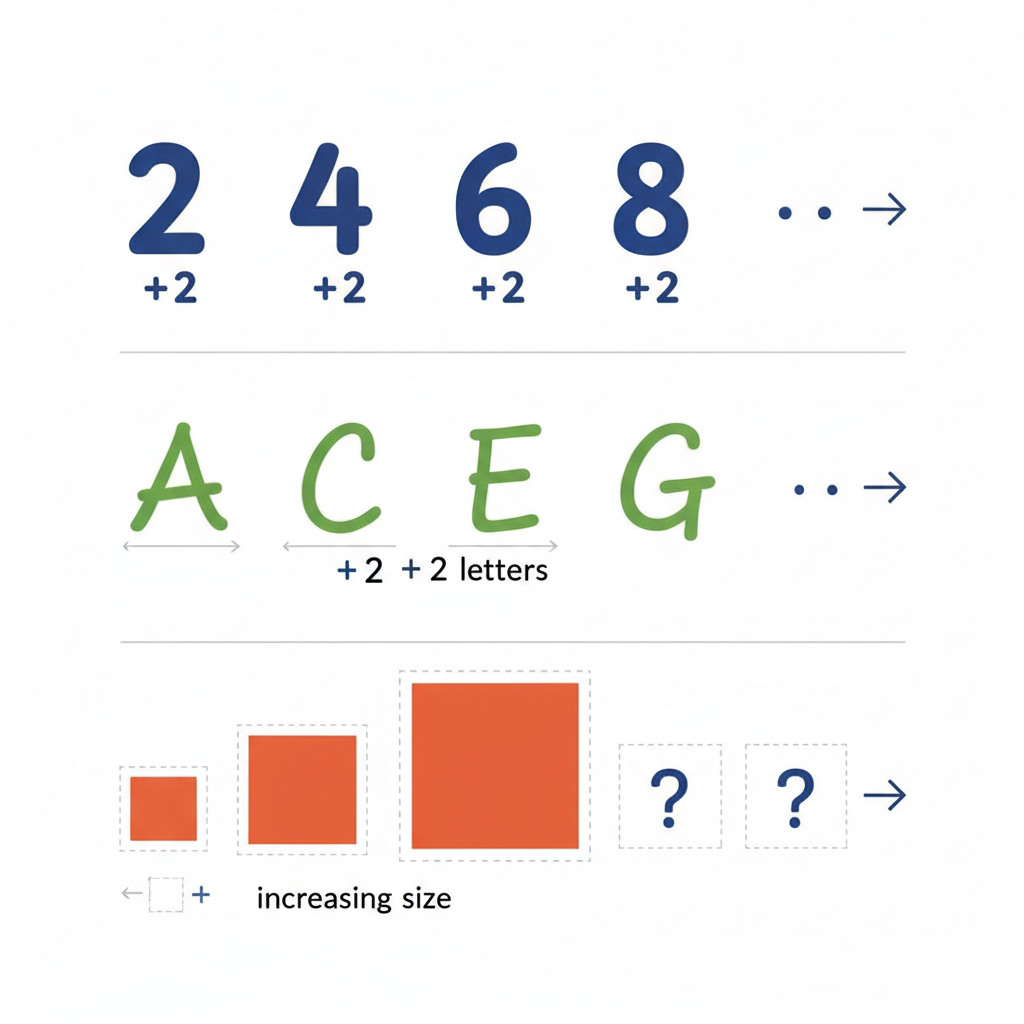
Think of it this way: If you count by 2s (2, 4, 6, 8...), that's a series. If you list the days of the week (Monday, Tuesday, Wednesday...), that's also a series. Each item in the series is called a 'term'.
And What About a Pattern?
A pattern is the hidden rule or the secret code that connects the terms in a series. It's like the repeating design on your wallpaper, or the predictable sequence of events in your daily routine (wake up, eat breakfast, go to school, eat lunch...). Once you discover the pattern, you can predict what comes next! Finding the pattern is like being a detective solving a mystery – you look for clues to understand the underlying rule.
So, a series is the list of items, and the pattern is the rule that generates that list.
Common Types of Series and Patterns
There are many kinds of patterns out there, but let's focus on the most common ones you'll encounter:
1. Arithmetic Series (Adding or Subtracting)
This is one of the simplest patterns! In an arithmetic series, the difference between consecutive terms is always the same. It's like climbing a staircase where every step has the exact same height.
- Analogy: Imagine you're saving money, and every week you add exactly
- Example: 3, 6, 9, 12, ?
- Pattern: Each number is 3 more than the previous one (+3). So, the next number would be 12 + 3 = 15.
- Another Example: 20, 18, 16, 14, ?
- Pattern: Each number is 2 less than the previous one (-2). So, the next number would be 14 - 2 = 12.
2. Geometric Series (Multiplying or Dividing)
In a geometric series, instead of adding or subtracting a constant value, you multiply or divide by a constant value. It's like when a recipe calls for doubling all ingredients, or when a population of bacteria grows by multiplying.
- Analogy: Think about a chain letter where you send a letter to 2 friends, and each of those friends sends it to 2 more friends. The number of letters would grow like this: 1, 2, 4, 8, 16... Each number is multiplied by 2.
- Example: 2, 4, 8, 16, ?
- Pattern: Each number is multiplied by 2 (*2). So, the next number would be 16 * 2 = 32.
- Another Example: 81, 27, 9, 3, ?
- Pattern: Each number is divided by 3 (/3). So, the next number would be 3 / 3 = 1.
3. Fibonacci Series (Adding the Previous Two)
The Fibonacci series is a very special and famous pattern where each number (after the first two) is the sum of the two preceding ones. It appears surprisingly often in nature!
- Analogy: Imagine a family tree where you add the number of your two immediate ancestors to get the next generation's count (this is a simplified analogy). A more famous analogy is how rabbits reproduce or how spirals form in sunflowers.
- Example: 0, 1, 1, 2, 3, 5, 8, ?
- Pattern: 0+1=1, 1+1=2, 1+2=3, 2+3=5, 3+5=8. So, the next number would be 5 + 8 = 13.
4. Alphabetical Series
These patterns use letters of the alphabet instead of numbers. The trick here is often to think of each letter as having a numerical position (A=1, B=2, C=3, and so on).
- Analogy: It's like a special alphabet train where some carriages are skipped according to a rule.
- Example: A, C, E, G, ?
- Pattern: Each letter skips one letter (B, D, F). So, the next letter after G (skipping H) would be I.
- Another Example: Z, X, V, T, ?
- Pattern: Letters are going backward, skipping one letter each time (Y, W, U, S). So, the next letter would be R.
5. Mixed/Combined Series
Sometimes, patterns can be a bit trickier, combining two or more simple rules. It's like a puzzle that requires you to use multiple kinds of pieces to solve it.
- Analogy: Think of a dance routine that combines steps from different styles like ballet and hip-hop. You need to recognize both elements.
- Example: 1, 4, 3, 6, 5, 8, ?
- Pattern: This one alternates! Look at the odd-positioned terms (1, 3, 5) – they are increasing by 2 (+2). Look at the even-positioned terms (4, 6, 8) – they are also increasing by 2 (+2). So, the next term, being an odd-positioned term, would follow 5 + 2 = 7.
Strategies for Finding the Pattern (Your Detective Toolkit!)
Becoming good at finding patterns is like building a detective's toolkit. Here are some tools:
- Look for the Difference: For number series, always try subtracting the first term from the second, the second from the third, and so on. If the differences are constant, it's likely an arithmetic series.
- Look for the Ratio: If the differences aren't constant, try dividing the second term by the first, the third by the second, etc. If the ratios are constant, it's likely a geometric series.
- Check for Alternating Patterns: Sometimes, every other term follows one rule, and the terms in between follow another (like in the mixed series example above).
- Consider Position: For alphabetical series, assign a numerical value to each letter (A=1, B=2...). Then, look for numerical patterns.
- Look for Squares or Cubes: Sometimes numbers are perfect squares (1, 4, 9, 16...) or cubes (1, 8, 27, 64...).
- Try Simple Operations: Don't overthink! Many patterns simply involve adding, subtracting, multiplying, or dividing by small numbers.
- Practice, Practice, Practice: The more you solve, the better you get at recognizing common patterns quickly!
Why is This Important? (Beyond the Classroom)
Understanding series and patterns isn't just for tests. It's a fundamental part of logical reasoning. This skill helps you to:
- Solve problems: Break down complex problems into smaller, manageable parts.
- Make predictions: Anticipate outcomes based on observed trends.
- Critical thinking: Evaluate information and identify underlying structures.
- Data analysis: See trends in data, from stock markets to scientific experiments.
So, every time you solve a pattern problem, you're not just finding a missing number; you're strengthening your brain's ability to think logically and solve real-world challenges!
Conclusion
You've now taken your first big step into the world of series and patterns! Remember, a series is a list of items, and a pattern is the rule connecting them. You've learned about arithmetic, geometric, Fibonacci, alphabetical, and mixed patterns. With your new 'detective toolkit' of strategies and a little practice, you'll be identifying and solving patterns like a pro in no time!
Keep learning, free
Create a free Syllabax account to unlock practice questions and games for this topic.
Visual Learning Enhanced! 🚀
To help you master this topic, we use Advanced Syllabax AI to generate detailed diagrams and visual models.
Note on Visuals: The AI sometimes makes spelling errors in image labels. Please refer to the lesson text for the correct terminology.