Embedded Figures – Non – Verbal Reasoning (Diagrammatic)
Watch this topic in 60 seconds
Free preview · Lesson 1
Embedded Figures – Non – Verbal Reasoning (Diagrammatic) (Foundational)
Welcome, Super Sleuths! Let's Uncover Hidden Shapes!
Hey there, future problem-solvers! Have you ever played a game where you had to find a specific object hidden in a busy picture? Like finding Waldo, or a tiny toy lost in a big pile? Well, today we're going to learn about something very similar, but with shapes! It's called Embedded Figures, and it's super fun and helps train your eyes to spot details.
What are Embedded Figures?
Imagine you have a small, simple shape – maybe a triangle or a square. Now, imagine that small shape is hiding inside a much bigger, more complex picture. Your job is to find that tiny, hidden shape without changing its size or turning it around (for our foundational level, we'll keep it simple!).
- The Embedded Figure is the small, simple shape you need to find. Think of it as the 'secret agent' hiding.
- The Complex Figure is the big, busy picture where the embedded figure is hiding. This is the 'crowded room' where our agent is blending in.
Why is this important?
Learning to find embedded figures isn't just a game! It helps you build awesome skills like:
- Observation Skills: This is your ability to look closely and notice details. It's like having 'eagle eyes'!
- Problem-Solving: You're figuring out a puzzle, which makes your brain stronger at solving all sorts of problems.
- Focus: It teaches you to concentrate and not get distracted by all the other lines and shapes around the one you're looking for.
How Do We Find the Hidden Shapes? (Your Detective Steps!)
Finding embedded figures is like being a shape detective. Here's your step-by-step guide:
-
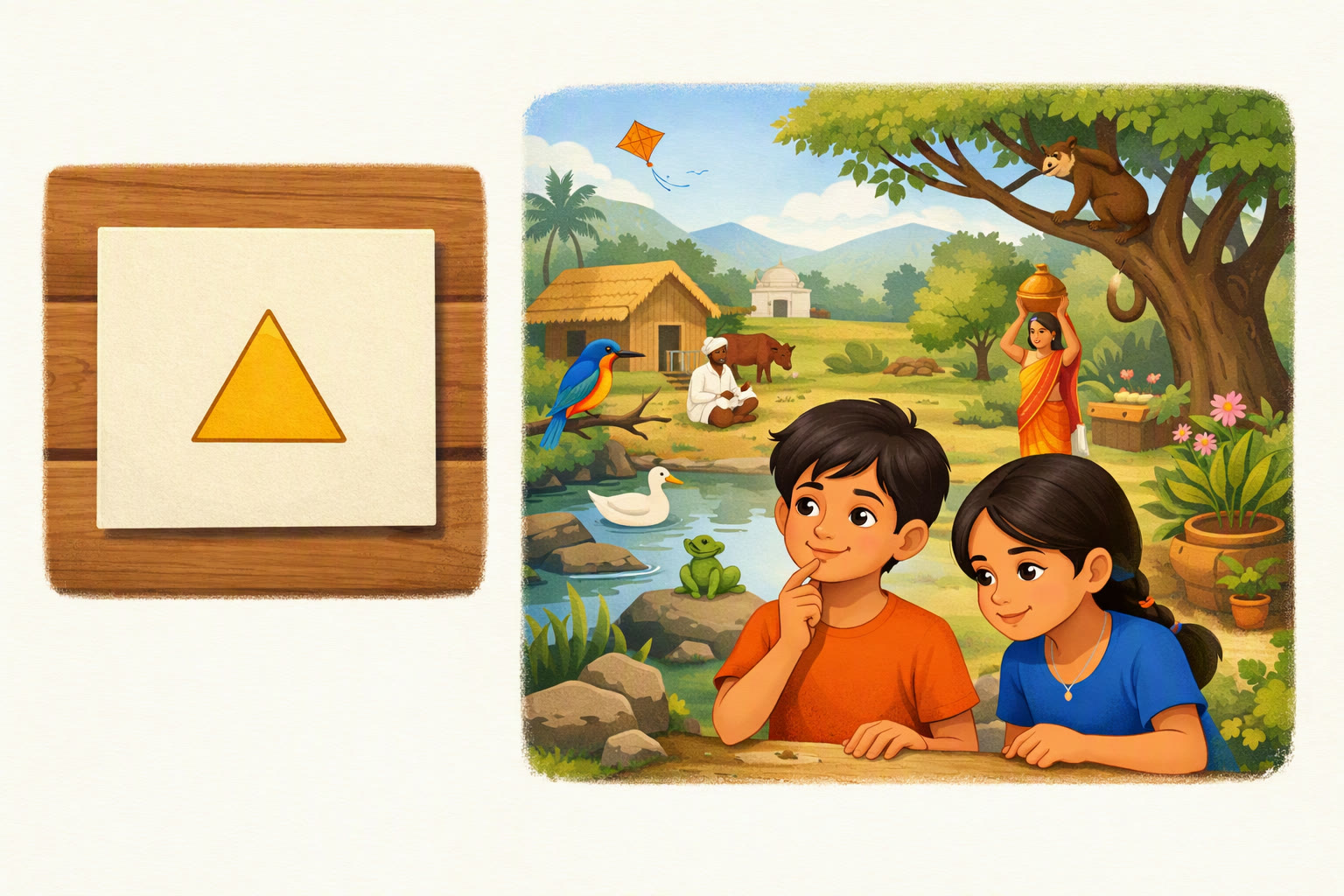
Look at the Embedded Figure FIRST: This is the small shape you're looking for. Memorize it! What does it look like? How many sides does it have? Are its lines straight or curved?
-
Scan the Complex Figure: Now, look at the big, busy picture. Don't rush! Let your eyes wander over all the lines and corners.

- Mentally Trace: As you look at the complex figure, try to imagine drawing the embedded figure within it. Can you find the exact lines that make up your target shape?
- Match Exactly: The embedded figure must be exactly the same size and orientation (facing the same way) as the one you're looking for. It can't be bigger, smaller, or turned upside down (for our foundational level).
- Don't Be Tricked: Sometimes, parts of the complex figure might look almost like your embedded figure, but not quite. Be careful to find an exact match!
Let's See an Example:
Imagine your Embedded Figure is a simple square.
Now, look at this Complex Figure:

Can you find the square hidden in the window frame? Yes! One of the window panes is a perfect square. The other lines in the window frame just form the 'complex' part of the figure.
You've got this! With a little practice, your eyes will become super sharp at spotting these hidden gems.
Keep learning, free
Create a free Syllabax account to unlock practice questions and games for this topic.
Visual Learning Enhanced! 🚀
To help you master this topic, we use Advanced Syllabax AI to generate detailed diagrams and visual models.
Note on Visuals: The AI sometimes makes spelling errors in image labels. Please refer to the lesson text for the correct terminology.