Learning Journey
Watch this topic in 60 seconds
Free preview · Lesson 1
Understanding Conversion: fractions ↔ decimals [Decimals]
Understanding Decimals: A Journey from Parts to Whole Numbers
Welcome, young mathematicians, to the exciting world of decimals! You already know about fractions, those wonderful ways to talk about parts of a whole, like half a pizza or a quarter of an hour. Decimals are like a secret code that lets us write these same parts using a special dot called a decimal point. Think of it as another way to slice the same pie!
What Exactly is a Decimal?
A decimal is a number that uses a decimal point to separate the whole number part from the fractional part. It's like a highway divider! Everything to the left of the decimal point is a whole number (like 1, 2, 3, or even 100!), and everything to the right represents parts of a whole.
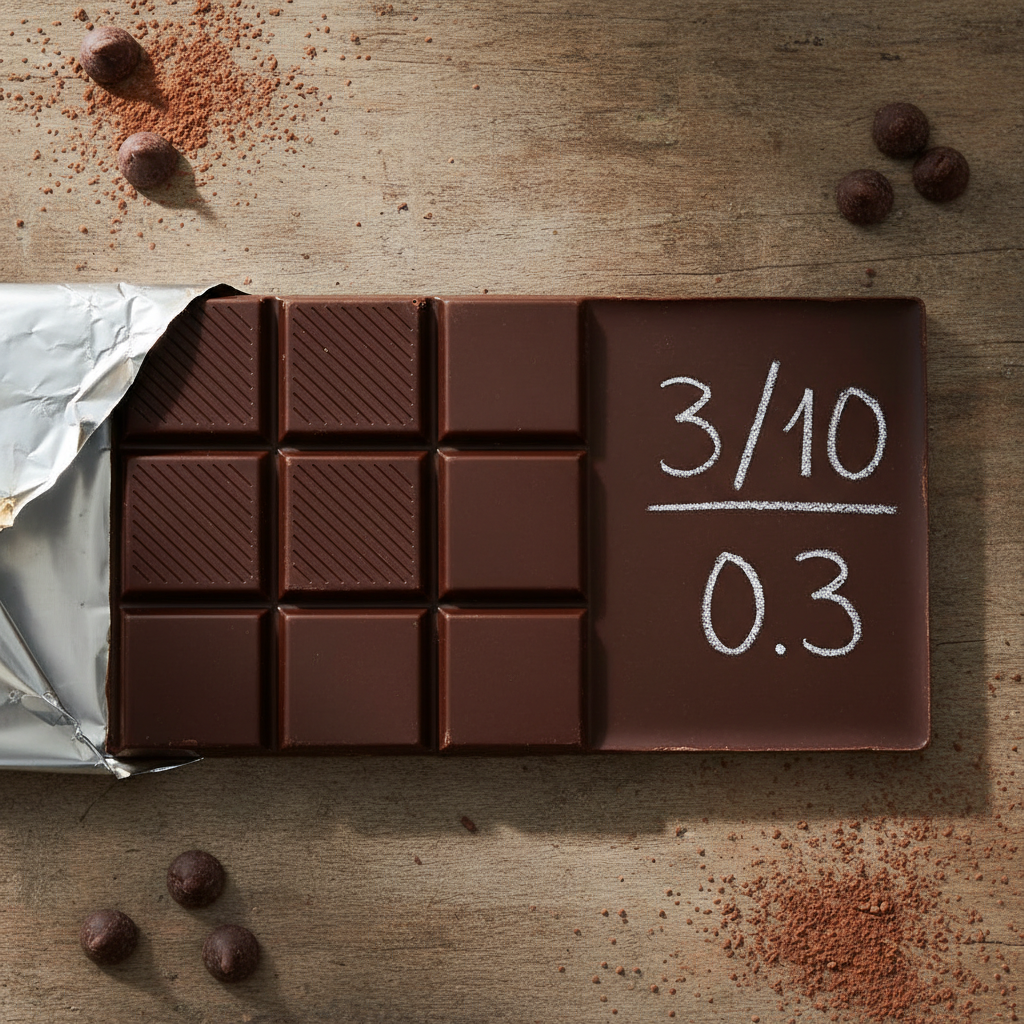
Imagine you have a yummy chocolate bar. If the whole bar is '1', then half the bar can be written as a fraction: 1/2. In decimal form, that same half is written as 0.5. See? It's just a different way to say the same thing. The '0' before the dot tells us there are no whole bars, and the '5' after the dot tells us we have 'five tenths' of a bar.
The Magic of Place Value with Decimals
Just like with whole numbers where each digit has a special job based on its position (ones, tens, hundreds), the digits after the decimal point also have important jobs. Let's look at this with our chocolate bar example:
- The Tenths Place: This is the first digit immediately to the right of the decimal point. If we divide our chocolate bar into 10 equal pieces, one piece is 1/10 of the bar. As a decimal, this is 0.1. Two pieces would be 2/10, or 0.2. It's like having 'ten small squares' as the smallest pieces you can break the bar into.
- The Hundredths Place: This is the second digit to the right of the decimal point. If we take each of those 10 pieces and cut them into 10 even smaller pieces, we now have 100 tiny pieces in total! One of these tiny pieces is 1/100 of the whole bar. As a decimal, this is 0.01. Two of these tiny pieces would be 2/100, or 0.02. Think of this as having 'one hundred tiny squares' in your chocolate bar.
- The Thousandths Place: You guessed it! This is the third digit to the right. If we cut each hundredth piece into 10, we get 1000 tiny pieces! One of these is 1/1000, or 0.001.
So, a number like 0.75 means 'seven tenths and five hundredths'. It's like saying you have 7 of the 'ten small squares' and 5 of the 'hundred tiny squares'. Together, these make up 75 out of the 100 tiny squares, which is 75/100!
Connecting Fractions and Decimals: The Big Picture
Fractions and decimals are like best friends who can talk to each other. They represent the same ideas, just in different languages. Here’s how they are related:
- Fractions with denominators of 10, 100, 1000, etc., are super easy to turn into decimals.
- A fraction like 3/10 becomes 0.3. The '3' goes in the tenths place.
- A fraction like 15/100 becomes 0.15. The '1' goes in the tenths place, and the '5' goes in the hundredths place.
- A fraction like 7/100 becomes 0.07. Notice the '0' before the '7'? That's because we don't have any tenths, only hundredths.
Think of it like this: the number of zeros in the denominator (the bottom number of the fraction) tells you how many places to the right of the decimal point you need to fill. If there's one zero (like in 10), you fill one place (tenths). If there are two zeros (like in 100), you fill two places (tenths and hundredths).
From Decimals Back to Fractions
It works the other way around too! If you see a decimal, you can easily turn it into a fraction.
- 0.4: The '4' is in the tenths place. So, it's 4 tenths, which is the fraction 4/10.
- 0.25: The '5' is in the hundredths place. So, it's 25 hundredths, which is the fraction 25/100.
- 0.09: The '9' is in the hundredths place. So, it's 9 hundredths, which is the fraction 9/100.
Remember our place value? It's your best friend here. The last digit in the decimal tells you what the denominator (bottom number) of your fraction will be (10, 100, 1000, etc.). The entire decimal number (without the decimal point) becomes the numerator (top number).
Why Do We Need Decimals?
Decimals are used everywhere in real life! When you go shopping, the prices are in decimals (like $3.99). When you measure things, you might use a ruler with centimeters and millimeters, which are like tenths and hundredths of a meter. Even when we talk about scores in games or temperatures, decimals come into play.
They make calculations easier, especially when we need to add or subtract numbers that have parts. Think about adding up the cost of two items:
Key Ideas to Remember:
- A decimal point separates whole numbers from parts of a whole.
- Digits to the right of the decimal represent tenths, hundredths, thousandths, and so on.
- Fractions with denominators of 10, 100, 1000 can be easily converted to decimals, and vice versa.
Keep learning, free
Create a free Syllabax account to unlock practice questions and games for this topic.
Visual Learning Enhanced! 🚀
To help you master this topic, we use Advanced Syllabax AI to generate detailed diagrams and visual models.
Note on Visuals: The AI sometimes makes spelling errors in image labels. Please refer to the lesson text for the correct terminology.