Advanced grid-based puzzles – Higher grid-based puzzles (HOTS)
Watch this topic in 60 seconds
Free preview · Lesson 1
Advanced grid-based puzzles – Higher grid-based puzzles (HOTS) (Foundational)
Advanced Grid-Based Puzzles (HOTS) - Foundational
Welcome to the world of advanced grid-based puzzles! These puzzles take the basic ideas of grids and logic and make them more challenging. We'll be focusing on Higher Order Thinking Skills (HOTS) as we solve these.
What are Grid-Based Puzzles?
Grid-based puzzles present you with a grid and a set of clues. Your goal is to use these clues to fill in the grid correctly, often with symbols, numbers, or colors. Simple puzzles use direct information to solve. Advanced puzzles, like the ones we'll explore, require more complex reasoning and inference.
Higher Order Thinking Skills (HOTS)
HOTS involve thinking critically and creatively. When solving advanced grid puzzles, you'll use these skills:
- Analysis: Breaking down the clues into smaller parts.
- Inference: Drawing conclusions based on the clues provided.
- Evaluation: Judging the accuracy of your deductions.
- Problem-Solving: Finding solutions to complex issues presented in the puzzle.
Types of Advanced Grid-Based Puzzles
Logic Puzzles
Logic puzzles involve matching items or people based on a set of constraints. The clues are not always direct; you must use inference to determine the correct pairings.
Sudoku Variations
Beyond the standard Sudoku, there are many variations that introduce additional rules or constraints. These might involve specific regions of the grid, sums of numbers, or relationships between digits.
Nonograms
Also known as Picross, nonograms require you to shade cells in a grid to reveal a hidden picture. The numbers along the sides of the grid indicate the lengths of consecutive blocks of shaded cells in each row and column.
Solving Advanced Puzzles: A Step-by-Step Approach
- Understand the Rules: Make sure you know the rules of the specific type of puzzle you're tackling.
- Read Clues Carefully: Pay attention to all details in the clues. Underline or highlight key words.
- Start with Direct Clues: Look for clues that directly give you information about the grid.
- Use Inference: Combine clues to make deductions. If a clue says X is not Y, then eliminate that possibility.
- Mark Your Grid: Use symbols or notes to track your progress and eliminate possibilities.
- Check for Contradictions: If you find a contradiction, go back and review your deductions.
- Look for Patterns: Sometimes patterns will emerge that can help you solve the puzzle.
Example
Imagine a simple logic puzzle: Three friends, Alice, Bob, and Carol, each like a different fruit: apples, bananas, and cherries. Alice doesn't like apples. Bob doesn't like bananas or cherries. What fruit does each person like?
- Analyze the clues: We know Alice doesn't like apples and Bob only likes apples.
- Infer: Since Bob likes apples, and Alice doesn't, Carol must like either bananas or cherries.
- Deduce: Bob likes apples. This means Alice likes bananas and Carol likes cherries.
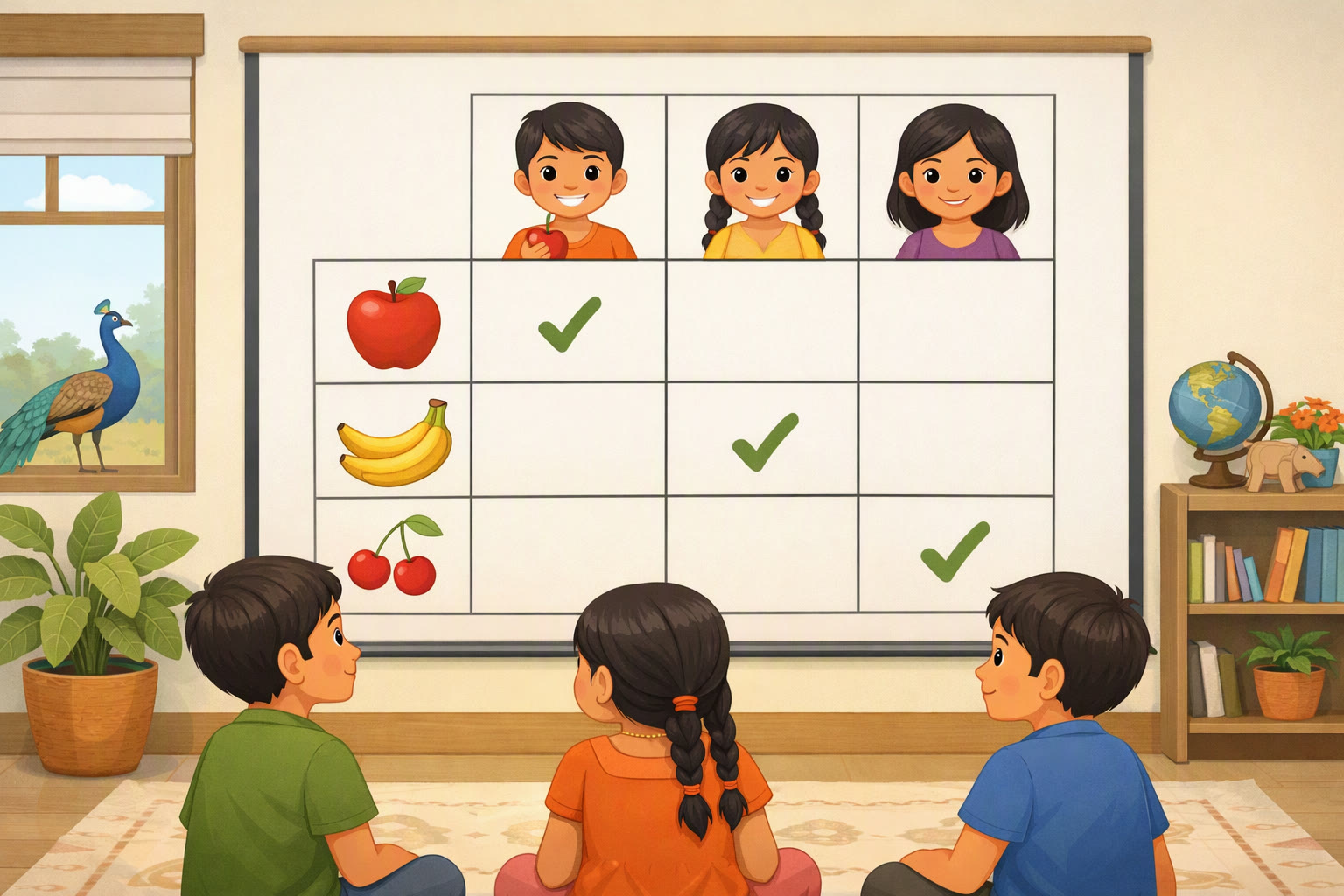
This simple example illustrates the core idea of using clues and logic to solve a puzzle. More complex puzzles simply expand on this concept.
Keep learning, free
Create a free Syllabax account to unlock practice questions and games for this topic.
Visual Learning Enhanced! 🚀
To help you master this topic, we use Advanced Syllabax AI to generate detailed diagrams and visual models.
Note on Visuals: The AI sometimes makes spelling errors in image labels. Please refer to the lesson text for the correct terminology.