Learning Journey
Watch this topic in 60 seconds
Free preview · Lesson 1
Understanding The Probability Scale (0 to 1)
Understanding the Probability Scale (0 to 1)
Hello, future mathematicians! Have you ever wondered about the chances of something happening? Like, what are the chances it will rain tomorrow? Or what are the chances you'll pick your favorite color candy from a bag? This idea of "chances" is what we call probability!
What is Probability?
In simple terms, probability is a way of measuring how likely something is to happen. It's like having a special superpower that helps you guess the future, but with numbers! We use probability every day, even when we don't realize it. When a weather reporter says there's a "70% chance of rain," they're talking about probability.
The Probability Scale: A Number Line for Chances!
To make it easy to understand and compare different chances, mathematicians use something called the probability scale. Think of it like a ruler or a number line, but instead of measuring length, it measures how likely an event is. This scale always goes from 0 to 1.
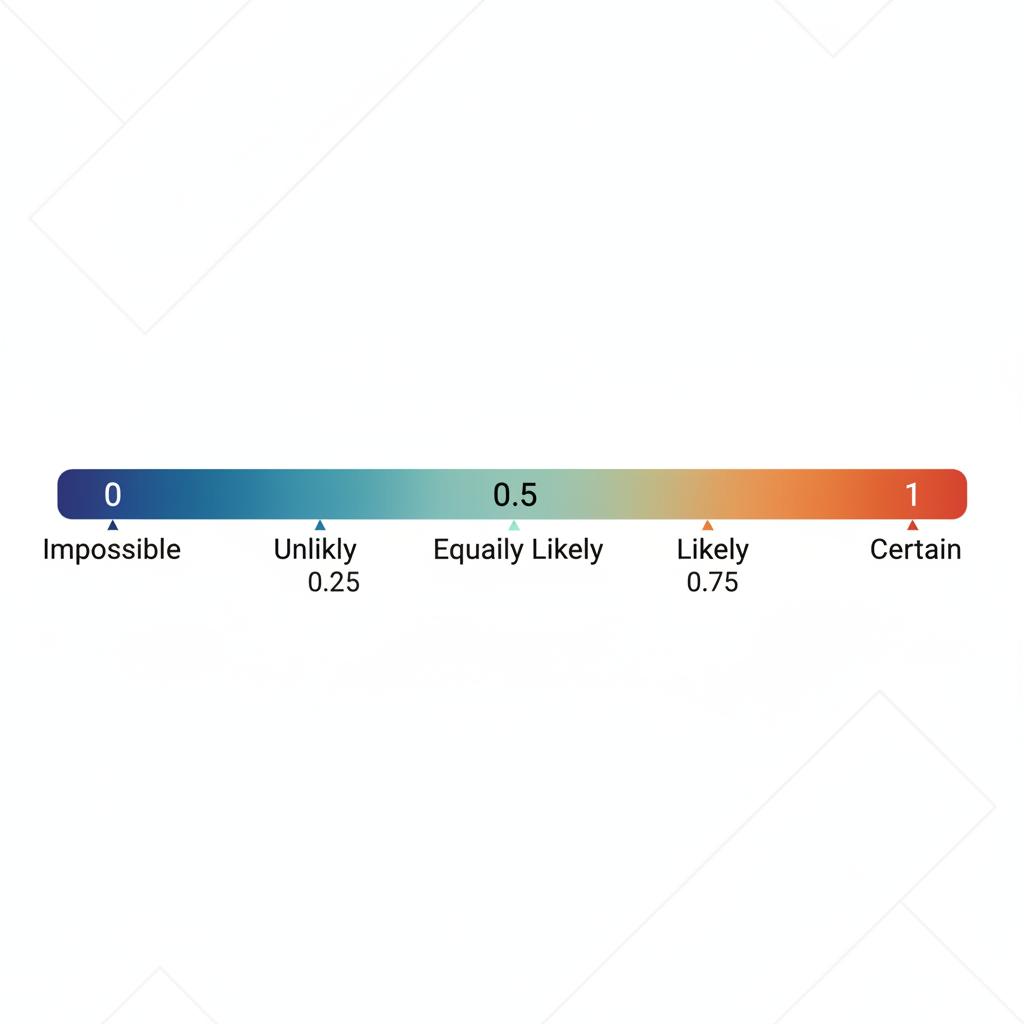 ⚠️ This picture may have spelling mistakes. Trust the words in the lesson.
0: Absolutely Impossible!
If an event has a probability of 0, it means that event is impossible. It will never, ever happen. There's zero chance! Think of it this way:
- Analogy 1: What's the probability that a pig will fly by your window tomorrow? 0! Pigs don't have wings, so it's impossible.
- Analogy 2: What's the probability that you'll roll a '7' on a standard six-sided die? 0! A standard die only has numbers 1 through 6, so rolling a 7 is impossible.
So, 0 means "no way, not ever!"
1: Absolutely Certain!
On the other end of the scale, if an event has a probability of 1, it means that event is certain. It will definitely, absolutely happen. There's a 100% chance!
- Analogy 1: What's the probability that the sun will rise in the east tomorrow? 1! The sun always rises in the east (from our perspective on Earth), so it's a certain event.
- Analogy 2: What's the probability that if you drop a ball, it will fall towards the ground? 1! Thanks to gravity, this is always true.
So, 1 means "yes, definitely!"
0.5 (or 1/2): Equally Likely
Right in the middle of our scale, we have 0.5 (which is the same as 1/2 or 50%). When an event has a probability of 0.5, it means it's equally likely to happen as it is not to happen. It's a 50/50 chance!
- Analogy 1: If you flip a fair coin, what's the probability it will land on heads? 0.5! It's just as likely to land on heads as it is on tails.
- Analogy 2: If you have a bag with 5 red marbles and 5 blue marbles, and you pick one without looking, what's the probability you'll pick a red marble? 0.5! There are an equal number of red and blue, so the chances are even.
So, 0.5 means "it could go either way!"
Between 0 and 0.5: Unlikely Events
Any probability between 0 and 0.5 means the event is unlikely to happen. It's possible, but not very probable. The closer the number is to 0, the more unlikely it is.
- Analogy 1: What's the probability you'll win the lottery? Very, very close to 0 (like 0.000001)! It's not impossible, but it's highly unlikely.
- Analogy 2: Imagine a jar with 99 red candies and 1 blue candy. What's the probability of picking the blue candy? It would be 1/100 or 0.01. This is a very small number, meaning it's unlikely you'll pick the blue one.
Between 0.5 and 1: Likely Events
Any probability between 0.5 and 1 means the event is likely to happen. It's more probable than not. The closer the number is to 1, the more likely it is.
- Analogy 1: What's the probability that you'll go to school tomorrow (on a weekday)? Very close to 1 (like 0.95 or 0.99)! Unless you're sick or it's a holiday, it's very likely.
- Analogy 2: Using the candy jar again, with 99 red candies and 1 blue candy. What's the probability of picking a red candy? It would be 99/100 or 0.99. This is a very high number, meaning it's very likely you'll pick a red one.
Summarizing the Probability Scale
Let's put it all together:
- 0: Impossible (Never happens)
- Close to 0 (e.g., 0.1, 0.2): Unlikely (Small chance)
- 0.5: Equally Likely (50/50 chance)
- Close to 1 (e.g., 0.8, 0.9): Likely (Good chance)
- 1: Certain (Always happens)
Sometimes you might see probabilities as fractions (like 1/4, 1/2) or percentages (like 25%, 50%). Just remember that these are all different ways to express the same chance. For our scale, we focus on decimals from 0 to 1.
Putting It into Practice
When you encounter a situation, try to place it on the probability scale. Ask yourself:
- Could it definitely not happen? (0)
- Could it definitely happen? (1)
- Is it equally likely to happen or not happen? (0.5)
- Is it more likely to happen than not? (Between 0.5 and 1)
- Is it less likely to happen than not? (Between 0 and 0.5)
Understanding the probability scale helps you make sense of the world around you, from weather forecasts to game outcomes. It's a fundamental concept in mathematics that you'll use for many years to come!
Keep learning, free
Create a free Syllabax account to unlock practice questions and games for this topic.
Visual Learning Enhanced! 🚀
To help you master this topic, we use Advanced Syllabax AI to generate detailed diagrams and visual models.
Note on Visuals: The AI sometimes makes spelling errors in image labels. Please refer to the lesson text for the correct terminology.