Composite shapes [Perimeter]
Watch this topic in 60 seconds
Free preview · Lesson 1
Understanding Composite shapes [Perimeter]
Discovering the Perimeter of Composite Shapes!
Hello, super mathematicians! Today, we're going on an exciting adventure to explore something called **composite shapes**. Think of them as shape mashups or shape collages! They are made by putting together simpler shapes, like squares, rectangles, triangles, and even half-circles, to create a new, more interesting shape.
Imagine building a castle with LEGO bricks. You don't just use one big brick, right? You combine many smaller bricks to make towers, walls, and windows. Composite shapes are like that! They are built from basic shapes.
What is Perimeter?
Before we dive into composite shapes, let's remember what **perimeter** is. Perimeter is like the fence around a garden. It's the total distance around the **outside edge** of any 2D shape.
Think about walking around the edge of your school playground. The total distance you walk is the perimeter of the playground. Or, if you were to put a ribbon around the edge of a picture frame, the length of that ribbon would be the perimeter.
To find the perimeter of a simple shape, like a square or a rectangle, you just add up the lengths of all its sides.
- For a square with sides of 4 cm, the perimeter is 4 + 4 + 4 + 4 = 16 cm.
- For a rectangle that is 5 cm long and 3 cm wide, the perimeter is 5 + 3 + 5 + 3 = 16 cm.
Composite Shapes: The Shape Mashups!
Now, let's get back to our composite shapes. These are shapes made by joining together two or more basic shapes. Here are some examples:
- A rectangle with a triangle on top (like a house shape).
- A square with a semi-circle (half-circle) attached to one side.
- Two rectangles joined side-by-side.
The cool thing about composite shapes is that finding their perimeter is just like finding the perimeter of simpler shapes, but we have to be a little more careful.
How to Find the Perimeter of Composite Shapes
The main rule for finding the perimeter of a composite shape is to **add up the lengths of ALL the sides that are on the OUTSIDE edge** of the combined shape.
Let's use an analogy. Imagine you have a chocolate bar that's broken into two pieces, and you stick them together side-by-side to make a longer bar. To find the perimeter of this new longer bar, you would only measure the outside edges. You wouldn't measure the part where the two pieces are stuck together, because that's in the middle, not on the outside!
Here’s a step-by-step guide:
Step 1: Identify the Basic Shapes
Look at the composite shape and break it down in your mind into the simpler shapes it's made from. For example, a shape might look like a rectangle with a triangle glued on top.
Step 2: Look for All the Outside Edges
Carefully trace the entire outside boundary of the composite shape. Each segment you trace is a part of the perimeter.
Step 3: Find the Lengths of ALL Outside Sides
This is the most important part! You need to know the length of *every* side that forms the outer edge. Sometimes, the lengths of all the outside sides are given to you directly. Other times, you might need to do a little detective work.
What if some sides are missing?
Sometimes, when shapes are joined, some of their original sides become internal. For example, if you join two rectangles together, the side where they touch is no longer on the outside edge. The lengths of these internal sides are NOT included when you calculate the perimeter.
Example 1: A House Shape (Rectangle + Triangle)
Imagine a rectangle that is 6 meters long and 4 meters high. On top of the rectangle, there's a triangle. The base of the triangle perfectly matches the top side of the rectangle, which is 6 meters. The two slanted sides of the triangle are each 5 meters long.
To find the perimeter of this house shape:
- Outside Sides: We have the bottom of the rectangle (6m), the two sides of the rectangle (4m each), and the two slanted sides of the triangle (5m each).
- Add them up: 6m (bottom) + 4m (side) + 4m (side) + 5m (slanted) + 5m (slanted) = 24 meters.
Notice we *don't* include the top side of the rectangle because it's covered by the triangle and is not on the outside edge.
Example 2: A Square with a Semicircle on Top
Let's say we have a square with sides of 8 cm. A semicircle is attached to the top side of the square. The diameter of the semicircle (which is the straight line across its middle) is equal to the side of the square, so it's 8 cm.
To find the perimeter:
- Outside Sides: We have the bottom side of the square (8cm), the two vertical sides of the square (8cm each), and the curved part of the semicircle.
- Find the curved part: The curved part of a semicircle is called its arc. The formula for the circumference (perimeter) of a full circle is π * diameter. For a semicircle, it's half of that: (π * diameter) / 2. We'll use an approximation for π (pi) as 3.14. So, the arc length is (3.14 * 8 cm) / 2 = 25.12 cm / 2 = 12.56 cm.
- Add them up: 8cm (bottom) + 8cm (side) + 8cm (side) + 12.56cm (curved part) = 36.56 cm.
Remember, we don't count the side of the square where the semicircle is attached because it's hidden!
Key Tips for Finding Perimeters of Composite Shapes:
- Draw it out! If a diagram isn't provided, sketch the shape yourself. This helps you visualize the outside edges.
- Label everything! Write down the length of every outside side.
- Ignore internal lines! Any line segment where two shapes are joined together is *not* part of the perimeter.
Finding the perimeter of composite shapes is like being a detective who needs to find the total length of a secret fence. You only measure the parts of the fence that are visible from the outside!
Let's look at a visual example:
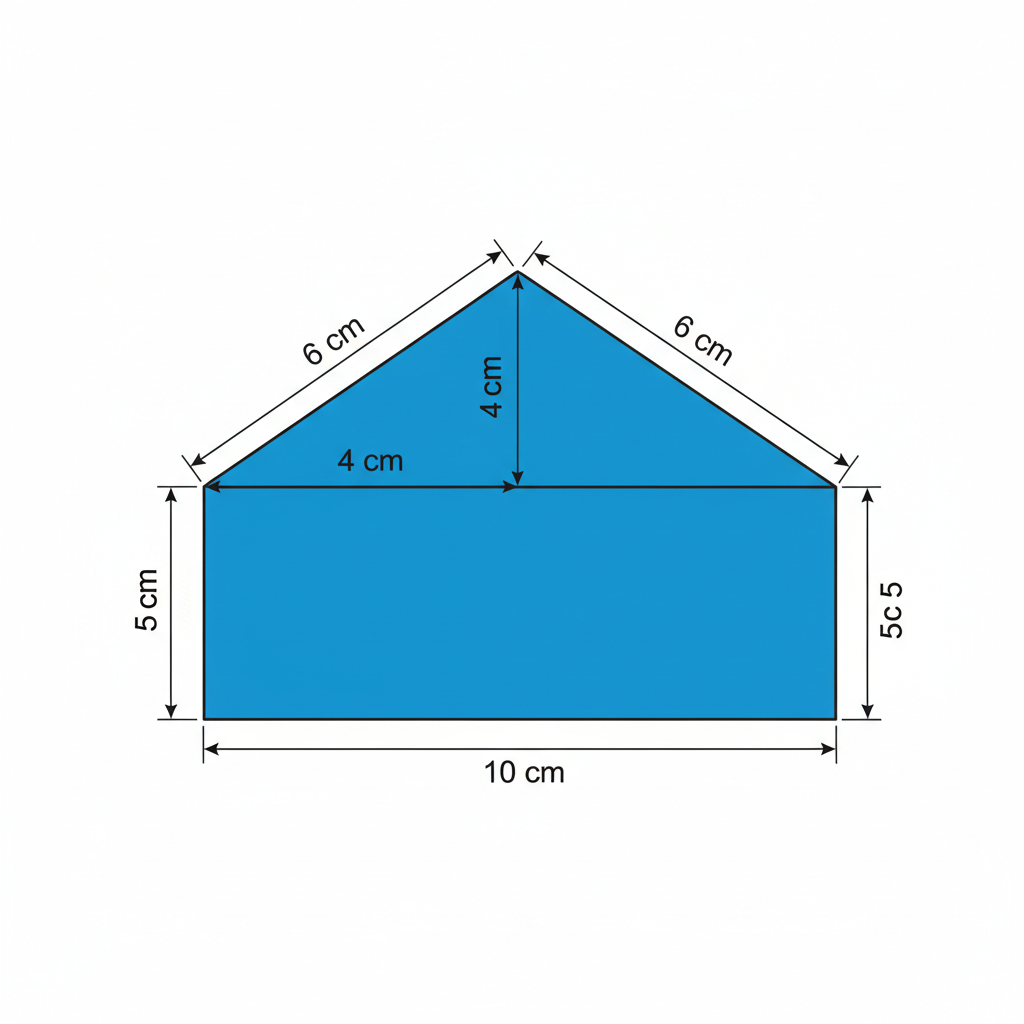 ⚠️ This picture may have spelling mistakes. Trust the words in the lesson.
In the image above, imagine you are a tiny ant walking along the outside edge. You would walk along the bottom, up one side, across the slanted top, down the other slanted top, and finally down the other side. You would NOT walk on the line where the rectangle and triangle meet – that line is hidden!
Keep practicing, and you'll become a composite shape perimeter pro in no time!
Keep learning, free
Create a free Syllabax account to unlock practice questions and games for this topic.
Visual Learning Enhanced! 🚀
To help you master this topic, we use Advanced Syllabax AI to generate detailed diagrams and visual models.
Note on Visuals: The AI sometimes makes spelling errors in image labels. Please refer to the lesson text for the correct terminology.