Properties & differences[CHEMISTRY]
Watch this topic in 60 seconds
Free preview · Lesson 1
Understanding Properties & differences[CHEMISTRY]
Properties & Differences: The Building Blocks of Matter!
Welcome, young scientists, to the fascinating world of chemistry! Today, we're going to explore something super important: the properties of different things and how they help us understand the differences between them. Think of it like being a detective, using clues to figure out what something is and how it's unique!
What are Properties?
Imagine you have a favorite toy. What makes it your favorite? Maybe it's the color, how soft it is, if it's heavy or light, or if it makes a funny noise. All these things – color, softness, weight, sound – are called properties. Properties are like the special characteristics or features that describe something.
In chemistry, we talk about the properties of matter. Matter is anything that takes up space and has mass (that's a fancy word for 'stuff'!). So, your toy is matter, your pencil is matter, the air you breathe is matter, and even the water you drink is matter. Each of these things has its own set of properties.
Types of Properties
Properties can be grouped into a few main types. Let's look at some!
1. Physical Properties
These are properties you can observe or measure without changing what the substance actually is. Think about describing your toy again. You can tell its color, its shape, how big it is, and if it's smooth or rough. These are all physical properties.
Here are some common physical properties:
- Color: Is it red, blue, green? (Like a red apple vs. a green apple)
- Shape: Is it round, square, or a funny shape? (Like a ball vs. a block)
- Size: Is it big or small? (Like a giant teddy bear vs. a tiny action figure)
- Mass/Weight: Is it heavy or light? (Like a brick vs. a feather)
- Texture: Is it smooth, rough, soft, or hard? (Like a silky scarf vs. a bumpy rock)
- State of Matter: Is it a solid, liquid, or gas? (Think of ice (solid), water (liquid), and steam (gas) – they are all water, but in different states!)
- Melting Point: The temperature at which a solid turns into a liquid. (Butter melts when it gets warm, but ice melts in the sun.)
- Boiling Point: The temperature at which a liquid turns into a gas. (Water boils and turns into steam when it gets very hot.)
- Density: How much 'stuff' is packed into a certain amount of space. Imagine a box filled with feathers and another box of the same size filled with rocks. The box of rocks is much denser because rocks are heavier than feathers for the same volume.
- Solubility: Whether something can dissolve in another substance. Sugar dissolves in water, but sand does not.
Let's use an analogy: Imagine you're describing a piece of fruit, like an orange. You'd say it's orange (color), round (shape), has a bumpy peel (texture), and weighs a certain amount (mass). You haven't changed the orange into something else; you've just described it!
2. Chemical Properties
Chemical properties are a bit different. They describe how a substance can change into a new substance. To see a chemical property, you usually have to do a chemical reaction, which changes the original material.
Here are some examples of chemical properties:
- Flammability: How easily something burns. Wood is flammable; it burns to become ash and smoke. Rocks are not flammable.
- Reactivity: How likely a substance is to react with other substances. Some metals, like iron, rust when they are exposed to air and water. Other metals, like gold, are not very reactive and don't rust easily.
- Toxicity: Whether something is poisonous. Some substances are safe to eat or touch, while others can make you very sick.
- Ability to Rust: A specific type of reactivity, like iron turning reddish-brown when exposed to oxygen and moisture.
- Ability to Oxidize: A broader term for reacting with oxygen, which can cause changes like rusting or burning.
Analogy time! Think about baking a cake. You start with flour, eggs, sugar, and milk (these are the ingredients with their own properties). When you bake them, they undergo a chemical change. They become something completely new – a cake! The ability of the ingredients to transform into a cake is related to their chemical properties. You can't go back to the original flour and eggs easily!
How Properties Help Us Understand Differences
Now, why do we care about these properties? Because they are how we tell things apart! If two things have different properties, they are different substances.
Imagine you have two white powders. One is sugar, and the other is salt. How can you tell them apart?
- Taste: Sugar tastes sweet, while salt tastes salty. (This is a chemical property related to how our taste buds react!)
- Solubility: Both dissolve in water, so solubility isn't the best way to tell them apart in this case.
- Crystal Shape: If you look closely with a magnifying glass, sugar crystals and salt crystals have different shapes. (This is a physical property!)
By observing their different properties (taste, crystal shape), we can easily tell that sugar and salt are not the same thing, even though they both look like white powders.
Let's think about metals. You know iron, silver, and gold are all metals, but they are very different.
- Color: Iron is grayish, silver is shiny white, and gold is yellow.
- Reactivity: Iron rusts easily, gold does not rust at all.
- Density: Gold is much denser than iron or silver.
- Melting Point: They all melt at different high temperatures.
These differences in properties are why we use iron for nails, silver for jewelry and coins, and gold for very special jewelry and electronics. Each metal is suited for different jobs because of its unique set of properties.
Visualizing Properties
Sometimes, visualizing helps! Imagine different objects and their properties.
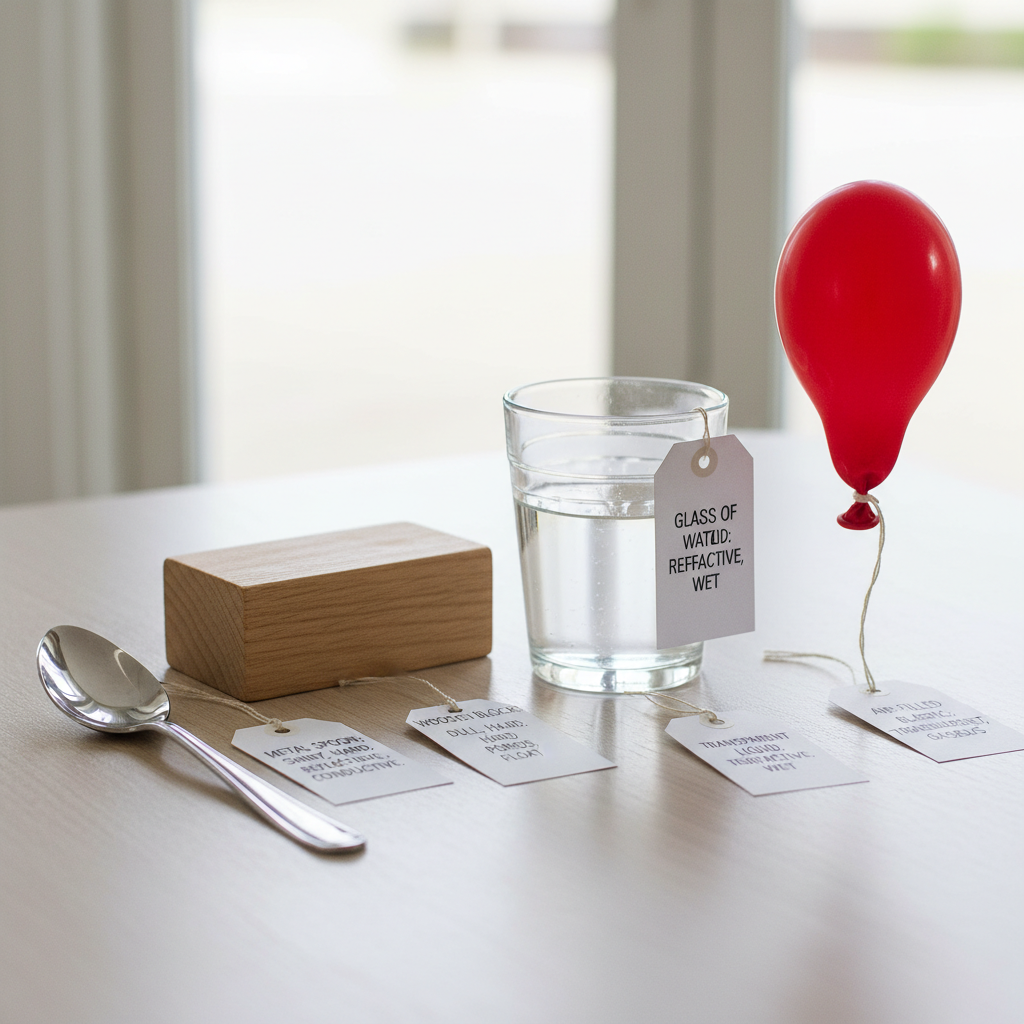 ⚠️ This picture may have spelling mistakes. Trust the words in the lesson.
Look at the picture. We have a metal spoon, a wooden block, water, and air.
- The spoon is hard (texture), shiny (color/luster), and a good conductor of heat (a physical property – it gets hot quickly!).
- The wooden block is hard but not shiny, and it's a poor conductor of heat (an insulator). Wood is also flammable (chemical property), while the metal spoon is not easily flammable.
- Water is a liquid at room temperature, can be clear, and can dissolve many things (solubility).
- Air is a gas, colorless, and we can't easily feel its mass unless we have a lot of it (like in a balloon). Air is also essential for things to burn (related to flammability).
See how many ways we can describe and differentiate these common items just by looking at their properties?
Key Differences Recap
Remember, the main difference we discussed is between physical properties and chemical properties:
- Physical properties describe what something is like without changing it into something new. You can observe them directly!
- Chemical properties describe how something can change into something new through a chemical reaction. You often need to test them to see them.
Understanding these properties is the first step to understanding why different materials behave the way they do and why they are useful for different things. Keep observing the world around you like a scientist, and you'll discover tons of properties!
Keep learning, free
Create a free Syllabax account to unlock practice questions and games for this topic.
Visual Learning Enhanced! 🚀
To help you master this topic, we use Advanced Syllabax AI to generate detailed diagrams and visual models.
Note on Visuals: The AI sometimes makes spelling errors in image labels. Please refer to the lesson text for the correct terminology.