Grouping similar items (Sorting & Grouping)
Watch this topic in 60 seconds
Free preview · Lesson 1
Understanding Grouping similar items (Sorting & Grouping)
Learning Resource: Grouping Similar Items (Sorting & Grouping)
Hello young learners! Today, we're going on a fun adventure to learn about something super useful: **Grouping Similar Items**! Have you ever helped sort your toys, or put all your red crayons together? That's exactly what we'll be doing!
What is Grouping?
Imagine you have a big box full of toys. Some are cars, some are dolls, and some are building blocks. If you wanted to find your favorite car quickly, it would be much easier if all the cars were in one pile, all the dolls in another, and all the blocks in a third pile, right?
That's what grouping means! It's like putting things that are alike, or belong together, into their own special teams or piles.
Analogy: Think about your lunchbox. You probably put your sandwich in one part, your fruit in another, and your juice box somewhere else. You're grouping similar food items together to keep things tidy and easy to find!
Why Do We Group Things?
Grouping helps us in many ways:
- It makes things tidy: Just like putting toys away neatly, grouping makes our surroundings organized.
- It makes things easy to find: When everything is in its right group, we can find what we need in a jiffy!
- It helps us understand things better: When we see things grouped, we can easily see how they are alike.
Analogy: Imagine you're at a grocery store. The fruits are all together in one section, the vegetables in another, and the snacks in a third. This makes it much easier for your grown-ups to find everything they need!
Sorting: The First Step to Grouping
Before we can group things, we often need to **sort** them. Sorting is like looking at each item and deciding which team it belongs to. We look for special characteristics or features that make items similar.
What are these special characteristics?
- Color: Are they all red? Blue? Yellow?
Analogy: Think of sorting socks. You might put all the white socks together and all the black socks together.
- Shape: Are they round? Square? Star-shaped?
Analogy: Imagine sorting shapes you draw. You could put all the circles in one pile and all the squares in another.
- Size: Are they big? Small? Medium?
Analogy: When you line up your toy cars, you might put the smallest car first, then the medium one, and then the biggest one.
- Type: Are they animals? Food? Toys? Letters? Numbers?
Analogy: At the zoo, you see the lions in one enclosure, the monkeys in another, and the elephants in their own space. They are grouped by type of animal!
Let's Practice Grouping!
Look at this picture. We have different kinds of fruits!
We have apples, bananas, and oranges. How can we group them?
- We can make a group of all the apples.
- We can make a group of all the bananas.
- We can make a group of all the oranges.
See? We sorted them by their type!
Now, let's look at these shapes.
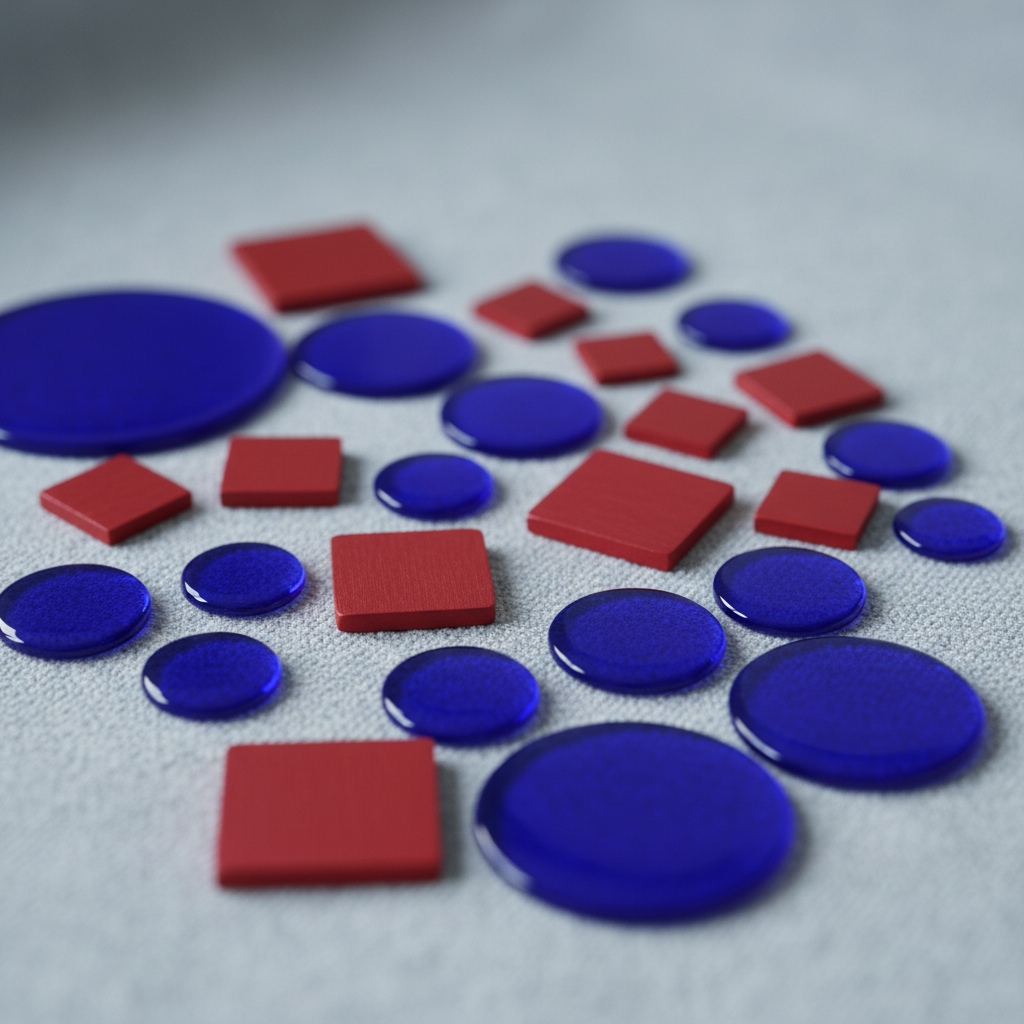 ⚠️ This picture may have spelling mistakes. Trust the words in the lesson.
We have blue circles and red squares. How can we group them?
- We can make a group of all the blue items.
- We can make a group of all the red items.
This time, we sorted them by color!
Or, we could group them by shape:
- A group of all the circles.
- A group of all the squares.
You can often group things in more than one way! It all depends on what you are looking for.
Summary
Grouping similar items is a very important skill. It helps us keep things organized, find what we need easily, and understand the world around us better. We often sort items by their color, shape, size, or type to create these helpful groups.
Keep learning, free
Create a free Syllabax account to unlock practice questions and games for this topic.
Visual Learning Enhanced! 🚀
To help you master this topic, we use Advanced Syllabax AI to generate detailed diagrams and visual models.
Note on Visuals: The AI sometimes makes spelling errors in image labels. Please refer to the lesson text for the correct terminology.