Number sequences (Patterns in Numbers)
Watch this topic in 60 seconds
Free preview · Lesson 1
Understanding Number sequences (Patterns in Numbers)
Discovering Hidden Stories: Number Sequences!
Welcome, young mathematicians, to a magical world where numbers tell stories! Have you ever noticed how some numbers seem to follow a special rule, like a secret code? These special sets of numbers are called number sequences. Think of them like a train where each car is a number, and they all follow each other in a specific order. Today, we're going to become number detectives and uncover the patterns hidden within these sequences!
What is a Number Sequence?
A number sequence is simply a list of numbers that are arranged in a particular order or pattern. It’s like a parade of numbers, and each number has its place for a reason!
Spotting the 'Rule': The Secret Code
The most exciting part of a number sequence is its rule. This rule is like the secret code that tells us how to get from one number to the next. Sometimes the rule is to add a certain number each time, sometimes it's to subtract, and sometimes it's even to multiply or divide!
Example 1: Adding to the Fun!
Let's look at a simple sequence: 2, 4, 6, 8, 10.
What's happening here? How do we get from 2 to 4? We add 2! How do we get from 4 to 6? We add 2 again! And from 6 to 8? Add 2! From 8 to 10? Add 2!
The rule for this sequence is: add 2 to the previous number to get the next number. It’s like each number is inviting 2 more friends to join the party!
Example 2: Taking Away the Clutter!
Now, let's try another sequence: 15, 12, 9, 6, 3.
How do we move from 15 to 12? We subtract 3! From 12 to 9? Subtract 3! From 9 to 6? Subtract 3! And from 6 to 3? Subtract 3!
The rule here is: subtract 3 from the previous number to find the next. This is like tidying up and putting 3 toys away each time.
Visualizing Sequences: A Number Line Adventure
Imagine a number line. A number sequence is like taking steps on this number line. If the rule is to add, you hop forward. If the rule is to subtract, you hop backward.
For the sequence 2, 4, 6, 8, 10, starting at 2, you hop 2 steps forward to get to 4, then 2 more steps to get to 6, and so on. Each hop is the same size!
Example 3: Doubling Up!
Some sequences have a rule that involves multiplication. Let's look at: 3, 6, 12, 24.
How do we get from 3 to 6? We can add 3, but let’s see if there’s another rule. What if we multiply? 3 multiplied by 2 equals 6! Now, let's check if this rule works for the next numbers. 6 multiplied by 2 equals 12! And 12 multiplied by 2 equals 24!
The rule for this sequence is: multiply the previous number by 2. This is like a magical plant that doubles its leaves every day!
Example 4: Halving the Amount!
Sometimes, we might divide. Consider the sequence: 40, 20, 10.
To get from 40 to 20, we can subtract 20, or we can divide by 2. Let's see if dividing by 2 works. 40 divided by 2 is 20! And 20 divided by 2 is 10!
The rule here is: divide the previous number by 2. This is like sharing a pizza equally between two friends, and then sharing one of the halves again.
Why are Number Sequences Important?
Number sequences are everywhere! They help us predict what comes next. Think about:
- Calendars: The days of the week repeat in a sequence (Monday, Tuesday, Wednesday...).
- Clocks: The minutes tick by in a sequence (1, 2, 3... up to 60).
- Money: If you save
- Building Blocks: If you stack blocks, adding one block each time, you create a sequence (1, 2, 3, 4...).
Understanding sequences helps us make sense of the world around us and solve problems more easily.
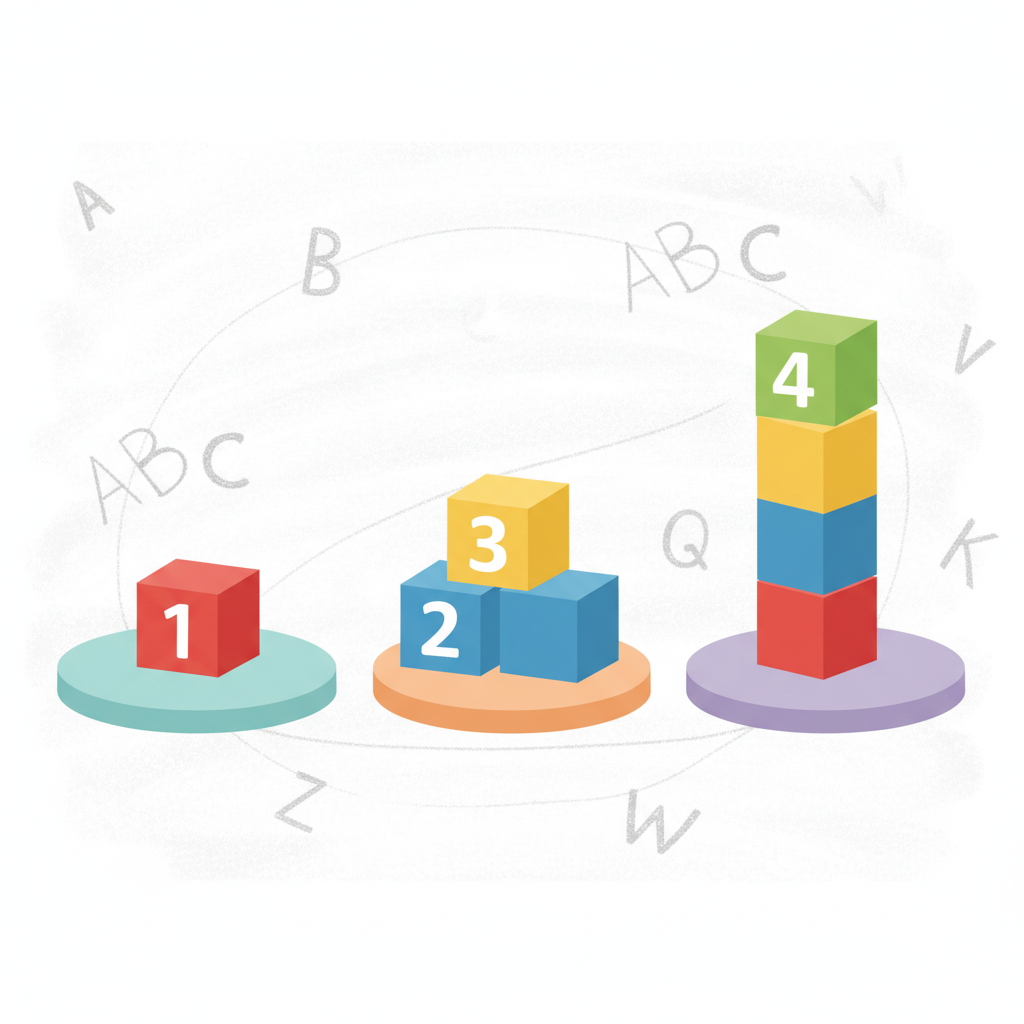 ⚠️ This picture may have spelling mistakes. Trust the words in the lesson.
Let's Be Pattern Detectives!
Your mission, should you choose to accept it, is to look for these number stories. When you see a list of numbers, ask yourself:
- What is the first number?
- What is the second number?
- How did we get from the first to the second? Did we add, subtract, multiply, or divide?
- Is that same 'step' or 'rule' used to get to the third number? And the fourth?
Keep practicing, and soon you'll be spotting number sequences and their secret rules like a true math wizard!
Keep learning, free
Create a free Syllabax account to unlock practice questions and games for this topic.
Visual Learning Enhanced! 🚀
To help you master this topic, we use Advanced Syllabax AI to generate detailed diagrams and visual models.
Note on Visuals: The AI sometimes makes spelling errors in image labels. Please refer to the lesson text for the correct terminology.