Learning Journey
Watch this topic in 60 seconds
Free preview · Lesson 1
Understanding Formation of shadows[PHYSICS]
Understanding Shadows: A Journey into Light and Darkness
Have you ever noticed that when you stand in the sun, there's a dark patch behind you on the ground? That dark patch is called a shadow! But how do shadows form? It's all thanks to the way light travels and how objects interact with it. Let's dive in and explore this fascinating phenomenon.
What is Light?
Imagine light as tiny, super-fast travelers, like invisible race cars zipping in straight lines. These 'light travelers' come from sources like the Sun, a light bulb, or even a candle. They move outwards in all directions, trying to fill up every space they can. When these light travelers reach our eyes, we see things!
Opaque, Transparent, and Translucent: How Objects Affect Light
Objects can behave differently when these light travelers hit them. We can group them into three main types:
- Opaque Objects: Think of a brick wall or a book. When light travelers hit an opaque object, they can't pass through it. They are either blocked completely or bounced off. It's like trying to throw a ball through a solid wall – it just won't go through!
- Transparent Objects: Imagine a clean window pane or a glass of water. Light travelers can pass straight through these objects without much trouble. They travel right on through, almost as if the object wasn't there. It's like the light travelers can just drive right through an open doorway.
- Translucent Objects: Think of frosted glass or a thin piece of paper. Light travelers can pass through these, but not in a straight line. They get scattered and jumbled up. It's like the light travelers are trying to drive through a foggy street – they can get through, but their path becomes messy and unclear.
The Birth of a Shadow: When Light Gets Blocked
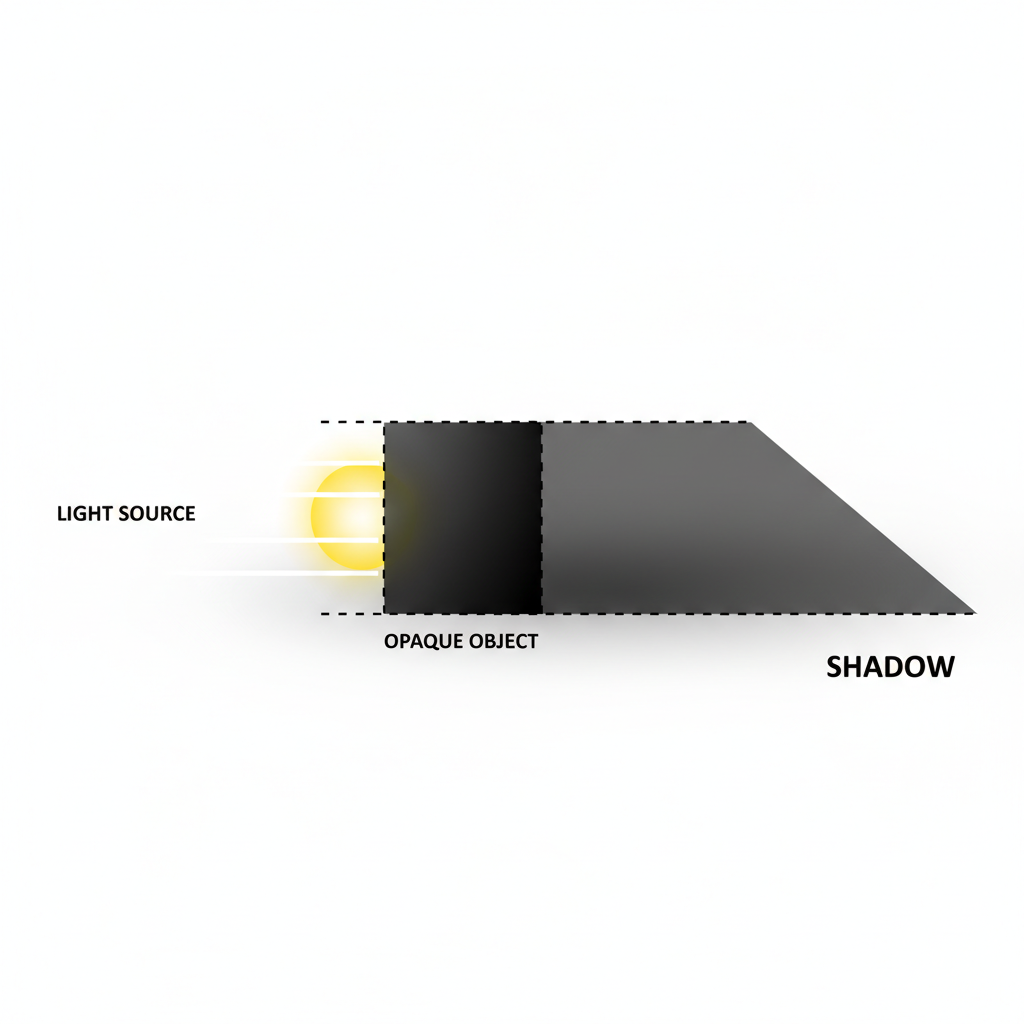
Now, let's put it all together to understand shadows. Shadows happen when an opaque object gets in the way of light travelers.
Imagine you are standing in a bright room with a flashlight (our light source). The light travelers from the flashlight are moving outwards in straight lines. When they reach you, since you are an opaque object, they cannot pass through you. Instead, they get blocked by your body.
Because the light travelers move in straight lines, they can't go around you. They are stopped by your front and continue to spread out behind you. The area behind you where the light travelers are blocked is the shadow. It's like a 'no-go zone' for light!
Think of it like this:
- Light Source: The flashlight is like the starting point for our light travelers.
- Opaque Object: You are like a wall that stops the light travelers.
- Shadow: The dark area on the wall behind you is where the light travelers couldn't reach because you were in the way.
The shadow is essentially the absence of light. Where the object blocks the light, it's dark. Where the light can reach freely, it's bright.
What Makes Shadows Change?
Shadows aren't always the same size or shape. They can change depending on a few things:
1. The Position of the Light Source:
Imagine shining a flashlight on a toy. If you hold the flashlight directly above the toy, the shadow on the table will be small and directly underneath it. But if you move the flashlight to the side, the shadow will get longer and stretch out away from the toy.
Analogy: Think about the Sun. In the morning, the Sun is low in the sky, and our shadows are long. At noon, when the Sun is high up, our shadows are short.
2. The Distance Between the Object and the Light Source:
If the opaque object is very close to the light source, the shadow will be larger. If the object is far away from the light source, the shadow will be smaller.
Analogy: Imagine you are holding your hand very close to a projector screen, and a light shines on your hand. You'll see a big shadow on the screen. Now, move your hand farther away from the screen, and the shadow gets smaller.
3. The Shape of the Object:
The shape of the shadow is usually the same as the shape of the object blocking the light. If you hold up your hand, the shadow will look like your hand. If you hold up a ball, the shadow will look round.
Umbra and Penumbra: The Two Parts of a Shadow
Sometimes, especially when the light source isn't a tiny point but something larger (like the Sun or a big lamp), shadows have two parts:
- Umbra: This is the darkest, central part of the shadow where the light is completely blocked. Think of it as the 'core' of the shadow.
- Penumbra: This is the lighter, outer part of the shadow where the light is only partially blocked. It's like a fuzzy edge around the dark core.
Analogy: Imagine you're trying to block a strong light with your fist. The part of the table directly behind your fist, where no light gets through, is the umbra. The area around that, where a little bit of light still peeks around the edges of your fist, is the penumbra.
Why Don't We See Shadows of Transparent Objects?
Remember transparent objects like glass? Light travelers pass right through them. Since the light isn't blocked, there's nothing to stop the light travelers from reaching the space behind the object. Therefore, no dark area is formed, and we don't see a shadow.
Why Do Shadows Sometimes Look Fuzzy?
Shadows can look fuzzy or have blurry edges when the light source is large, not a single tiny point. The Sun is a great example of a large light source. Because it's so big, light rays come from different parts of the Sun. This creates the umbra (fully dark) and penumbra (partially dark) effect, making the shadow's edge less sharp and more fuzzy.
Recap
Shadows are a result of light traveling in straight lines and being blocked by opaque objects. The size and shape of a shadow depend on the light source's position and distance, and the object's shape. Understanding shadows helps us understand how light works and how it interacts with the world around us!
Keep learning, free
Create a free Syllabax account to unlock practice questions and games for this topic.
Visual Learning Enhanced! 🚀
To help you master this topic, we use Advanced Syllabax AI to generate detailed diagrams and visual models.
Note on Visuals: The AI sometimes makes spelling errors in image labels. Please refer to the lesson text for the correct terminology.