Virtual & Augmented Reality
Watch this topic in 60 seconds
Free preview · Lesson 1
Understanding Virtual & Augmented Reality
Imagine a world where you can step inside your favorite video game, explore ancient Rome from your living room, or even see a dinosaur stomping around your backyard through your phone screen. Sounds like science fiction, right? Well, thanks to two incredible technologies called Virtual Reality (VR) and Augmented Reality (AR), these experiences are becoming more and more real every day! These aren't just gadgets; they're like new ways to see and interact with the world around us, and even with worlds that only exist in computers.
For an 8th grader, thinking about VR and AR might bring up images of futuristic helmets or games. While that's a big part of it, these technologies are much more than just entertainment. They're changing how we learn, how we work, and how we connect with others. Let's dive in and explore what makes VR and AR so special, using lots of easy-to-understand analogies.
What is Virtual Reality (VR)?
Think of Virtual Reality (VR) as a magical portal that completely transports you to another place. When you put on a VR headset, it's like you're instantly stepping into a completely different world – a world created entirely by a computer. Your own room, your desk, your friends – they all disappear from your sight, replaced by whatever the VR experience wants you to see. It's a bit like putting on a super fancy, digital blindfold, but instead of seeing darkness, you see an amazing, interactive 3D environment.
VR: Stepping Inside a Computer World
- Full Immersion: The key word for VR is "immersion." This means you feel like you are physically inside the virtual world. It takes over your senses, primarily sight and sound. Imagine you're watching a movie, but instead of seeing it on a screen in front of you, you're standing right in the middle of the action!
- How it Works (Simply): VR headsets usually have two small screens inside, one for each eye. These screens show slightly different images, which tricks your brain into seeing depth, just like in the real world. As you move your head, sensors inside the headset track your movements and update the virtual world in real-time. So, if you look left in real life, you look left in the virtual world.
- Analogy 1: The Magic Helmet: Imagine you put on a helmet that can show you any world you want. One minute you're in a spaceship, the next you're swimming with dolphins. That's VR!
- Analogy 2: Being Inside a Video Game: You know how you play video games on a screen? With VR, it's like you've physically jumped into the game world itself. You're no longer controlling a character from outside; you are the character!
- Analogy 3: A Digital Diving Bell: Think of a diving bell that takes you deep underwater. It separates you from the surface world and lets you explore a completely new environment. VR does the same, but with digital worlds.
What Can You Do with VR?
The possibilities are endless! Here are a few examples:
- Gaming: This is probably what most people think of first. Imagine playing a zombie game where the zombies feel like they're actually right in front of you, or flying a spaceship as if you're truly in the cockpit.
- Education: VR can take students on virtual field trips to historical sites, inside the human body, or even to distant planets. Learning becomes an immersive adventure!
- Training: Doctors can practice surgery, pilots can learn to fly, and even factory workers can train on complex machinery, all in a safe, virtual environment.
- Travel & Exploration: Want to visit the Great Wall of China or explore the Amazon rainforest? VR can take you there from your couch.
What is Augmented Reality (AR)?
Now, let's talk about Augmented Reality (AR). While VR completely replaces your world, AR is more like adding a layer of digital information or objects on top of your real world. It doesn't take you away to a new place; instead, it "augments" or enhances the reality you're already in. It's like seeing your normal surroundings but with magical, digital elements suddenly appearing.
AR: Blending Digital with Reality
- Enhancing Reality: The key idea here is "enhancement." AR lets you see digital images, videos, or 3D models mixed into your actual physical environment. You can still see your room, your friends, and your dog, but now there might be a digital monster dancing on your rug, or information popping up about a landmark you're looking at.
- How it Works (Simply): Most AR experiences you're probably familiar with with use your smartphone or tablet. The device's camera captures what's in front of you, and then software adds digital graphics onto that live camera feed. More advanced AR uses special transparent glasses that project images directly onto your view of the real world.
- Analogy 1: Digital Stickers on the World: Imagine having a magic marker that lets you draw digital stickers or holograms that stick to real-world objects. You can see your table, but now there’s a digital coffee cup sitting on it that isn't really there.
- Analogy 2: Superhero Vision: Think about superheroes who can see information pop up about their surroundings – a building's weak points, a villain's identity. AR is a bit like having that kind of "super-vision" on your phone or through special glasses.
- Analogy 3: A Pop-Up Book for Reality: You know how pop-up books make flat pictures jump out in 3D? AR does something similar, but for the real world. It makes digital objects appear to pop out and interact with your actual surroundings.
What Can You Do with AR?
AR is already quite common in many everyday applications:
- Gaming: The most famous example is Pokémon GO, where you hunt digital Pokémon in your real neighborhood using your phone's camera.
- Shopping: Apps like IKEA Place let you see how furniture would look in your home before you buy it, by placing 3D models virtually in your room.
- Social Media Filters: Those fun filters on Snapchat or Instagram that put dog ears on your face or change your hair color are a form of AR.
- Navigation: Some car navigation systems use AR to overlay directions directly onto a live view of the road ahead, making it easier to follow.
- Learning & Repair: Imagine looking at an engine with your phone and seeing labels pop up explaining each part, or even instructions on how to fix something.
VR vs. AR: What's the Big Difference?
Here's the simplest way to remember the core difference:
VR = Virtual Reality = Replaces your reality with a digital one. (Think: You are GONE from your real world)
AR = Augmented Reality = Adds digital elements to your real reality. (Think: You are STILL HERE, but with extra digital stuff)
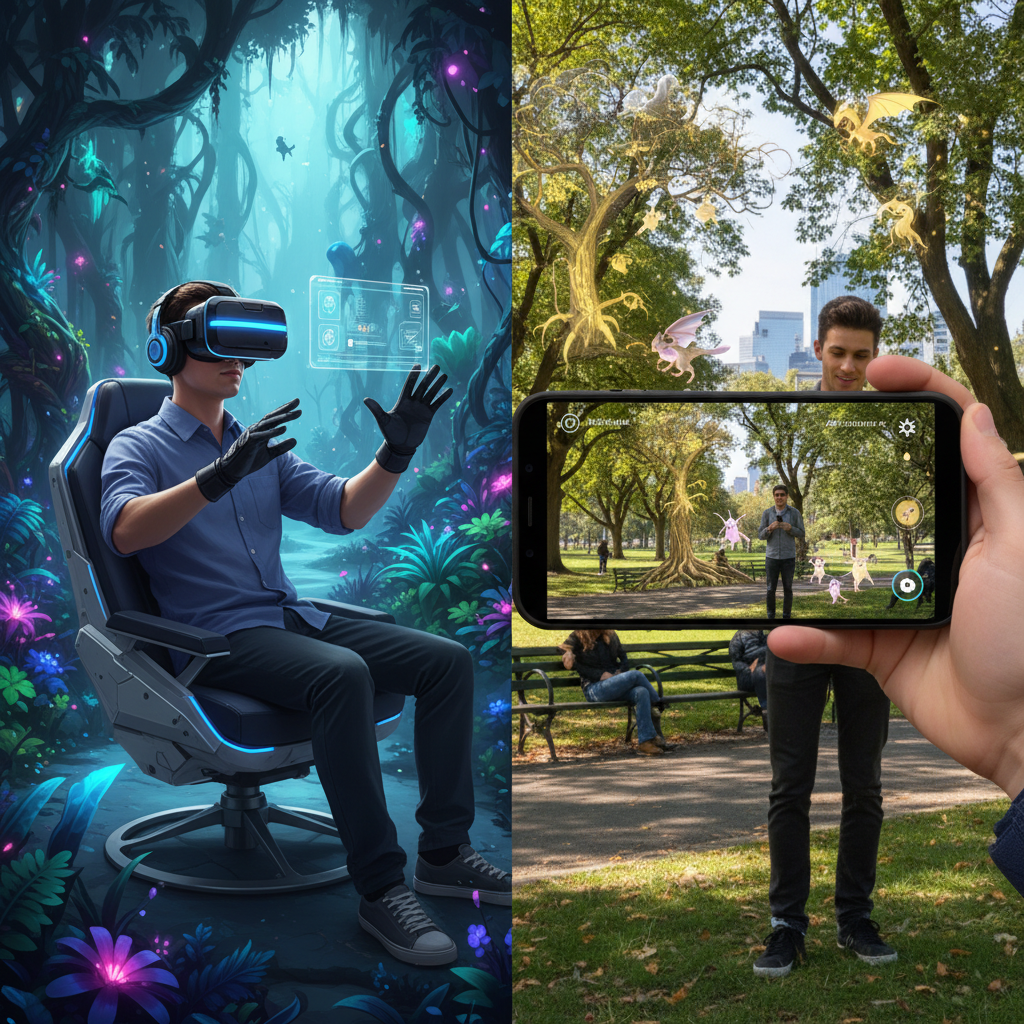
Another Way to Think About It:
- VR is like a deep-sea dive: You put on special gear (a headset) and go to a completely different world (underwater). You can't see your original world at all.
- AR is like looking through a window with digital drawings: You're still in your house, looking out your window at the real world, but now someone has drawn a digital monster on the windowpane that seems to be interacting with the view outside. You see both the real world and the digital drawing at the same time.
The Future is Now (and Beyond!)
Both VR and AR are rapidly evolving technologies. They are not just for games; they're becoming powerful tools for education, healthcare, manufacturing, design, and even everyday communication.
- Challenges for VR: Sometimes, VR can make people feel a bit motion sick, and the headsets can be expensive and a little bulky.
- Challenges for AR: Battery life for AR glasses is a big hurdle, and making digital objects perfectly blend with the real world is still tricky.
However, scientists and engineers are working hard to solve these problems. In the future, we might see VR headsets that are as light as sunglasses and AR glasses that let us interact with digital content seamlessly throughout our day, making our world even more interactive and amazing.
Conclusion
Virtual Reality and Augmented Reality are two powerful technologies that are changing how we interact with information and our environment. VR takes us to entirely new, computer-generated worlds, offering deep immersion. AR enhances our existing reality by overlaying digital content onto it. Both offer incredible potential for entertainment, learning, and solving real-world problems. As you continue to grow, you'll likely see more and more of these technologies integrate into your daily life, transforming the way we experience the world, one digital layer or immersive experience at a time.
Keep learning, free
Create a free Syllabax account to unlock practice questions and games for this topic.
Visual Learning Enhanced! 🚀
To help you master this topic, we use Advanced Syllabax AI to generate detailed diagrams and visual models.
Note on Visuals: The AI sometimes makes spelling errors in image labels. Please refer to the lesson text for the correct terminology.